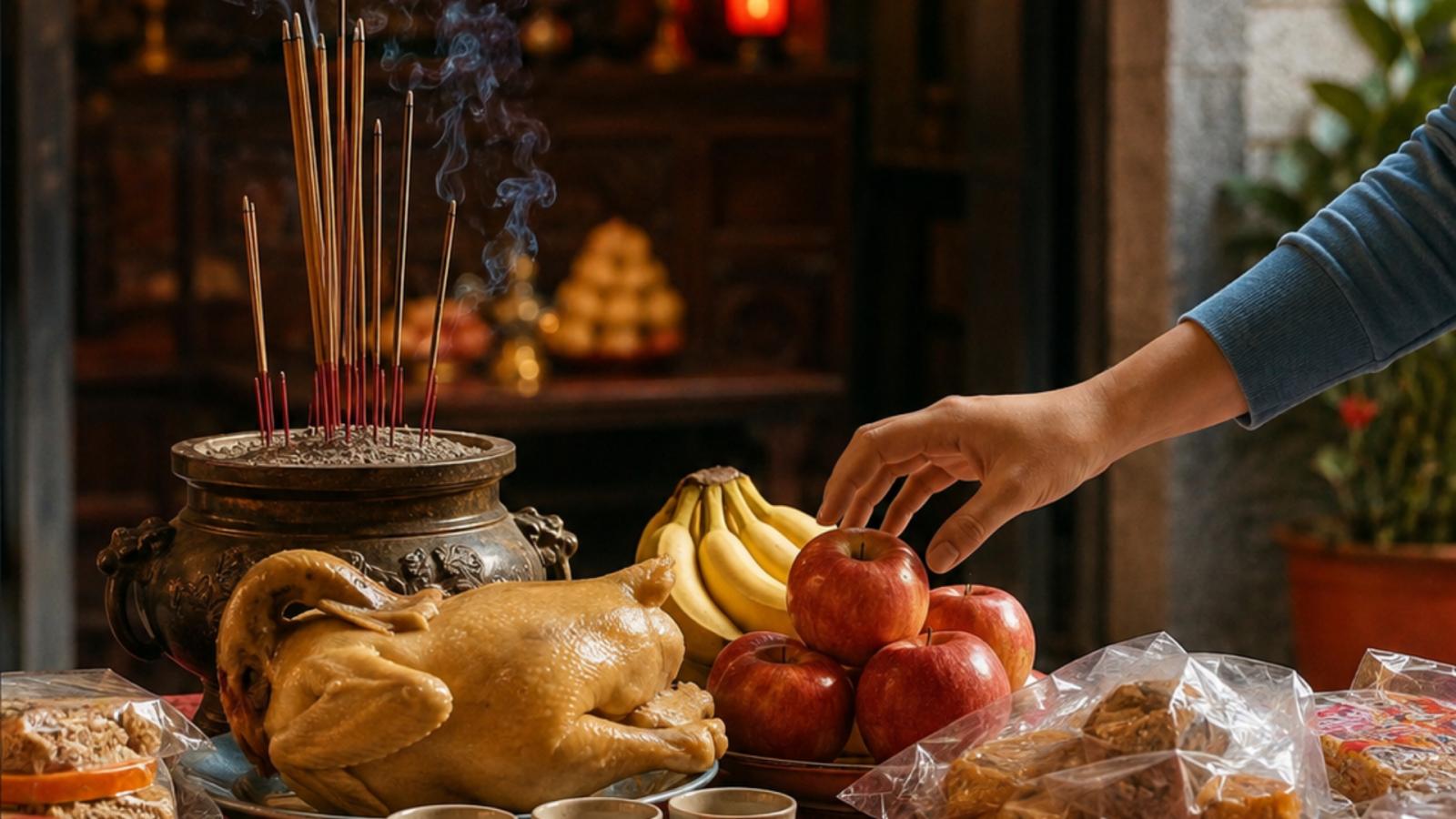
Every year during the 15th day of the seventh lunar month, Zhongyuan Festival (also known as Ghost Month), households across Taiwan set up altars filled with instant noodles, biscuits, canned goods, fruits, and more elaborate offerings like chicken, pork, fish (the 'three sacrificial animals'), and full-course cooked meals. However, when it comes time to clear the offerings, many people wonder: 'Has this food already been 'eaten' by the 'good brothers' (spirits)? Can humans still eat it? Isn’t it unclean?' In fact, if we separate folk beliefs from modern food safety principles, the answer is quite straightforward. There is no universal taboo against eating food after it has been offered. As long as the ritual is complete and the food has been stored safely, offerings can still be consumed. The real concern should be how long the food was left out in hot conditions.
Can You Eat Food After Zhongyuan Offerings? Being Offered Doesn’t Mean It’s Inedible
First, it’s important to distinguish between two commonly confused scenarios: 'eating offerings during the ritual' and 'eating offerings after the ritual has ended.' These are not the same.
When New Taipei City Government previously compiled guidelines on Zhongyuan customs, they cited temple authorities stating that offerings are meant to honor the 'good brothers,' so eating them during the ritual is considered taboo. However, this rule applies only during the ritual itself and does not mean that offerings cannot be consumed by people afterward.
In fact, in some Taiwanese temples’ Zhongyuan traditions, cooked dishes offered to spirits are later re-cooked and shared among worshippers.
For example, Kaohsiung City Government’s Kaohsiung Magazine described the Neimen Zhongyuan Festival tradition: banquet dishes are placed on the altar for about 'three incense sticks'—roughly 1 to 2 hours. After the ritual, worshippers take back their personal offerings, while temple-prepared dishes are returned to the kitchen, reheated, deep-fried, or stewed again, and then served at a 'Peace Banquet' for communal consumption.
In other words, at least from these real-life examples in Taiwanese folk culture, 'having been offered' does not automatically mean 'cannot be eaten.'
If 'Good Brothers' Have 'Eaten' the Offerings, Is the Food Really Unhygienic?
Zhongyuan Festival, commonly known as 'worshipping the seventh month,' traditionally involves preparing offerings to honor wandering spirits—commonly referred to as 'good brothers.'
According to the National History Museum Taiwan Historical Archives, the Zhongyuan Festival customs were brought to Taiwan by Han Chinese immigrants and had already developed into large-scale rituals by the Qing Dynasty. Even today, many regions continue the practice of preparing lavish offerings to 'entertain' the good brothers.
Traditional events like Keelung’s Ghost Festival also describe the ritual using terms like 'attending a banquet' or 'enjoying the offerings,' emphasizing the idea of spirits partaking in the feast.
Therefore, the real question after Zhongyuan Festival should not be: 'Have the good brothers already eaten this?' but rather: 'How long has this dish been sitting out?'
This is the true key to determining whether offering food is still safe to eat.
The Real Danger Isn’t the 'Good Brothers'—It’s Heat and Bacteria
The Zhongyuan Festival typically falls during Taiwan’s hot and humid summer. Many offerings are placed outdoors—on porches, temple grounds, outside offices, or in open-air spaces—where cooked food may sit for tens of minutes or even hours.
The real concern here is food safety.
The Taiwan Food and Drug Administration (TFDA) states that temperatures between 7°C and 60°C fall within the 'danger zone' for food, where bacteria can rapidly multiply.
Generally, cooked food should not be left at room temperature for more than 2 hours. If the ambient temperature exceeds 32°C, it’s recommended not to leave food out for more than 1 hour.
In 2026, the TFDA reiterated that cooked food left in the danger zone for extended periods increases the risk of microbial growth and toxin production. Leftover cooked food should be refrigerated promptly, and when reheated, the internal temperature should reach at least 70°C.
So when elders say, 'Don’t eat food that’s been offered too long,' from a food safety perspective, there’s actually some truth to it.
It’s just that the issue likely has nothing to do with ghosts—it’s simply that the food has been sitting in hot conditions for too long.
Is Reheating Enough to Make It Safe? Not Necessarily
Another common myth is: 'It’s fine—we can just reheat it at home until it boils again.'
But that’s not always safe.
The TFDA warns that some bacteria can produce heat-resistant toxins if food is improperly stored. For example, Bacillus cereus (commonly found in rice and starchy cooked foods) can multiply rapidly and produce toxins if cooked food is left at room temperature for too long.
Worse, some of these toxins are heat-resistant—meaning even reheating may not fully eliminate the risk.
Also, contaminated food doesn’t always smell bad, change color, or visibly spoil. So you can’t rely solely on 'it smells fine' to determine if it’s safe to eat.
This is why, after Zhongyuan offerings, cooked foods like chicken, pork, fish, seafood, rice, and soups require extra caution compared to sealed items like instant noodles, biscuits, and canned goods.
Which Offerings Can Be Eaten After Zhongyuan Festival? Here’s How to Decide
When collecting offerings after Zhongyuan Festival, you can make simple judgments based on food type:
- Unopened instant noodles, biscuits, drinks, canned goods: As long as packaging is intact, undamaged, and within expiration date, they can still be eaten even after being offered.
- Whole fruits: As long as there’s no visible rot, insect damage, or contamination, they’re safe to eat after thorough washing.
- Cooked foods (chicken, pork, fish, seafood, rice, dishes): The key is how long they were left out and the ambient temperature. If they’ve been in hot outdoor conditions for too long, even if they look normal, handle with caution.
- Cut fruits, cold salads, dairy products: These perishable items carry higher food safety risks if not refrigerated. Don’t force yourself to eat them just to avoid waste.
Most importantly, remember: 'Reheating' is not a magic fix for all spoiled food. If food has clearly exceeded safe storage time, the safest choice is not to eat it.
Offerings Don’t Need to Be Thrown Away Immediately—The Key Is Not to Waste, But Also Not to Force It
Preparing abundant offerings during Zhongyuan Festival originally carries meanings of hospitality, respect, and sharing.
The Council of Agriculture has previously addressed folk beliefs like 'bananas and pineapples shouldn’t be offered,' stating that the sincerity behind the offering matters most—there’s no need to overly obsess over various taboos.
So next time, when you see a table full of biscuits, fruits, and sacrificial meats that the 'good brothers' have 'eaten,' don’t throw everything away just because you think it’s 'unclean.'
Being offered doesn’t make food dirty. Being left out too long—that’s what might truly make it unsafe to eat.
Respecting tradition while handling offerings according to modern food safety principles may be the real way to ensure you and your family can 'eat in peace' after Zhongyuan Festival.
References: National History Museum Taiwan Historical Archives, 'Folklore Knowledge: On Zhongyuan Festival Offerings' New Taipei City Government, 'Zhongyuan Festival Offerings: How Temples Teach You to Worship Correctly' Kaohsiung City Government, Kaohsiung Magazine, 'Zhongyuan Banquet: Even Good Brothers Deserve a Feast' Ministry of Health and Welfare, Food and Drug Administration, 'Common Q&A on Food Poisoning' Ministry of Health and Welfare, Food and Drug Administration, 'Bacillus cereus' Ministry of Health and Welfare, Food and Drug Administration, 2026 Food Storage and Reheating Safety Guidelines Keelung City Government, 'Enjoy the Festival and Understand the Ritual: The Main Altar Invites Ancestors to a Grand Feast' Council of Agriculture, 'Debunking Taboo Myths: Bananas and Pineapples Are Welcome on the Zhongyuan Altar'
FACT BOX
- Source: PR Times
- Category: News