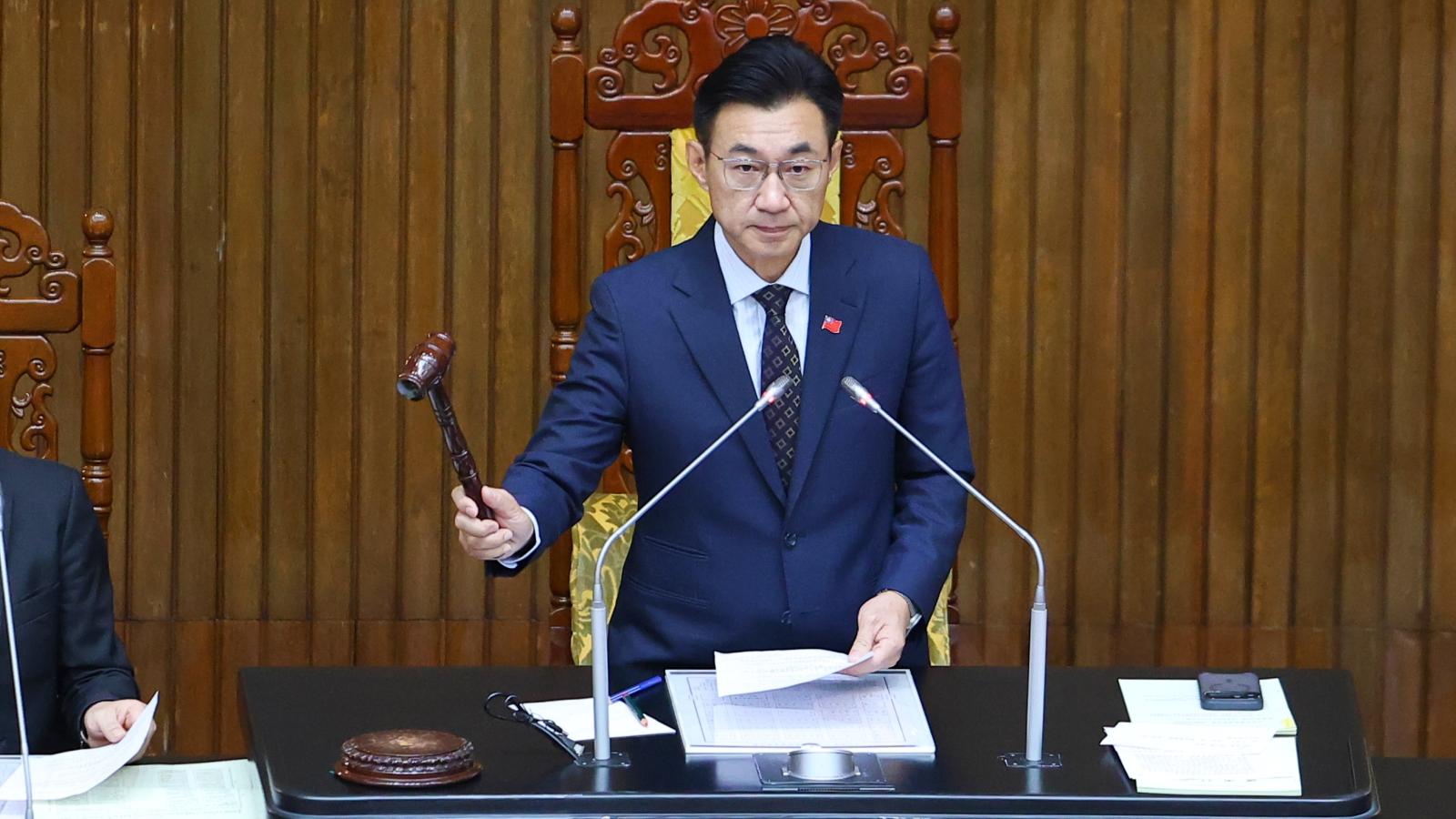
With just over three months until the 2026 county and city mayoral elections, the New Taiwan Think Tank released its latest public opinion poll on the Taichung mayoral race on the 17th. Chiang Chieh-kuen, KMT's Deputy Legislative Speaker, leads his opponent, DPP legislator Ho Hsin-chun, with 42.8% support—approximately 6.7 percentage points ahead. In terms of 'favorability outlook,' Chiang holds a clear lead with 48.2% compared to Ho's 23.6%, a gap of 24.6 percentage points, while 28.2% expressed no clear opinion.
Regarding 'appreciation ratings,' 46.8% of respondents said they appreciate Chiang, while 25.2% do not. For Ho, 40% expressed appreciation and 21.8% do not.
Psychiatrist Shen Cheng-nan posted on Facebook on the 18th under the title 'Ho Hsin-chun is genuinely catching up; Chiang should promise not to return to the legislature if defeated, forcing Ho to follow suit,' warning that Chiang must be more cautious.
Taichung has long been considered a bellwether swing district in Taiwan's elections. The New Taiwan Think Tank's poll released on the 17th shows the following:
Support: Chiang 42.8%, Ho 36.1%, a 6.7-point gap, with 21.1% undecided.
Favorability Outlook: Chiang 48.2%, Ho 23.6%, a 24.6-point gap, with 28.2% undecided.
Shen analyzed why the gap between the two candidates has narrowed to single digits. Looking at party blocs, the 'blue-white' coalition (KMT + TPP) still slightly exceeds the 'green' (DPP), with no apparent bias. Additionally, President Lai Qing-te's approval rating in this poll is under 40%, indicating this is not a pro-DPP skewed survey. Moreover, the survey's question format and executing agency appear identical to another media outlet's poll conducted months earlier, allowing for the exclusion of institutional bias.
So why is Ho gaining ground? Shen points to public dissatisfaction with the handling of the carcinogenic oil incident as the primary reason. The poll shows that as high as 51% of Taichung residents are dissatisfied with the response to the carcinogenic oil incident, which may be the key factor. In contrast, KMT Chairperson Chang Li-wen's influence is relatively minor.
Shen further stated that the gap in the mayoral race has narrowed by nearly 10 percentage points over the past three months, most likely due to the carcinogenic oil incident. However, he still believes Chiang will win, citing two main reasons: first, the 'blue-white' voter base remains larger than the 'green'; second, Chiang's personal qualifications and policy vision surpass Ho's.
In conclusion, Shen warned that Chiang must be more cautious and should pledge not to return to the legislature if defeated, demonstrating a 'burn the boats' determination. This could pressure Ho, a long-term legislator, to make a similar commitment. Such a move could also benefit Chiang's 2028 presidential ambitions—a two-birds-with-one-stone strategy.
The poll also assessed job performance. Chiang's approval as Deputy Legislative Speaker stands at 45.5% satisfied and 26.6% dissatisfied. Ho's approval as legislator is 43.3% satisfied and 19.7% dissatisfied.
Regarding Taichung Mayor Lu Shiow-yen's administration, 53.9% expressed satisfaction, 36.5% dissatisfaction, and 9.6% had no opinion. When comparing Lu's overall municipal development performance with that of former DPP mayor Lin Chia-lung, 45.5% believed Lu performed better, while 34.5% favored Lin.
The survey was conducted by the New Taiwan Think Tank, funded by the Ketagalan Foundation. The target population consisted of Taichung residents aged 20 and above. The survey was conducted via stratified random landline sampling from August 11 to 13, 2026, yielding 1,159 valid responses. At a 95% confidence level, the sampling error is ±2.88 percentage points, with weighting applied by registration location, gender, age, and education level.
FACT BOX
- Source: PR Times
- Category: Survey