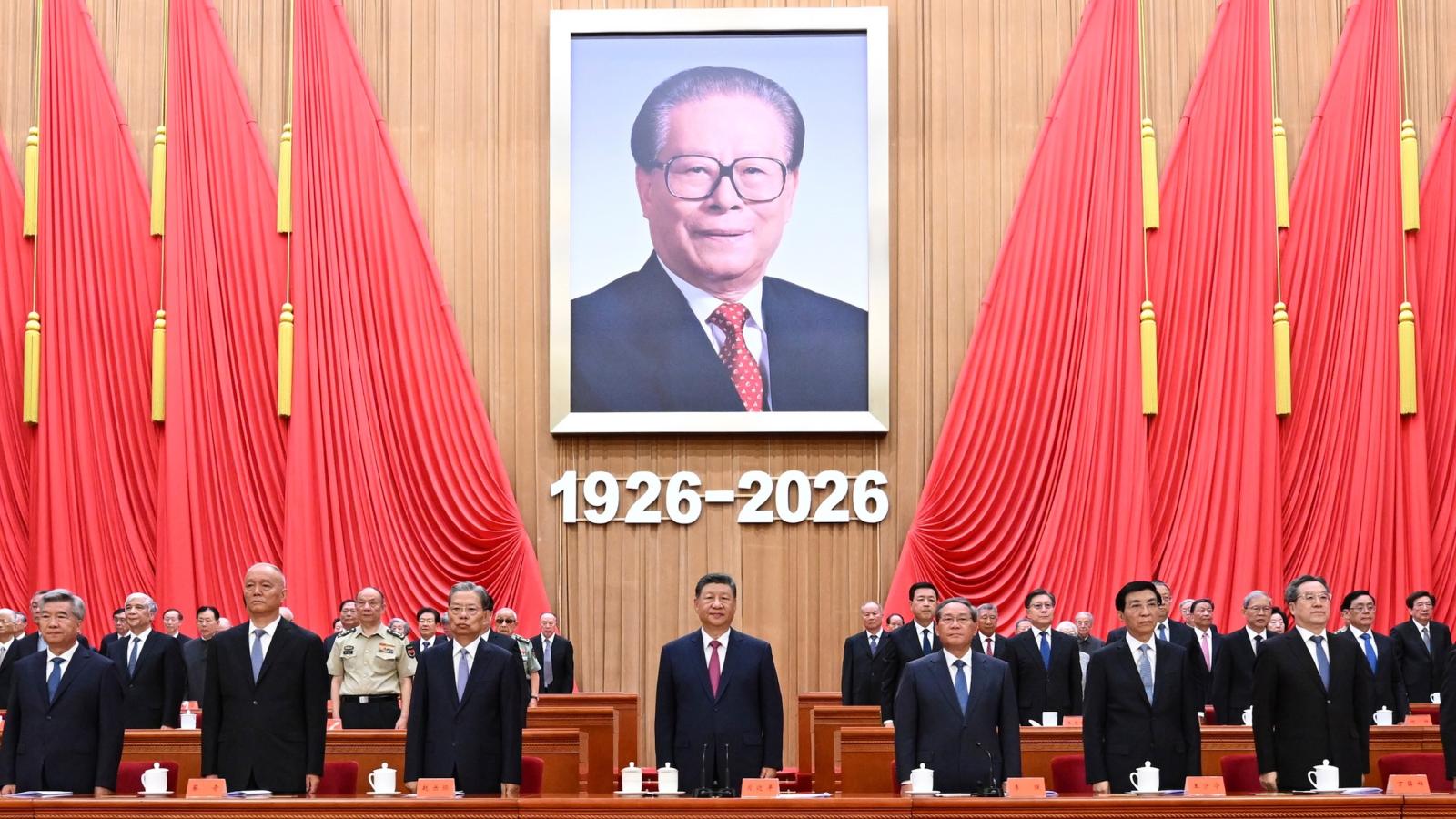
On Monday, the Chinese Communist Party held a memorial ceremony in Beijing to mark the 100th anniversary of the birth of former General Secretary Jiang Zemin. On Tuesday, the body of former Premier Zhu Rongji was cremated at Babaoshan Cemetery, with flags flown at half-mast at Tiananmen Square and other locations in mourning. What legacy do Jiang Zemin and Zhu Rongji leave for Xi Jinping? Can Xi Jinping use the memory of a bygone era to calm public sentiment and further consolidate his power?
Senior Chinese officials led by Xi Jinping gathered at the Great Hall of the People in Beijing on Monday (August 17) to commemorate the 100th anniversary of the late leader Jiang Zemin's birth. Xi delivered a roughly 40-minute speech.
Jiang Zemin passed away in 2022 at the age of 96. After the 1989 Tiananmen democracy movement was suppressed, he was selected by Deng Xiaoping as the 'core of the third-generation leadership' of the Chinese Communist Party. After Deng Xiaoping's 'Southern Tour' in 1992, Jiang led the party in further economic reforms, enabling China to experience a decade of rapid economic growth.
His governing partner, former Premier Zhu Rongji, passed away last week. According to China's state media Xinhua News Agency, Zhu's body was cremated on Tuesday. Xi Jinping led senior party officials to Babaoshan 'Revolutionary Cemetery' to bid farewell, while former President Hu Jintao sent a wreath. AFP reporters observed that government buildings across Beijing and Tiananmen Square lowered their flags to half-mast on Tuesday.
Public opinion widely holds that these two leaders will be jointly enshrined in history, and their passing marks the end of China's high-speed reform era that lasted from the 1990s into the early 2000s.
In contrast, Xi Jinping has strengthened central control and promoted a state-led economic policy centered on technological self-reliance and strategic industries.
Several experts interviewed by Deutsche Welle believe that Xi Jinping intends to use the commemoration and mourning of Jiang Zemin and Zhu Rongji to calm public sentiment amid economic difficulties and further consolidate his governing authority.
'Xi Jinping and Jiang Zemin were not actually close'
At the memorial, Xi Jinping praised Jiang Zemin's life as 'a glorious life, a life of struggle,' and repeatedly emphasized Jiang's significant contributions to the 'great cause of socialism with Chinese characteristics.'
Chong Ja Ian, a political scholar at the National University of Singapore, told Deutsche Welle that the memorial event showcases the continuity of the CCP leadership and may also aim to further solidify Xi Jinping's legitimacy in leading the party and the nation.
Chong stated that Jiang Zemin's political legacy is tied to China's economic reopening after the 'June 4' crackdown and China's accession to the World Trade Organization. This helps reinforce the foundation of China's current development trajectory.
Professor Zhang Lun of Cergy-Paris University in France believes that 'Xi Jinping has long harbored dissatisfaction with Deng Xiaoping and has tended to downplay Deng while elevating Mao Zedong,' but still needs a predecessor to legitimize his own rule.
Xi Jinping has intensified ideological campaigns in recent years. Zhang told Deutsche Welle that maintaining stability during major crises while sustaining economic development may be the most important challenge facing the CCP. Commemorating Jiang Zemin might 'send a message to society: we still aim to get rich.'
In his speech, Xi Jinping reiterated his own doctrine of the 'Two Upholds'—'resolutely upholding Comrade Xi Jinping's position as the core of the Party Central Committee and the whole Party, and resolutely upholding the authority of the Party Central Committee and its centralized, unified leadership.'
Steve Tsang, Director of the China Institute at the School of Oriental and African Studies (SOAS), University of London, told Deutsche Welle that 'Xi Jinping and Jiang Zemin were not actually close.' Jiang's 'Shanghai Clique' was effectively purged by Xi Jinping by the 20th Party Congress in 2022. Jiang's 'Three Represents' theory originally aimed to steer China in a direction different from the one Xi Jinping later set. 'Therefore, the two were no longer ideological allies nor strategic partners in any substantive sense.'
Tsang noted that Xi Jinping used Jiang Zemin and the Shanghai Clique to suppress Li Keqiang and the 'Youth League faction' at the 17th Party Congress in 2007 and the 18th in 2012, but since then has steadily consolidated his own power, which can now be said to be nearly complete.
Will loyalty to the core leadership be rewarded?
Such events attended by Xi Jinping are closely watched by China observers to infer political rankings, the health of retired leaders, and political stability.
In official media footage, Jiang Zemin's immediate successor, 83-year-old former President Hu Jintao, did not appear. His last public appearance was at Jiang Zemin's funeral in late 2022; previously, at the closing of the 20th Party Congress, Hu was seen being 'escorted' out of the venue by staff.
Hu Jintao's absence has sparked public speculation about his health.
Wang Qishan, once a key ally in Xi Jinping's 'anti-corruption' campaign, appeared at the memorial. In recent years, many officials close to Wang have been investigated, fueling rumors about the relationship between Wang and Xi.
Hu Ping, a democracy activist and honorary editor-in-chief of the journal 'Beijing Spring,' believes that in recent years, many of Wang Qishan's and Wen Jiabao's former aides have fallen from grace, but this does not mean that Wang and Wen themselves are in crisis or on the brink of downfall. Wang knows that without Xi's support, he would be attacked by other officials; Xi knows that discrediting Wang would mean discrediting the anti-corruption campaign and, by extension, himself. Thus, Xi Jinping will protect Wang Qishan.
Hu Ping added that since coming to power, Xi Jinping has continuously strengthened surveillance over retired elders. In 2022, the General Office of the Central Committee issued a document titled 'Opinions on Strengthening Party Building Work for Retired Cadres in the New Era,' explicitly stating that 'they must not make unwarranted comments on the major policies of the Central Committee.' 'Wen Jiabao and Wang Qishan are not having an easy time, but they will not be brought down.'
China expert Steve Tsang pointed out: 'Jiang Zemin has remained silent since the 20th Party Congress, which means he accepts and fully respects Xi Jinping as the core leader of the party. Xi Jinping is sending a signal to other senior leaders: if you support the core leadership, you will be rewarded.'
What legacy did Jiang Zemin and Zhu Rongji leave for Xi Jinping?
During the tenure of Jiang Zemin and Zhu Rongji, China implemented a series of major reforms: closing long-term loss-making state-owned enterprises, abolishing the old housing system and replacing it with a commercial housing market, weathering the late 1990s Asian financial crisis, and joining the World Trade Organization in 2001.
Singaporean scholar Chong Ja Ian told Deutsche Welle that Jiang Zemin indeed presided over the reconstruction of China's economic order after the 'June 4' crackdown, but also experienced the tense period of the 1995–1996 Taiwan Strait Crisis.
The measures of that era drove rapid economic growth in China, but also laid the groundwork for today's economic difficulties. Reuters reports that Xi Jinping has inherited both the growth legacy and the challenges, while facing additional pressures: trade tensions with the U.S. and Europe, heightened tensions over Taiwan, slowing economic growth, and the loss of demographic dividends.
Zhang Lun notes that whether Xi Jinping's attempt to link Jiang Zemin's political agenda and theoretical discourse to his own will succeed remains highly questionable. After all, Jiang's era was one of relatively expanded freedoms, while under Xi Jinping, social control has been tightened and freedoms significantly curtailed—there are important directional differences.
Zhang also noticed a telling detail: the 'Three Represents' was Jiang's most cherished theory and is widely recognized as his signature doctrine. In Xi's speech, 'Three Represents' was mentioned twice, but in a passing manner. In Xinhua's report on the memorial, many of Xi's praises for Jiang were repeated, but 'Three Represents' was not mentioned at all.
'Mohe Culture' carries a double irony
Prior to Monday's event, China's main state media, CCTV, aired a 12-episode documentary during prime time reviewing Jiang Zemin's life and achievements. The documentary mentioned that in 1989, Jiang Zemin forcibly shut down the Shanghai reformist newspaper 'World Economic Herald,' which had called for expanded freedom of speech and expressed support for the student democracy movement.
Some netizens noticed that in Episode 3, 'Taking Command in a Crisis,' the camera fully scanned the front page of the newspaper, clearly showing the headline: 'We need an environment where we can freely speak the truth.'
Jiang Zemin himself was a student protester in the 1940s and, in 1986, during a discussion with students at Shanghai Jiao Tong University, recited a passage from Lincoln's 1863 Gettysburg Address in English. At the time, students in the Shanghai student movement adopted phrases like 'of the people, by the people, for the people' from that speech as protest slogans.
During Jiang Zemin's leadership, the internet entered China in the mid-1990s. But within a few years, the so-called 'Great Firewall' was established, isolating China's internet from the rest of the world to prevent the public from accessing information and ideas deemed potentially destabilizing.
During Jiang's tenure, a large-scale crackdown was also carried out against the 'Falun Gong' organization, which had risen across China.
Despite this, some Chinese netizens still fondly remember Jiang Zemin as a symbol of a more optimistic era—when rapid economic growth translated into tangible improvements in daily life.
On Chinese social media, the names of current and former leaders are usually censored. Jiang Zemin is referred to as the 'Elder.' 'Mohe Culture' is popular on the Chinese internet. Netizens who participate in or refer to themselves as 'Mohe' are called 'Hesi' (toad fans) or 'Mofashi' (worshipping法师). 'Mo' comes from 'worship,' while 'he' (toad) stems from Jiang Zemin's frequent wearing of frog-eye glasses and the perception that his appearance resembles a toad.
FACT BOX
- Source: PR Times
- Category: News