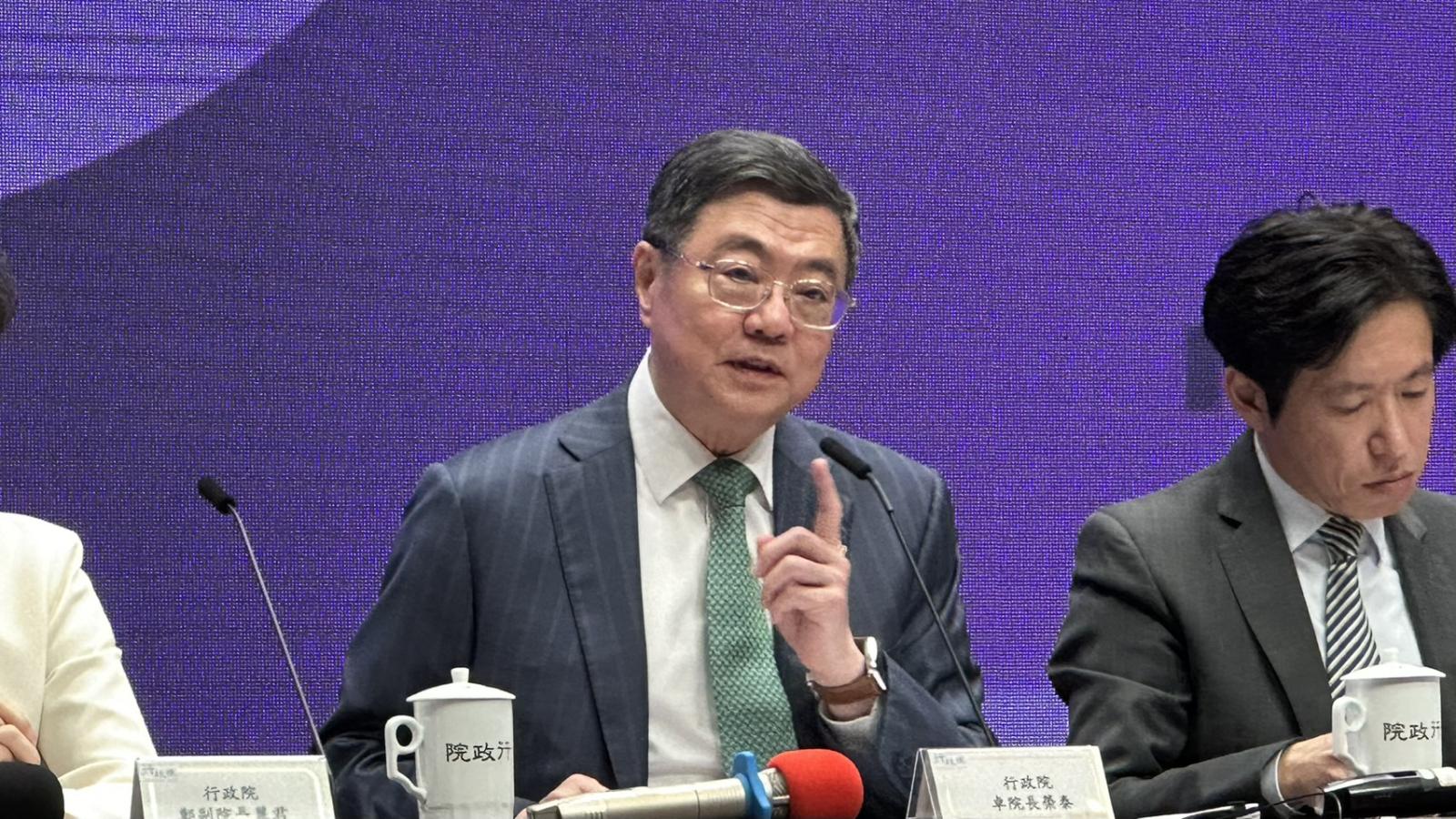
President Lai Qing-te recently announced a universal NT$10,000 disbursement for next year. Premier Zhuo Rong-tai stated on the 20th that the 2025 central government budget achieves revenue-expenditure balance, legally repays debt, incurs no new debt, and further reduces overall debt levels. Therefore, the cash handout will not require borrowing or burden future generations, refuting opposition criticism that it would 'bankrupt Taiwan.' Last year, the government expanded debt under financial pressure, but this year, there is fiscal leeway with no new borrowing, so there is no issue of financial distress—this is a policy to enrich the people, not bankrupt Taiwan.
Zhuo noted that on the 20th, the Executive Yuan reviewed the impact of the Legislative Yuan's deliberations on the 2026 central government budget. He raised two key appeals: budget reviews should be reasonable and completed within the constitutional timeframe. This year's budget deliberations were severely delayed, and many unreasonable cuts were made—such as to policy promotion expenses at the Executive Yuan's Department of New Media, the Ministry of Culture, the Ministry of the Interior's anti-fraud budget, and the president's state affairs discretionary fund. Budget reviews must be rational and fair. The Executive Yuan has repeatedly called for improvements, but progress has been limited.
Zhuo emphasized that AI development, economic growth, national security, and public welfare cannot wait. Every budget item comes from citizens' contributions. The Executive Yuan drafts the budget, and the Legislative Yuan reviews it—this is a constitutional duty, not a favor. Passing the budget is an obligation that must be completed on time. This year's budget took 351 days—'an indivisible burden'—and he urged that next year's process must not repeat this.
Citing the Directorate General of Budget, Accounting and Statistics, Zhuo noted Taiwan's economic growth reached 14.15% in the first half and is projected to reach 11.05% for the full year—remarkably high. Given this growth, the government should assess whether it can further invest in national development. Following President Lai's directive and the Legislative Yuan's passage of the budget, the Executive Yuan decided to allocate an additional NT$235.7 billion as 'AI dividends.'
Zhuo stated the 2025 central government budget totals NT$3.9 trillion, achieving revenue-expenditure balance. Government debt is projected to fall to 23.4%, and including this year's passed budget, it will drop to 22.4%—the lowest level since accounting reforms. This is a budget that balances revenue and expenditure, legally repays debt, adds no new debt, and reduces debt—so no borrowing is needed, and no burden is passed to future generations. Thus, it is not 'bankrupting Taiwan' as the opposition claims.
Zhuo reiterated: last year, debt was expanded under pressure; this year, there is fiscal surplus and no new borrowing—so there is no financial distress. This is a policy to enrich the people, not bankrupt Taiwan. The Executive Yuan prepares the budget per the Constitution and submits it to the Legislative Yuan—a statutory, constitutional process. As long as the constitutional framework is followed, the process is lawful and constitutional, with no illegality or unconstitutionality. The government meets fiscal discipline and causes no crowding-out effects. He urged the legislature to review the budget prudently, reasonably, and promptly—the best guarantee of accountability to the people.
FACT BOX
- Source: PR Times
- Category: News