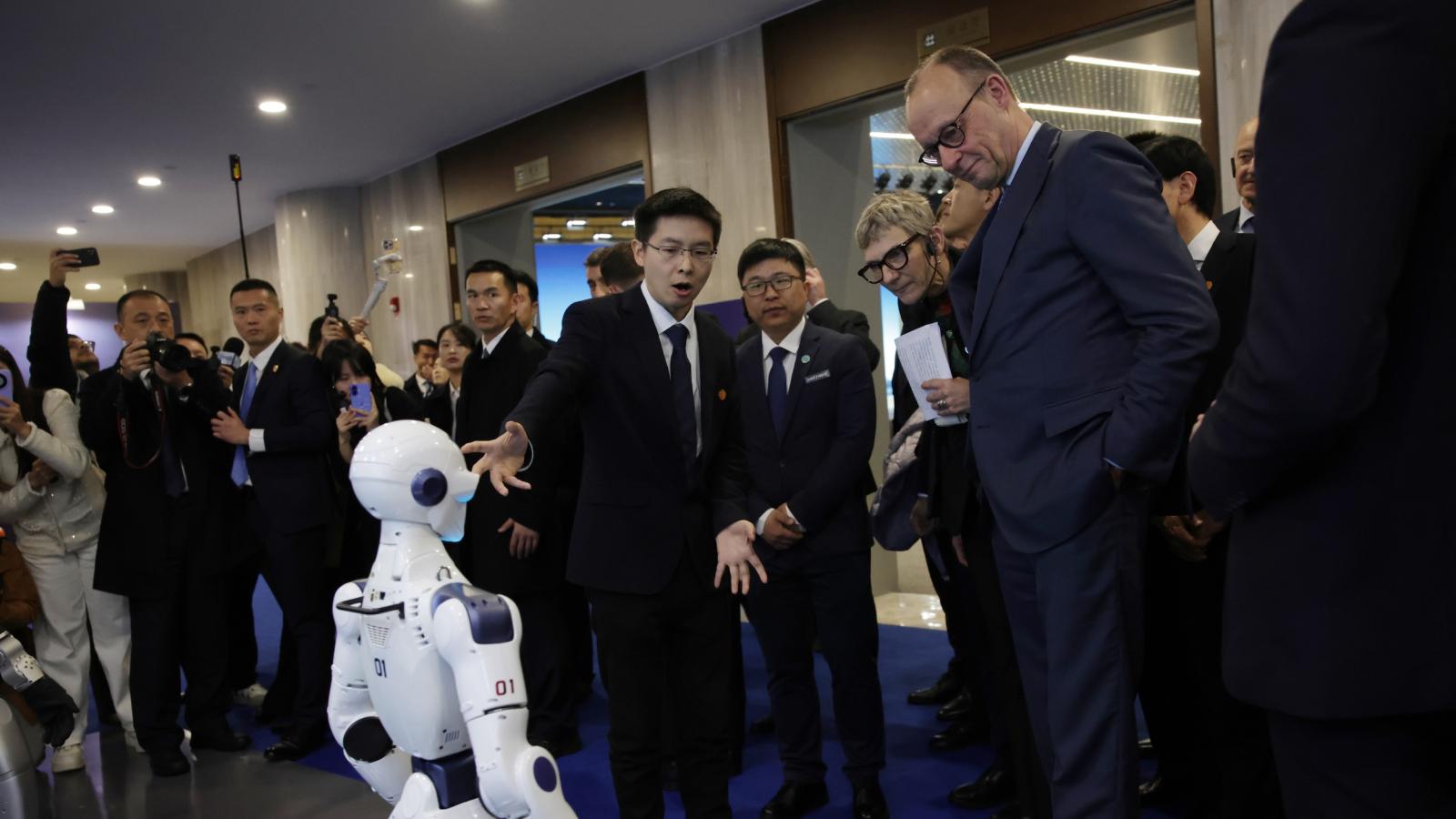
The world's largest humanoid robot manufacturer, Unitree Robotics, has gone public on the Shanghai Stock Exchange's Science and Technology Innovation Board (STAR Market), with its shares closing up more than 460% on the first trading day. The Chinese company offered its shares to investors at 150.80 yuan per share (USD 22.36; TWD 714.79), closing at 845 yuan on Wednesday (August 19). This highly anticipated IPO took place on the STAR Market, widely known as China's Nasdaq, marking a significant step in Beijing's ambitious plan to advance its domestic robotics industry. Currently, the United States and China are competing for dominance in the global markets for robotics and the artificial intelligence (AI) models that power them. While Unitree is not the first Chinese humanoid robot manufacturer to go public, it is the first from mainland China to do so. Robots such as automated industrial equipment and smart vacuum cleaners are already widely used in factories, warehouses, and homes. Now, the humanoid robotics sector is attracting massive investments, with major companies like Tesla, BYD, and Amazon developing bipedal robots capable of performing tasks typically done by humans. Unitree Robotics – The Hangzhou-Based Robotics Leader Officially named Hangzhou Unitree Robotics Technology Co., Ltd., founded in 2016, Unitree plays a key role in Beijing's plan to promote advanced technology development. The company has emerged as a leader in the robotics industry, selling products ranging from sensors and automated robotic arms to quadruped and humanoid robots. As market demand grows, Unitree shipped over 5,500 humanoid robots last year. It is one of the few profitable companies in the field, reporting a net profit of 278 million yuan in 2025. Due to its ability to offer robots with functionality comparable to U.S. competitors at significantly lower prices, it is seen as a strong rival to American developers. The company is headquartered in Hangzhou, a city in eastern China that has developed a so-called 'golden cluster' of robotics enterprises, benefiting from massive government investment. According to the official English-language China Daily, the number of robotics companies in China has more than tripled between 2020 and 2024, supported by relevant policies. Dr. Qin Fei, Associate Professor at the University of Bath, said robots are also seen as a potential solution to China's aging population, as demographic shifts are expected to lead to labor shortages. She said Beijing views the robotics industry as a 'strategic priority' for achieving leadership in advanced technologies. Dr. Qin added, 'Robots are where artificial intelligence moves from the screen into economic activity,' including factories, hospitals, and potentially homes in the future. Dr. Harold Soh, a researcher at the National University of Singapore, said U.S. robots typically have more user-friendly software, but the low prices offered by Chinese manufacturers are hard to ignore. Unitree's quadruped robot starts at USD 2,700 (18,200 yuan; 86,100 TWD), a fraction of the approximately USD 70,000 price tag of Boston Dynamics' Spot robot. Dr. Soh said, 'They're not entirely comparable, as some of Unitree's robots are much smaller, but the price difference is very clear.' Unitree began selling humanoid robots in 2023, launching its G1 model the following year—a child-sized robot priced at USD 13,500. Meanwhile, major U.S. competitors, including Tesla led by Elon Musk, have yet to begin delivering similar products. Ahead of its IPO, Unitree's humanoid robots became the centerpiece of a large-scale marketing campaign. This week, the company's robots are competing in the 2026 World Humanoid Robot Games in Beijing, an event attracting hundreds of teams with challenges including running, soccer, and less physically demanding tasks like unpacking boxes and sorting library books. In February, Unitree's G1 robot demonstrated martial arts moves on China's Spring Festival Gala, drawing public and research attention. Robotics researcher David Hsu said the live footage showed the robot completing a series of movements 'in a way we've never seen before.' Hsu added, 'This shows an industry on the rise.' A Bellwether for Robotics Companies? Some experts expect Unitree's post-IPO market performance to reflect investor interest in the rapidly growing humanoid robotics sector. Jack Pearson of investment firm RoboStrategy said the IPO gives the public a rare opportunity to invest in a humanoid robotics company and could set a valuation benchmark for other manufacturers. Pearson said Unitree's success also represents a 'turning point' for China's robotics industry, especially as it comes amid U.S. restrictions on foreign-made robots. Unitree's listing comes nearly three years after its smaller Chinese competitor, UBTech Robotics, went public in Hong Kong. In July, UBTech launched a humanoid robot described by Chinese state media as 'highly realistic,' capable of providing 'emotional support and daily interaction,' drawing global attention. In the coming months, more robotics companies, including Leju Robotics and AgiBot, are expected to follow UBTech and Unitree to the public markets. However, behind the optimism, some experts question the demand for humanoid robots beyond industrial and commercial uses. Dr. Soh said robots are still years away from effectively entering home environments, noting that developers still need to solve issues like battery life, privacy protection, and reliability. He added that the initial market will primarily focus on settings like factories and hospitals. U.S.-China Tech Competition As both countries view robotics and AI as strategically important industries, this sector has become a new front in their rivalry. The Trump administration announced in July that, citing national security and the protection of U.S. manufacturing, it would ban new Chinese-made humanoid and quadruped robots from entering the U.S. market. Beijing denied the claims and accused Washington of 'politicizing' trade issues. The U.S. has also imposed strict restrictions on other Chinese tech products, including AI models and electric vehicles. Christine Wan, a researcher at the Peterson Institute for International Economics, said China's dominance in the robotics industry reflects a broader challenge for Washington: Chinese companies are becoming increasingly embedded in the global manufacturing ecosystem. Wan said other countries may be reluctant to reduce reliance on Chinese suppliers, as doing so could disrupt their own manufacturing operations. So far, Western robots have not achieved the same level of impact on factory production lines or consumer markets. Boston Dynamics, a major U.S. robotics developer, said it plans to deploy humanoid robots in Hyundai's factories within two years. The South Korean company currently holds a controlling stake in Boston Dynamics. Amazon, Tesla, and other U.S. firms have also announced plans to use humanoid robots in their operations. Earlier this year, Musk's company announced it would use its California factory—responsible for producing Model S and Model X cars—to manufacture its Optimus humanoid robot series. Amazon tested using humanoid robots in warehouses in 2023 and told the BBC it is continuing research into next-generation robotics technology. The BBC also contacted Tesla and Boston Dynamics for comment on their humanoid robot plans. Hsu said one thing is clear: the U.S. has lost its lead in the robotics field. He added, 'We no longer hear about U.S. robotics companies in the news. Now, it's Chinese robotics companies making headlines.' 'They've replaced the U.S. as the most prominent new force.' This article was originally written in English. We used AI to assist with translation, which was reviewed by BBC journalists before publication. Learn more about how we use AI.
FACT BOX
- Source: PR Times
- Category: Funding
- Organizations: Unitree Robotics / Boston Dynamics / Tesla