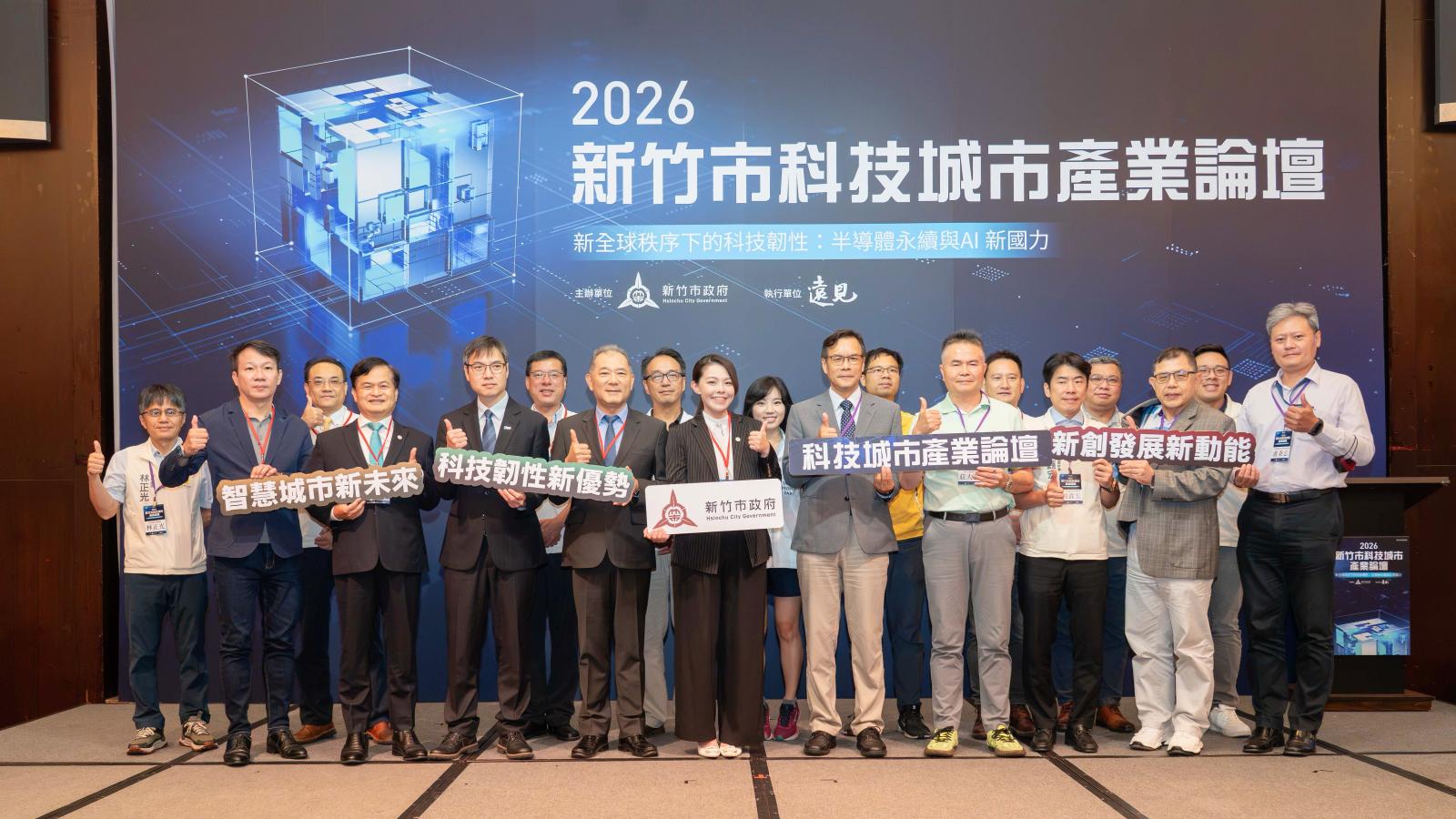
Amid rapid global advancements in AI technology, semiconductor supply chain restructuring, and the trend toward net-zero transformation, Hsinchu City, as Taiwan’s core hub for high-tech industries, plays a pivotal role in connecting industrial innovation with international competitiveness. Today (the 20th), the Hsinchu City Government held the "2026 Hsinchu City Tech Forum" at the Hsinchu Ambassador Hotel, with Mayor Kao Hung-an attending alongside representatives from industry, government, academia, and research sectors. The forum, themed "Technological Resilience in a New Global Order: Semiconductor Sustainability and AI as a New National Strength," focused on semiconductor sustainability, AI innovation applications, smart governance, talent cultivation, and regional cooperation. It brought together professionals from the tech industry and various fields for in-depth discussions to explore new opportunities for technological industry development in the AI era and to build a tech city that combines innovative momentum with sustainable competitiveness.
Mayor Kao stated that today’s forum featured an impressive lineup of speakers covering semiconductors, AI, and ESG sustainability, fully demonstrating the technological momentum accumulated by Hsinchu’s industry-government-academia-research community. Their participation enabled exchanges of learning and experience sharing to collectively grasp the latest industrial developments. She expressed gratitude to "CommonWealth Magazine" for their support, noting that the Tech City Industry Forum has now entered its third year, annually showcasing Hsinchu’s latest industrial momentum. This year’s event further connects industrial and urban development topics—from technological industry growth and corporate transformation to ESG sustainability and talent cultivation.
Mayor Kao emphasized that Hsinchu is actively promoting joint ESG sustainability actions between businesses and the city. The municipal government utilizes Taiwan’s first-ever ESG matchmaking platform to align corporate sustainability needs with actual urban development. (Photo / Hsinchu City Government)
Kao pointed out that Hsinchu’s international visibility has steadily increased in recent years, attracting visits from numerous international cities interested in Taiwan’s rapid advancements in semiconductors and AI, as well as the role of local governments during science park development. For example, during TSMC’s establishment of a factory in Kumamoto, Japan, local government officials visited Hsinchu multiple times to understand how local authorities coordinate transportation, logistics, and urban governance to support industrial development. They observed commuting and logistics flow patterns around the science park firsthand and brought these insights back to Kumamoto as a reference for supporting corporate investment and factory setup.
Kao shared that Hsinchu actively promotes joint ESG sustainability actions between enterprises and the city. Through the nation’s first ESG matchmaking platform, the city government integrates corporate sustainability demands with real urban development, ensuring ESG goes beyond internal corporate activities and becomes a vital force in urban development. For instance, the city collaborated with TSMC on a tree-planting initiative at Nanliao Fishing Port, planting over 48,000 trees. World Advanced adopted Sakura Park, committing to environmental maintenance. These public-private collaborations enable corporate sustainability efforts to take root in the city’s environment.
"ESG is not just about planting trees; it can extend to urban philanthropy and animal care," Kao noted. The Hsinchu City Zoo partners with tech enterprises to advance ESG initiatives in areas such as animal habitat improvement, enrichment, and feeding methods, allowing corporate employees to directly participate in civic welfare. The city continues exploring more possibilities for business-city collaboration, enabling the sustainable power of the tech industry to permeate every corner of the city and create a positive cycle benefiting businesses, the city, and citizens alike.
The morning session of today’s forum centered on "Technological Resilience in a New Global Order: Semiconductor Sustainability and AI as a New National Strength." It featured keynote speeches by Dr. Ming-Jer Lee, Chairman and General Manager of Synopsys Taiwan, who spoke on "From Hsinchu to the World: Key Pathways for Taiwan’s Semiconductor Industry to Evolve from Chip Design to System Innovation in the AI Era"; Lin Yin-Chih, Sustainability Officer of E Ink Holdings, who presented on "Corporate Sustainability and Urban Prosperity: Public-Private Partnership Creating a New ESG Model for Hsinchu City"; and Wu Tian-Sheng, Dean of Taoyuan Smart Industry Academy, who discussed "Cross-Domain Talent Cultivation in Semiconductors and AI," emphasizing the importance of talent development for the future tech competitiveness of the Taoyuan-Hsinchu-Miaoli region. In-depth dialogues explored resilient strategies for the tech industry under the new global order from perspectives of technological sustainability, AI advancement, and talent cultivation.
The afternoon sessions focused on "Local Leadership—Hsinchu City’s Field Validation of Smart City Applications and Startup Momentum," highlighting Hsinchu’s tech city development strategy, smart governance, and industrial innovation. Business representatives shared practical experiences in tech entrepreneurship, smart supply chains, cold-chain logistics, smart city field validation, and circular economy. Through cross-domain exchanges and deep dialogues, participants explored how urban environments can become crucial drivers for implementing technological innovations, linking startups, enterprises, and urban governance needs to expand real-world validation outcomes of technological applications.
Mayor Kao stressed that Hsinchu will continue collaborating with central authorities, neighboring Taoyuan-Hsinchu-Miaoli municipalities, and industry partners to deepen regional cooperation, promote smart governance, sustainable development, and technological innovation. The city aims to accelerate the implementation of AI technologies and smart applications, creating a more resilient and competitive tech industry environment. Going forward, through diverse strategies such as industrial guidance, smart city field validation, startup incubation, and international linkages, Hsinchu will strengthen its technological innovation capabilities, maintain its position on the global tech industry stage, and work hand-in-hand with industry, government, academia, and research to embrace new opportunities in the AI era and build a more internationally competitive tech innovation city.
FACT BOX
- Source: PR Times
- Category: Event