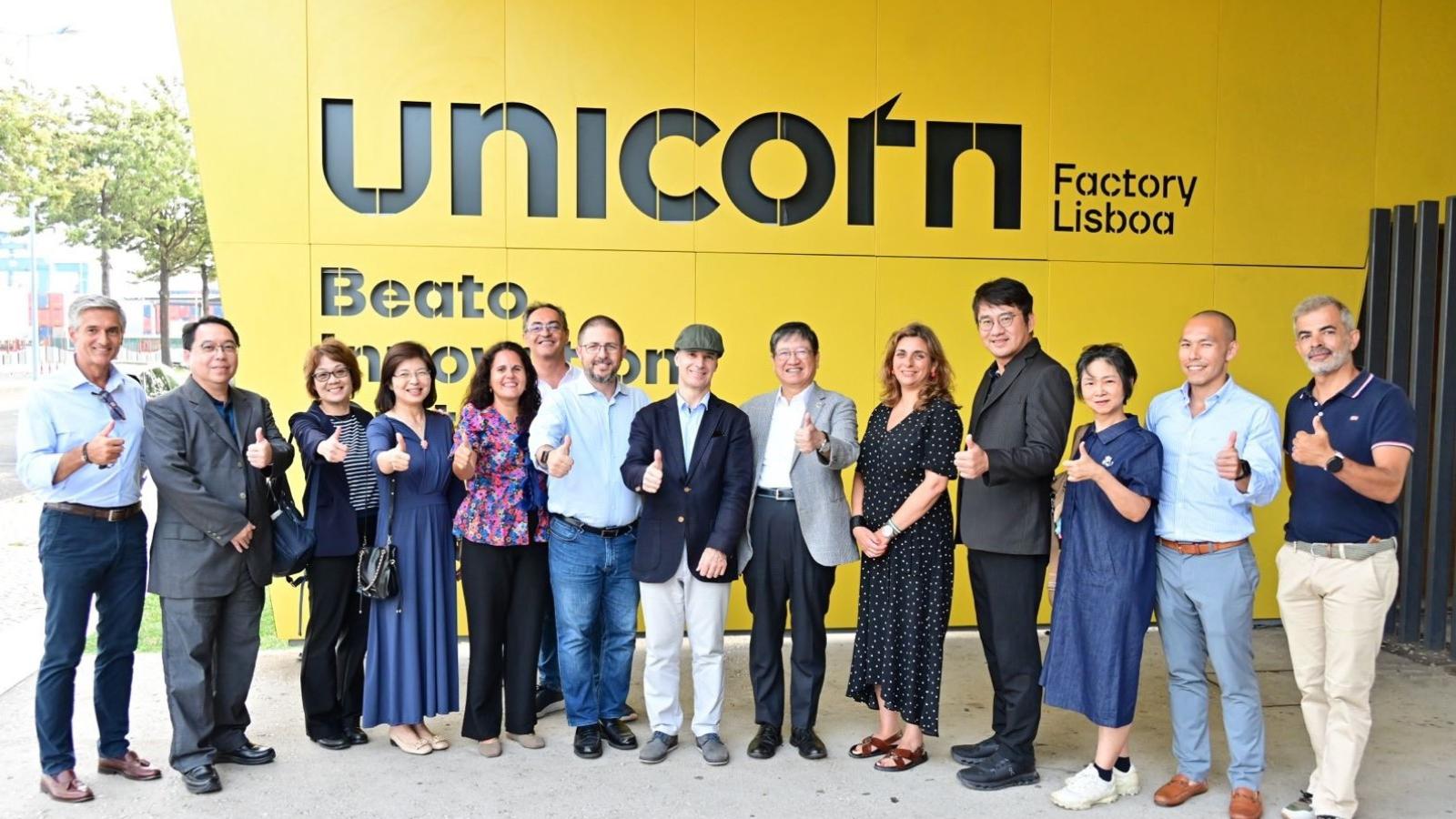
To deepen exchanges with local cities and industries in Portugal, Hsinchu County Magistrate Yang Wen-ke led a county government delegation to Portugal. On the 19th (local time), they visited the Taipei Representative Office in Portugal and toured the Unicorn Factory Lisboa to understand Portugal’s development model for startups and innovation clusters, serving as a key reference for Hsinchu County’s industrial transformation, technological innovation, and balanced regional development.
This exchange was initiated through coordination by Chuang Teng-hsiang, Honorary President of the Federation of Taiwan Chambers of Commerce in Europe. On May 29 this year, Chuang accompanied Urhome Group and CEO Bobby O’Reilly to meet with Magistrate Yang, inviting him to lead a delegation to Portugal, thus facilitating further contact between Hsinchu County and Portugal in urban, industrial, and innovative development.
The visit also included representatives from global and Japanese Hakka community organizations, such as Li Wan-tang, President of the Global Taiwan Hakka Federation; Chiu Jung-kuang, President of the World Taiwan Hakka Federation; Lu Hsing-hui, President of the Tokyo Hakka Tsung Tsin Association; Hsu Wen-tsung, President of the Tokyo Taiwan Chamber of Commerce; and Hsieh Ching-chih, Vice President of the Kansai Hakka Tsung Tsin Association. Leveraging the overseas Hakka community’s established exchange networks, this trip combined technological and industrial collaboration with broader diaspora and cultural engagement.
Magistrate Yang Wen-ke expressed special gratitude to Chang Ya-kuang, Representative of the Taipei Representative Office in Portugal, for her warm reception and meticulous arrangements, which enabled the delegation to gain deeper insights into Portugal’s industrial development and innovation policies. (Photo / Hsinchu County Government)
Representative Chang Ya-kuang noted that although Portugal’s market size is modest, it holds geographical advantages connecting Europe, the Americas, and Africa. In recent years, Portugal has actively developed its startup sector, building solid foundations in research, innovation, and talent. She emphasized that beyond central government diplomacy, local government exchanges offer a practical path to strengthen Taiwan-Portugal relations. Cities can build cooperation in areas like industry, culture, tourism, talent, and urban governance, gradually building mutual trust through people-to-people connections.
Chang added that Hsinchu County possesses strengths in technology industries and high-caliber talent. This local-level industrial visit helps Portugal better understand Taiwan and opens doors for future collaboration in industry, innovation, and urban development.
Magistrate Yang stated that his visit to Portugal aimed not only at observing startups but also understanding how a city cultivates an environment conducive to innovation. As a major technology hub in Taiwan, Hsinchu hosts integrated clusters in semiconductors, AI, biomedicine, and smart manufacturing. The county is advancing major projects such as the AI Smart Park, Biomedical Park, Taizhi Park, and Phase III of the Hsinchu Science Park. Thus, Portugal’s experience in innovation and urban transformation offers valuable lessons for Hsinchu.
Yang highlighted that after visiting Unicorn Factory Lisboa, the most instructive insight was not merely establishing a startup park, but integrating government, enterprises, universities, innovation organizations, and international resources to create an ecosystem supporting startup growth. Mechanisms like incubation, acceleration, and international linkages foster interactions across industries and talents, driving a holistic innovation ecosystem.
Yang explained that Hsinchu’s “One Core × Three Innovation Hubs” strategy aims to extend innovation from its existing tech core to Zhudong, Guanxi, and Hengshan. Beyond attracting high-tech industries, the county will explore ways to revitalize existing industrial spaces and integrate talent and innovation resources, enabling each region to develop unique characteristics and creating an environment where industry, life, and innovation coexist.
The delegation paid particular attention to Portugal’s public-private collaboration model in developing innovation parks. Rather than relying solely on government subsidies, public sectors lead urban planning and environmental development, then partner with private enterprises, innovation groups, and academic institutions to gradually build an environment where businesses want to settle, talents choose to stay, and startups can thrive.
Magistrate Yang reiterated his appreciation to Representative Chang Ya-kuang for her hospitality and detailed arrangements, allowing the team to deeply understand Portugal’s local governance, industrial development, and innovation policies. He noted that Portugal’s emphasis on cross-sector integration and international connectivity complements Hsinchu’s current direction toward balanced regional development and industrial upgrading. Future cooperation could deepen in smart city governance, innovation park management, youth entrepreneurship support, and industrial internationalization, through mutual visits, project collaborations, and industry matchmaking to build substantive partnerships.
Chen Ying-chou, Director of the Department of Industrial Development, said a key takeaway was recognizing that innovation clusters do not emerge overnight nor rely solely on infrastructure. Instead, they require gradual ecosystem building—from regional positioning and urban planning to industry introduction and integration of talent and innovation resources. This aligns closely with Hsinchu’s ongoing efforts in balanced regional development and innovation node deployment. Many of Hsinchu’s industrial zones were established early and located in water or environmental protection areas, causing environmental impacts and resident opposition. Adopting a unicorn-style innovation strategy—where government drives transformation of industrial zones into service or tech sectors—can reduce environmental burdens while revitalizing spaces and boosting local employment. The county will further study how to adapt international experiences to its local context.
Magistrate Yang emphasized that Hsinchu County will continue deepening exchanges with Portugal and other international cities, seeking collaboration in technological innovation, industrial transformation, smart governance, talent cultivation, and cultural exchange. The goal is to transform international engagement from ‘observing experiences’ to ‘building connections and finding partnerships,’ creating more possibilities for Hsinchu’s industrial advancement and urban internationalization.
FACT BOX
- Source: PR Times
- Category: Event