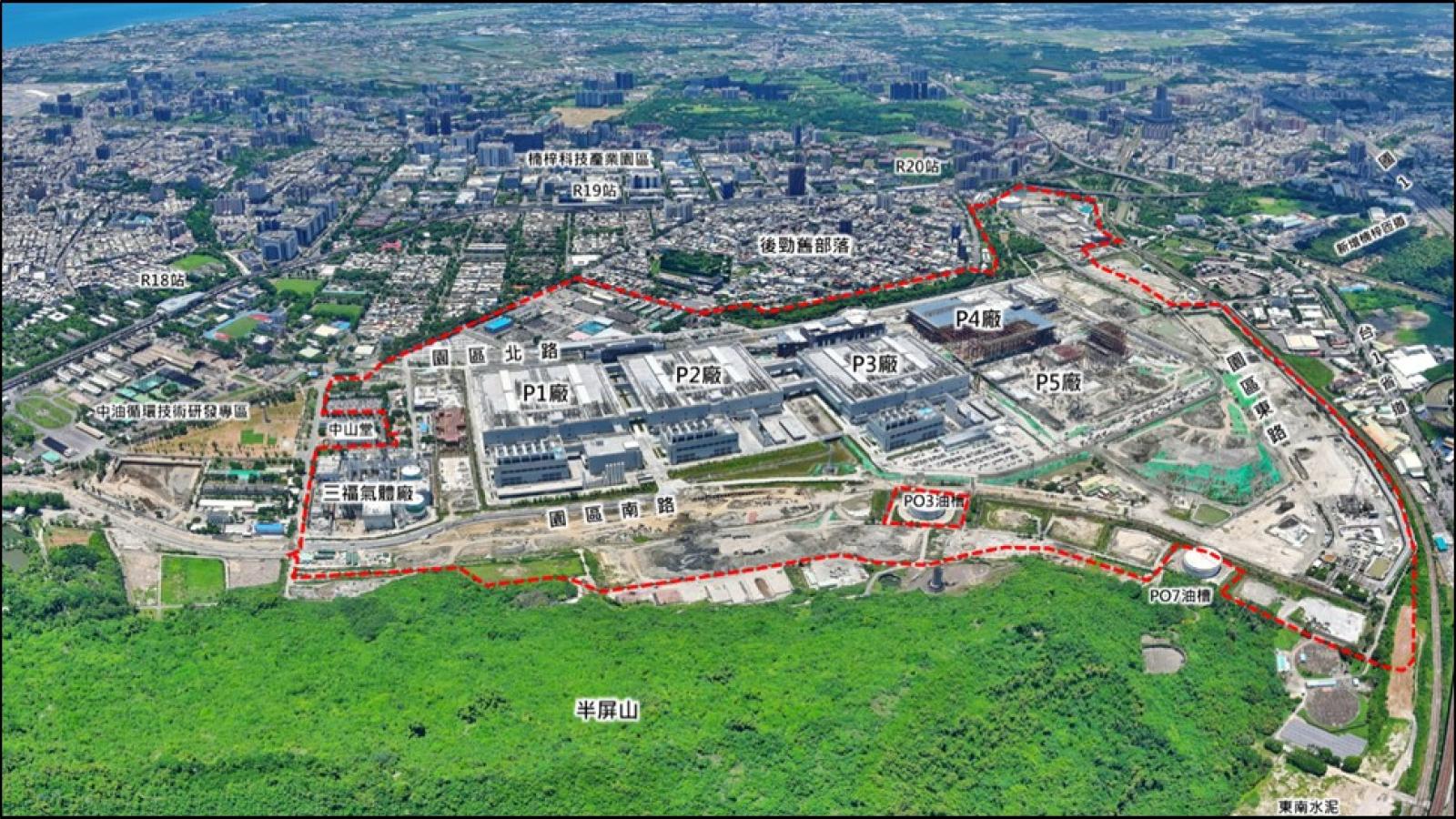
Kaohsiung City's Urban Planning Committee today (20th) approved the urban plan amendment for the 'Expansion of the Southern Science Park Kaohsiung Third Campus (Nanzi Park)', symbolizing the former Kaohsiung Refinery site's official entry into a critical phase of industrial transformation.
Following the Industrial Innovation Act, the Kaohsiung City Government took the lead in initiating urban plan changes and development for approximately 29.83 hectares of the former refinery land, providing space for TSMC to establish advanced process fabrication facilities. Subsequently, after the Executive Yuan approved the Nanzi Park construction plan, the Southern Taiwan Science Park Administration took over comprehensive development, establishing a 'city-first, central-government-follow-up' model to gradually build a northern Kaohsiung semiconductor technology cluster.
Deputy Mayor Lin Chin-jung stated that, per the Executive Yuan-approved revised development plan, the Nanzi Park covers approximately 182.57 hectares, positioning Kaohsiung as a crucial base for Taiwan's national semiconductor strategy.
Aligned with TSMC's advanced process layout at its Kaohsiung Wafer Fab 22, the P1 facility has already entered mass production, P2 is scheduled to begin operations in Q4 this year, P3 aims for commissioning in Q1 next year, and P4 and P5 began simultaneous construction in August last year, with phased operations expected from Q4 next year.
Lin emphasized that as advanced process capacity comes online, Nanzi Park will evolve beyond a single company's production base, integrating semiconductor manufacturing, supply chains, and surrounding industries into a complete technology cluster. According to estimates from the revised plan, the park is projected to generate an annual output value of about NT$960 billion and create approximately 6,600 jobs, driving industrial chain development, talent growth, and improved living infrastructure in Nanzi, Qiaotou, and surrounding areas.
Boosting Output While Proactively Deploying Transportation Infrastructure
Lin stressed that while industrial attraction is the first step, success requires concurrent advancement in transportation, public facilities, and living amenities. To meet future industrial logistics and commuting demands, the park plans main and connecting roads ranging from 30 to 40 meters wide. The central government has approved NT$15.591 billion for the 'Overall External Transportation Plan for the Third (Nanzi) Park', jointly implemented by the Southern Science Park Administration, Kaohsiung City Government, and the Ministry of Transportation and Communications' Freeway Bureau.
Related projects include a new Nanzi ramp on National Highway No. 1, a ramp on Provincial Highway No. 1, and park connector roads, linking with surrounding routes such as Cuihua Road and New Provincial Highway No. 17. Major external infrastructure is scheduled for completion by the end of 2028. This integrated network will enhance the park's external connectivity, implement passenger-freight separation, alleviate traffic pressure on the existing Nanzi Interchange, and establish a robust transportation backbone supporting technological industry growth.
Early Layout of Recycled Water: Building a Water Recycling System for Northern Kaohsiung
Addressing the need for high-quality, stable water sources in advanced semiconductor processes, the Kaohsiung City Government has proactively laid the groundwork for recycled water infrastructure, collaborating with the central government on the Qiaotou and Nanzi Recycled Water Plants to establish a water recycling system supporting northern Kaohsiung's tech industry.
The Qiaotou plant's supply is expected to increase from 30,000 to 35,000 tons per day by 2027. The Nanzi plant is scheduled to supply 20,000 tons per day by the end of 2028, increasing to 35,000 tons by the end of 2029, and expanding further to 70,000 tons per day by the end of 2030.
Once both plants are fully expanded, they will collectively provide over 105,000 tons of recycled water daily, reliably meeting the park's industrial water needs and reducing the impact of industrial water usage on domestic and agricultural supplies.
The Department of Urban Development noted that ESG and net-zero transition principles have been incorporated into the Nanzi Park development plan, introducing measures such as recycled water, green power, resource circulation, and green transportation. This ensures environmental sustainability is balanced with industrial growth, advancing toward the goal of 'co-prosperity among industry, environment, and city'.
The department explained that the urban plan amendment followed a two-stage review process. After today's approval by the Kaohsiung City Urban Planning Committee, the master plan will be submitted to the Ministry of the Interior's Urban Planning Committee for further review. The city government will continue collaborating with the central government to refine industrial, transportation, water resource, and public facility support systems, transforming Kaohsiung from a traditional petrochemical base into an advanced semiconductor technology cluster, linking with the Southern Taiwan Semiconductor S-Corridor and further strengthening Kaohsiung's pivotal role in the nation's technology industry landscape.
FACT BOX
- Source: PR Times
- Category: News