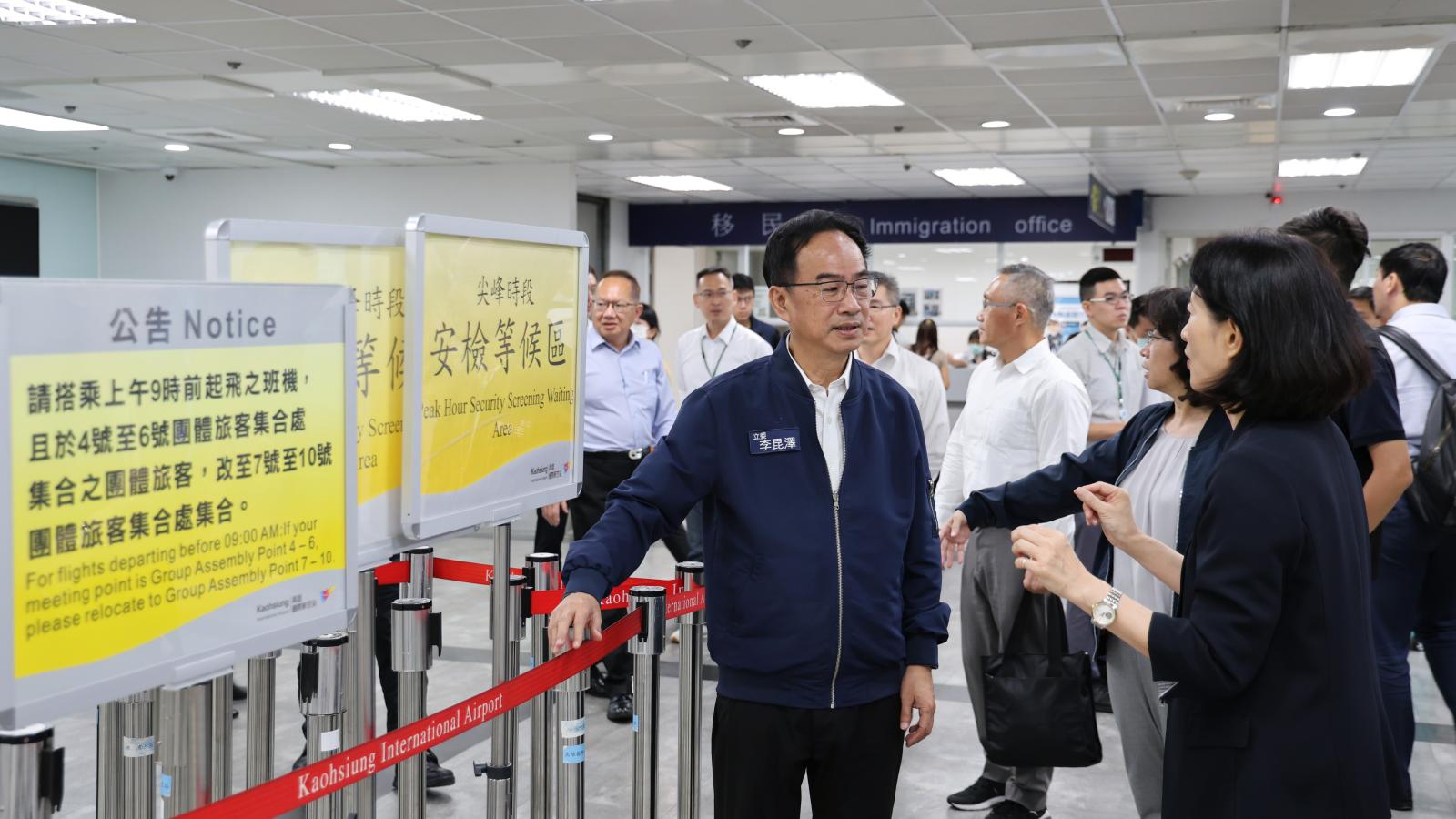
Legislators Li Kun-ze, Lai Rui-long, and Hsu Chih-chieh, along with the Legislative Yuan Transportation Committee, visited Kaohsiung International Airport today (20th) to inspect the improvement of immigration procedures, the addition of new security checkpoints, and the progress of the East Side Parking Lot project. Li Kun-ze emphasized that improving the service quality of Kaohsiung Airport should not only focus on hardware construction but also comprehensively improve the processes of security checks, check-in, immigration, and waiting areas based on actual passenger needs, aiming to create a more convenient and friendly international airport.
Li Kun-ze pointed out that he has been closely monitoring the service quality of Kaohsiung Airport for many years. As early as 2014, he demanded an increase in check-in counters, and in 2016, he secured 62 million NT dollars for floor tile repairs and exterior beautification. He also continuously requested the addition of automatic immigration and security checkpoints. With the efforts of Lai Rui-long and Hsu Chih-chieh, these improvement measures have been gradually implemented. The new security checkpoints are expected to be completed by August 28, which will help improve immigration efficiency during peak hours.
Currently, the average immigration time at Kaohsiung Airport is about 20 minutes, but during peak hours when flights are concentrated, there may still be congestion. Li Kun-ze pointed out that in the next stage, security check queues, passenger routes, and immigration procedures should be continuously optimized, and more clear and easily recognizable signs should be added to help passengers quickly understand the routes and reduce waiting and confusion.
In addition to immigration efficiency, Li Kun-ze also requested that the Civil Aeronautics Administration refer to the experience of Taoyuan Airport and other high-quality international airports to provide more support for Kaohsiung Airport in terms of hardware and service facilities. This includes charging stations, seats with outlets, passenger conveyors, children's play areas, and automatic jet bridges to improve the convenience of waiting and transfers.
With the gradual increase in international routes and international passengers at Kaohsiung Airport, Li Kun-ze believes that the airport's signage system should also be internationalized. In addition to Chinese and English, multilingual signs can be added based on routes and passenger composition, and transportation information and guidance services can be strengthened to help international passengers complete check-in, security checks, immigration, and urban transportation connections more smoothly after arriving in Kaohsiung.
During the inspection, some citizens pointed out to Li Kun-ze that although the immigration procedures for low-cost airlines have been gradually improved, due to insufficient check-in counters and staff, passengers may still have long queues at the front end. In response, Li Kun-ze and Hsu Chih-chieh immediately requested the Civil Aeronautics Administration to consider using preferential measures or administrative coordination to encourage low-cost airlines to increase check-in counters and staff, and introduce measures such as electronic counters and online pre-check-in to avoid the situation where 'the back-end immigration becomes faster, but the front-end check-in becomes congested,' thereby comprehensively improving the passenger experience.
Additionally, Li Kun-ze also expressed concern for the rights of residents around the airport, reminding the Civil Aeronautics Administration that the takeoffs and landings of aircraft at Kaohsiung Airport may affect the lives of nearby residents. After the completion of the East Side Parking Lot, measures such as providing preferential parking passes for nearby residents should be established to allow the benefits of airport construction to be returned to local residents.
Li Kun-ze emphasized that Kaohsiung Airport is an important gateway for southern Taiwan and a crucial link to the international community. In the future, in addition to continuously improving hardware facilities, it is necessary to start from 'passenger experience' to improve immigration efficiency, service facilities, international guidance, and the convenience of surrounding transportation, so that Kaohsiung Airport can not only 'allow people to enter and exit' but also welcome domestic and international passengers with higher quality services.
FACT BOX
- Source: PR Times
- Category: News