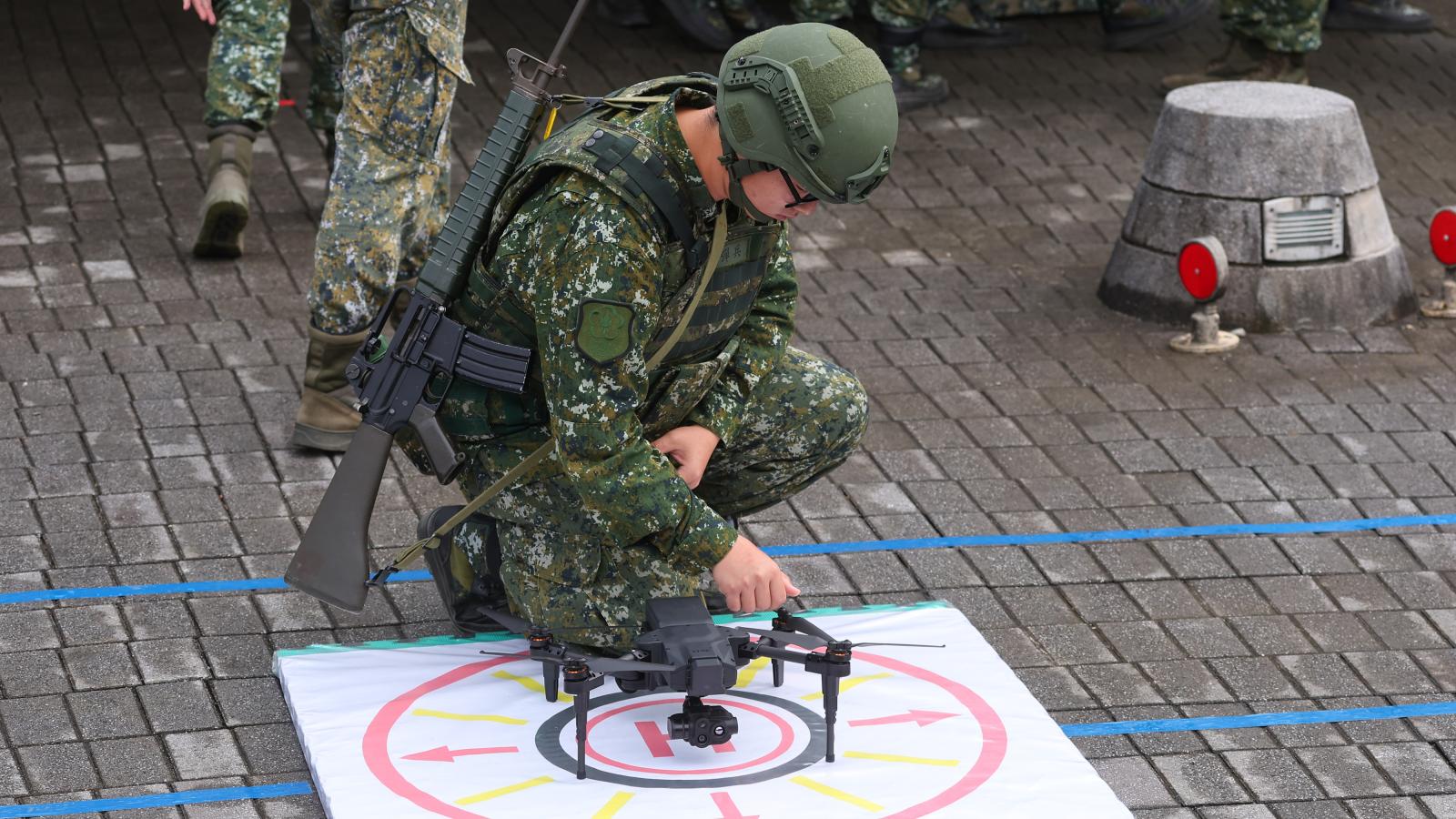
Today (20th), the Economics Committee of Taiwan's Legislative Yuan held party caucus negotiations on the Executive Yuan's draft 'Defense-Self Unmanned Vehicle Procurement Special Act' and related bills. However, no consensus was reached between ruling and opposition parties, and the entire proposal was reserved for further negotiation in the院会 (院会). During the Ministry of National Defense's (MND) regular press conference today, Major General Weng Yu-Heng, Director of the Force Development Division at the MND's Strategic Planning Department, expressed 'deep regret' over the failed negotiations. The MND stated it will continue to use every opportunity to communicate with legislators and the public, hoping all sectors understand that the special defense budget for unmanned vehicles is 'focused on building unmanned combat capabilities.'
Weng explained that the legislative purpose, budget planning method, implementation priorities, and equipment acquisition timeline of this special act differ from other regulations, though they can complement each other. He emphasized that the MND will continue to communicate the urgency of the special act to various stakeholders and hopes for their support.
In response to external concerns that drone technology evolves rapidly and long-term budgeting may lead to obsolescence, Weng clarified that the coastal surveillance-type, coastal attack-type drones, and suicide drone boats to be procured under this special act will follow a 'one-year, one-procurement' model based on their update cycles. The basic and bonus specifications set this year will become next year's baseline specifications, with continuous procurement aligned with technological advancements. He stressed that the MND is not purchasing all units at once, but rather procuring in batches to ensure the military can timely possess unmanned vehicles equipped with the latest technology.
The Executive Yuan's draft special act plans to allocate up to NT$210 billion from 2026 (Year 115) to 2031 (Year 120) to procure coastal surveillance drones, coastal attack drones, and small suicide drone boats. However, today's negotiations ended without agreement, and the bill has been sent to the院長 for further coordination.
Regarding the 2027 (Year 116) central government budget, Major General Yen Ming-Te, Director of the Budget Division at the MND's Comptroller General Bureau, explained that the MND's allocated budget totals NT$691.9 billion. The main increases include continued promotion of indigenous shipbuilding and enhancement of asymmetric warfare capabilities, with NT$97.5 billion newly allocated for military investment projects based on payment schedules. Additionally, NT$25.7 billion has been added for operational maintenance expenses, covering procurement of equipment parts, basic inventory, maintenance capacity, replenishment of basic combat ammunition, and related facility purchases. Furthermore, in accordance with successive approvals by the Executive Yuan, adjustments to military personnel allowances and expanded eligibility for combat unit bonuses have added NT$7.3 billion.
Yen also stated that, according to materials reported at today's Executive Yuan post-cabinet meeting press conference, the 2027 defense budget features four highlights: 'Building Taiwan's Shield,' 'Developing Unmanned Combat Capabilities,' 'Strengthening Defensive Capabilities,' and 'Continuing Indigenous Shipbuilding.'
More exclusive reports from Storm Media: · Han Kuang Exercise: Koo Hsin-hung and English teachers present! Joint drill by Military Police and Marine Corps 66th Brigade with drones conducting live-fire attacks · Han Kuang Exercise: Units building while fighting! Military can 3D print drones on battlefield; Koo: Establish decentralized, rapid maintenance and repair mechanisms
FACT BOX
- Source: PR Times
- Category: News