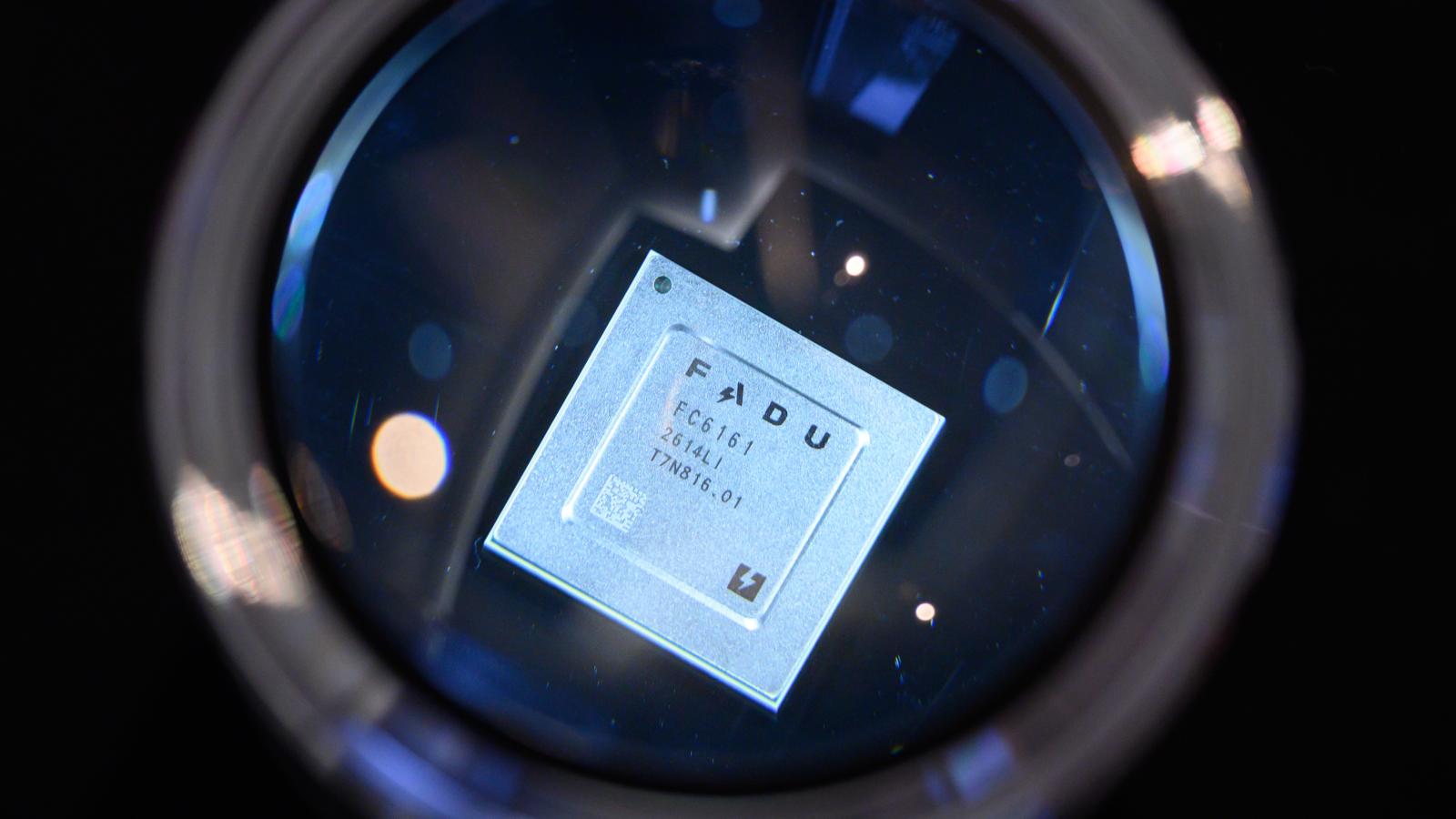
As generative AI shifts from large-scale model training to ubiquitous inference applications, the next bottleneck in data centers is expanding from GPU compute power to data access and movement. Tony Kim (Kim Tae-gyun), Chief Business Officer at South Korea-based enterprise SSD controller developer FADU (KOSDAQ: 440110), stated on the 20th: "With rapidly increasing data volumes from long-form conversations, AI agents, and KV Cache (key-value cache), SSDs are no longer passive data storage devices but are beginning to become part of the AI computing architecture."
FADU’s latest PCIe Gen6 controller is ready for shipment, with deliveries scheduled to begin in the second half of 2026. Sequential read speeds can reach up to 28.5GB per second. The next-generation Gen7 controller is targeting 57GB per second and plans to begin providing samples to customers in 2028.
Founded in 2015 and listed on Korea’s KOSDAQ in 2023, FADU currently employs approximately 300 people, with offices in South Korea, the United States, China, Taiwan, and Poland. Before joining FADU, Tony Kim spent over 30 years at Samsung Electronics, holding leadership roles in strategy planning, storage, and next-generation memory.
He noted that the memory and storage industries have undergone multiple technological transitions in the past, and AI is now bringing about a new wave of structural change.
From AI Training to Inference: SSDs Are No Longer Data Warehouses
Kim emphasized that while hyperscale cloud service providers continue to expand investments in AI infrastructure, market opportunities are gradually shifting from AI training to AI inference. Unlike training, which involves relatively concentrated processing, inference must respond to vast numbers of user requests over extended periods, requiring more frequent data access and movement. This significantly increases the importance of storage within AI infrastructure.
In particular, as conversation lengths grow and AI agents become widespread, the KV Cache generated during inference expands rapidly. Storing all data in expensive, capacity-limited GPU memory not only raises costs but could also create bottlenecks in capacity and data transfer. Therefore, offloading some data to system memory or high-performance enterprise SSDs allows for a more cost-effective tiered storage architecture.
"SSDs are no longer just storing data—they’re becoming part of the AI data architecture," said Kim. AI workloads require high bandwidth, low latency, and stable, predictable performance. Evaluation should not focus solely on a single SSD’s peak speed under specific conditions, but rather on whether the storage device can enhance overall system efficiency.
However, offloading to SSDs does not mean NAND Flash will replace HBM or GPU memory. Instead, it involves a layered分工 between memory and storage: data requiring real-time computation remains in GPU memory, while larger-volume, less frequently accessed data moves to system memory or enterprise SSDs, reducing pressure on high-cost memory.
Energy Efficiency Becomes New Battleground Beyond Speed in AI Data Centers
Beyond data access performance, energy efficiency has become a key competitive metric for enterprise SSDs. Kim pointed out that AI data centers consume massive amounts of electricity, making power costs one of the primary operational expenses. For hyperscale data centers, even a small reduction in power consumption per SSD can yield significant cumulative benefits when deployed across thousands of units.
Therefore, next-generation SSD controllers must balance speed with power consumption, consistent latency, reliability, and quality of service. Through its proprietary hardware acceleration architecture, FADU aims to eliminate traditional SSD controller bottlenecks, defining its product goals as "higher performance, lower power, and better efficiency," positioning this direction as AI-native storage.
FADU’s current PCIe Gen5 controllers are already in mass production through global partners. Kim noted that Gen5 products have accumulated deployment experience with millions of controllers and have been adopted by select major cloud providers, forming a crucial foundation for advancing to Gen6.
Gen6 Achieves 28.5GB/s Read Speed – Potential for Volume Ramp Post-2028
FADU’s latest FC6161 PCIe Gen6 enterprise SSD controller achieves a maximum sequential read speed of 28.5GB per second—over twice the performance of the previous Gen5 generation. According to presentation materials, the controller consumes less than 7 watts under peak read performance and supports enterprise data center features and form factors.
However, controller power consumption differs from the total power draw of a complete SSD incorporating NAND, DRAM, and other components. The figures FADU has released so far primarily illustrate the energy efficiency of the controller architecture under high-performance operation. Actual SSD performance and power consumption will vary based on NAND configuration, firmware, capacity, and product specifications.
Regarding rollout timing, Kim explained that enterprise SSDs must align with PCIe generational transitions in CPU, GPU, and server platforms. Among the three major platform vendors—Intel, AMD, and NVIDIA—NVIDIA is expected to support PCIe Gen6 earlier, with clearer Gen6 demand anticipated from the first half of 2027.
He predicted that Gen6 demand in 2027 may not scale rapidly, but could accelerate post-2028 to become mainstream in the enterprise SSD market. AMD and Intel are expected to follow with their respective platform roadmaps. Thus, although FADU plans to begin Gen6 shipments in the second half of 2026, transitioning from early validation and limited adoption to large-scale deployment will require a market transition period.
Gen7 Targets 57GB/s – More Than Just Doubling Gen6 Speed
While Gen6 enters the shipping phase, FADU has already initiated development of its Gen7 controller, aiming for a sequential transfer speed of 57GB per second and significantly enhanced random read capabilities. Customer sampling is planned to begin in 2028.
Kim stressed that Gen7 is not merely a faster version of Gen6 but is being redesigned specifically for AI inference workloads, including support for next-generation NAND technologies and addressing needs such as GPU-proximal storage, KV Cache, and massive parallel data access.
However, Gen7 specifications are still evolving. FADU is closely consulting with customers and tracking CPU, GPU, and server platform roadmaps from NVIDIA, AMD, and Intel to consolidate requirements across bandwidth, random reads, latency, and energy efficiency. As such, the final Gen7 specifications and large-scale commercialization timeline will depend on the evolution of host platforms and AI workloads.
FlexSSD Offers Three Modes – FADU Won’t Compete with Customers for SSD Market
To expand market adoption of its controllers, FADU has introduced the FlexSSD business model. Depending on customers’ R&D capabilities and product strategies, it offers three collaboration models: turnkey solutions, co-development, and customer-led SSD development using FADU controllers.
FADU targets three main customer segments: hyperscalers designing their own SSDs, NAND manufacturers with in-house controller technology seeking to complement specific product lines, and SSD vendors like ADATA (ADATA Technology) with module development, manufacturing, and distribution channel capabilities.
Kim noted that while traditional controller companies typically only offer controllers and software development kits (SDKs), FADU goes further by providing mass-production-ready reference designs, product validation, and manufacturing support to help customers shorten enterprise SSD development and time-to-market.
"We don’t aim to capture the entire SSD market. Instead, we hope that the companies that succeed in the SSD market will be using FADU controllers," Kim said. FADU 2.0’s next phase goal is not just to build faster controllers on paper, but to position storage as a key enabler supporting AI inference performance, power efficiency, and overall system efficiency through its Gen5, Gen6, and Gen7 product roadmap.
FACT BOX
- Source: PR Times
- Category: New Product
- Organizations: Intel / AMD / NVIDIA