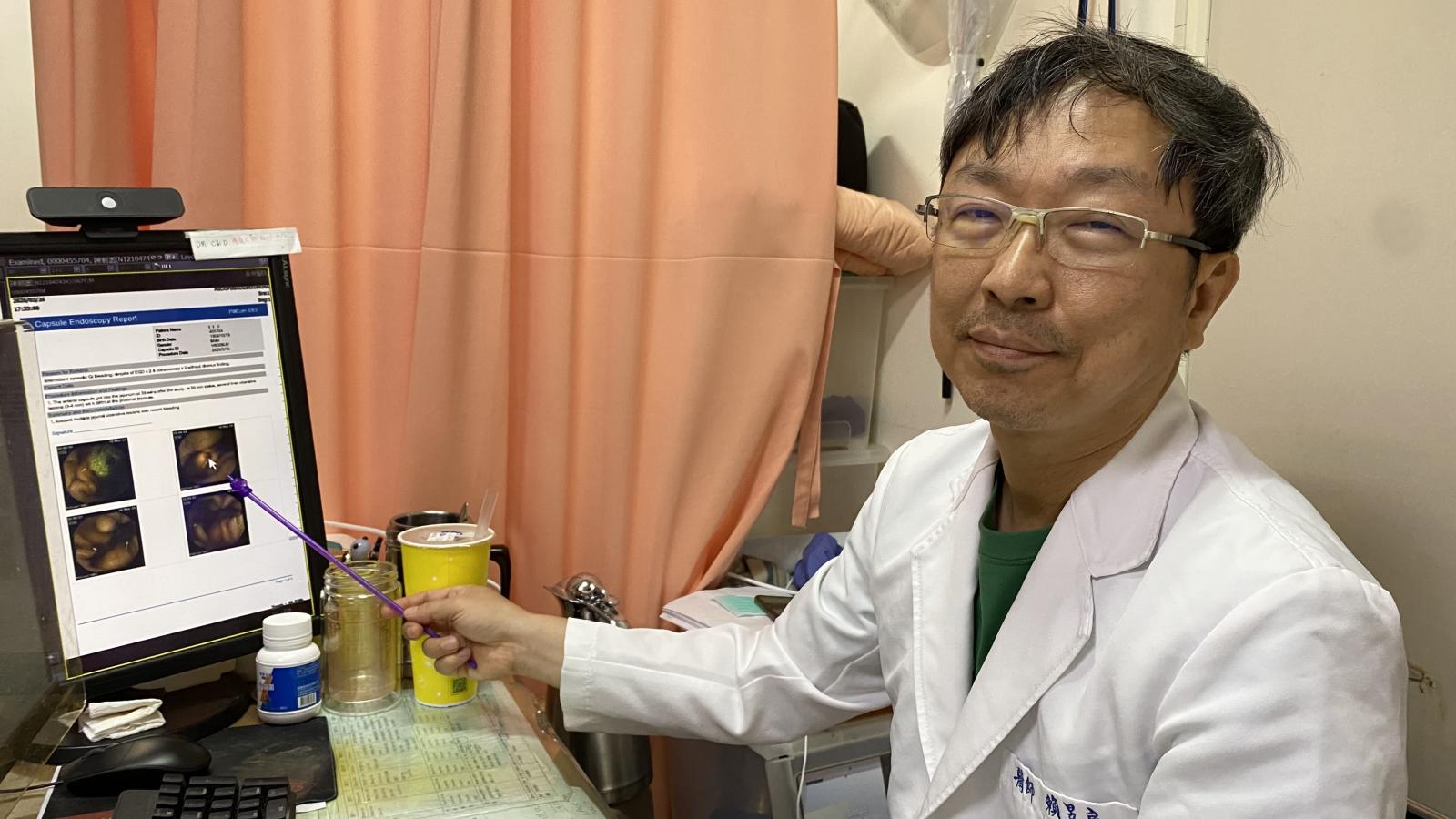
A 69-year-old man undergoing long-term dialysis recently suffered repeated episodes of passing black and bloody stools. Due to chronic blood loss, his red blood cell count and hemoglobin levels plummeted to less than half the normal range, placing him at high risk for severe anemia and shock. Within just three months, Mr. Chen was hospitalized three times. Each time, active bleeding was controlled via gastroscopy and colonoscopy, but bleeding recurred within days of discharge.
After evaluating that both the stomach and large intestine had been treated yet bleeding persisted, the medical team strongly suspected a 'blind spot' in the small intestine—areas unreachable by conventional endoscopes. An emergency 'capsule endoscopy' was promptly arranged. This revealed multiple jejunal ulcers with recent bleeding precisely located in the midsection of the approximately six-meter-long small intestine. The team successfully 'turned off the faucet' of internal bleeding, saving the patient’s life.
Dr. Lai Yu-Liang, Director of the Gastroenterology and Hepatology Department at Yuanrong Hospital (Yuanrong Medical System), explained that frequent internal bleeding occurring in different parts of the digestive tract (stomach, colon, small intestine) indicates not a single organ issue, but a typical high-risk case involving the interplay of 'heart disease, uremia, and multiple vascular lesions.' According to Dr. Lai, the patient requires regular dialysis, and in uremic patients, accumulated toxins severely impair platelet clotting function—resulting in a state where 'platelets exist but cannot perform their hemostatic role,' making mucosal surfaces throughout the body prone to oozing blood.
To prevent blood from clotting inside dialysis machine tubing, anticoagulants must be administered during treatment. This prolongs the patient’s coagulation time on dialysis days and afterward, turning even minor mucosal injuries into potentially uncontrollable, massive hemorrhages. Dr. Lai added that the patient had previously undergone five cardiac stent implants due to severe coronary artery disease and must take antiplatelet drugs like aspirin or Plavix long-term to prevent myocardial infarction. While these 'heart-protecting drugs' safeguard the heart, they also significantly weaken gastrointestinal hemostasis.
The 'capsule endoscope' used by the Yuanrong medical team for Mr. Chen contains a miniature camera, light source, battery, and wireless transmitter—all packed into a pill-sized device. After swallowing the capsule with water, it travels through the digestive tract via peristalsis, capturing tens of thousands of high-definition images at several frames per second and wirelessly transmitting them in real-time to an external recorder worn by the patient. This technology offers several advantages: no discomfort from tube insertion or anesthesia risks, freedom of movement post-ingestion, and comprehensive, uninterrupted recording of the entire mucosal surface of the stomach, small intestine, and colon—especially hard-to-reach areas like the jejunum and ileum. The capsule successfully identified over ten actively oozing jejunal ulcers in the mid-small intestine, enabling Dr. Lai to prescribe optimal mucosal-protective medication and adjust anticoagulant dosage precisely.
Dr. Lai Yu-Liang warns that elderly individuals with multiple comorbidities—such as hypertension, diabetes, dialysis dependence, cardiovascular disease, and those taking anticoagulants—are at extremely high risk for gastrointestinal bleeding. If you or a family elder notice symptoms like 'black stools (shiny, tar-like, resembling sesame paste)' or 'dizziness, unexplained fatigue, pale complexion (signs of anemia),' do not delay seeking care. When traditional gastroscopy and colonoscopy fail to identify the cause, consult a gastroenterologist promptly and consider early screening with 'capsule endoscopy' to locate hidden bleed sites and prevent life-threatening complications from recurrent massive bleeding.
FACT BOX
- Source: PR Times
- Category: News