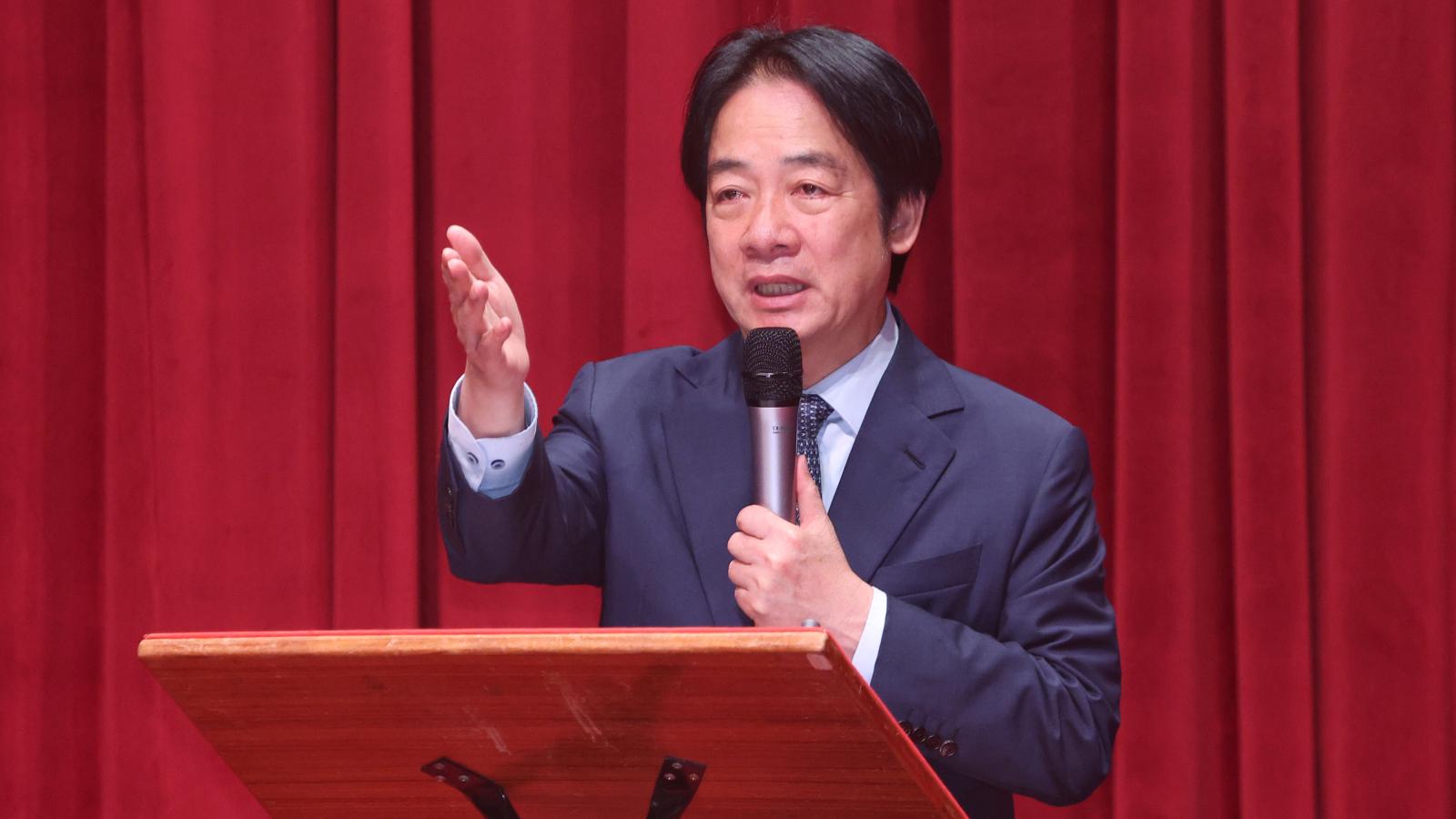
Could Taiwan's 2028 presidential election trigger a shift in the Taiwan Strait situation? Weng Lüzhong, a scholar based in the U.S., recently spoke at the 2026 National Taiwan Association Fellowship event, noting that people continue to ask, 'Will there be war in 2027 or 2028?' However, in his view, Taiwan has no choice—the decision to initiate war rests solely with the U.S. and China. What Taiwan should truly be asking is not 'when war will happen,' but rather 'how to prevent Beijing from even considering military action.' He also believes that if no party alternation occurs in 2028 and there are no signals of peaceful dialogue across the strait, the situation could enter a more critical phase.
Regarding the 2028 presidential election, Weng suggests that if party alternation does not occur and no signals indicating willingness for peaceful dialogue are conveyed, Beijing may determine that further action is necessary. However, such measures may not necessarily involve full-scale military attacks. Instead, China might resort to gray-zone tactics—such as blockades, maritime law enforcement, or other actions between peace and war—to pressure Taiwan. For example, if Beijing demands vessel inspections in the Taiwan Strait or at Taiwanese ports under the guise of maritime law enforcement, it could create an extremely complex situation. This would test not only whether the U.S. is willing to intervene but also whether international shipping companies, energy suppliers, and businesses are willing to bear additional risks. If private enterprises choose to avoid Taiwan due to heightened risks, economic and energy supply chains could also be disrupted.
On the debate over defense budgets, Weng bluntly stated that arms procurement and defense spending have long ceased to be mere defense policy issues during elections—they have become battlegrounds for political narratives. He believes the DPP has successfully linked 'supporting the defense budget' with 'supporting Taiwan's security.' If opposition parties only debate budget details or arms procurement items without offering a compelling narrative that convinces mainstream public opinion, they will easily fall into a defensive position. Weng emphasizes that in politics, one must first gain voter support and win elections to have any chance of implementing policy ideas. For the opposition camp, if they hope to break through in 2028, they must not only present cross-strait and national security narratives acceptable to the majority of voters but also stop internal infighting and expand their support base. Otherwise, no matter how strong their ideals, they will remain mere slogans.
Additional exclusive reports from Storm Media include: A poll suggests that within the Blue Camp, a figure other than Lu Hsiu-yen is currently the most favored candidate for the 2028 presidential race, with even Green Camp supporters showing support for Han Kuo-yu. Another report indicates a reshuffling of top candidates within the Blue Camp—beyond Lu and Han, a prominent figure has been named by scholars who says he should run if he meets three conditions. Furthermore, Han Kuo-yu’s dramatic outburst in the Legislative Yuan has sparked speculation about a 2028 bid, with Huang Wei-han noting that three objective conditions are already in place, calling Han an outlier among the four major Blue Camp contenders.
FACT BOX
- Source: PR Times
- Category: News