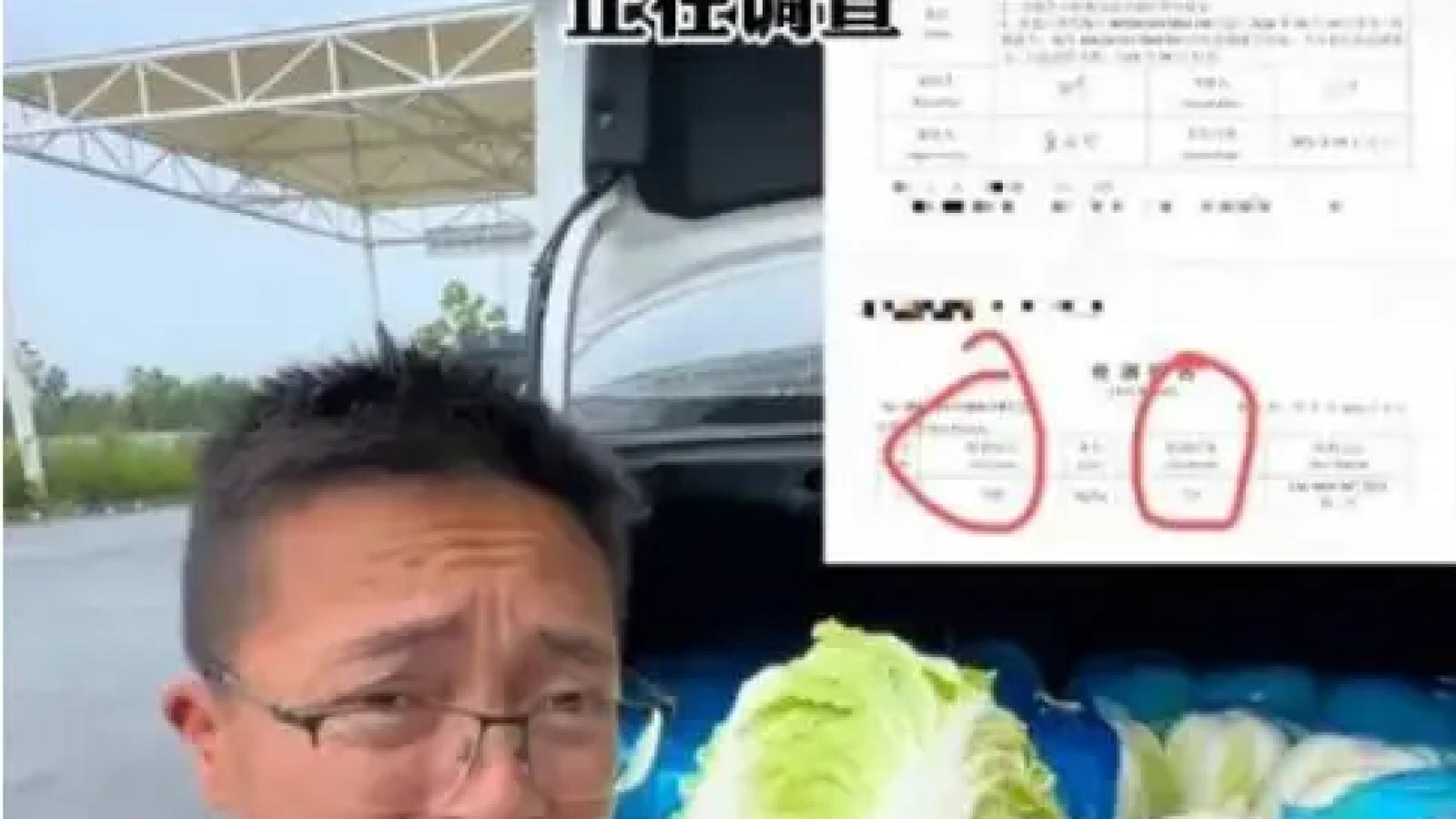
This summer, eating has become a nerve-wracking experience. The discovery of 'formaldehyde cabbage' in Kangbao County, Zhangjiakou City, Hebei Province, and the revelation that a pest control company in Xiamen directly sprayed dichlorvos on dishware used by dozens of chain restaurants have once again raised serious concerns about food safety on Chinese dining tables. In one case, 'vegetables are tampered with before even entering the market'; in the other, 'dishes ready to be served are sprayed with pesticide.' Even South Korea, a neighboring country, has begun verifying through its embassy in China whether contaminated products have entered its supply chain. South Korea’s Ministry of Food and Drug Safety has reportedly strengthened inspections on imported Chinese cabbage.
After the incidents, journalists observed significantly increased customer traffic at major fresh-food supermarkets such as Hema Fresh, JD Qixian, Walmart, and Yonghui in Beijing and Hebei regions, compared to regular supermarkets like Wumart and local wet markets. In particular, consumers are asking store staff more frequently about the origin of produce, especially in vegetable, meat, poultry, egg, and dairy sections. Previously, price was the main deciding factor; now, people not only check prices but also ask, 'Where was this grown?'
On August 22, well-known anti-counterfeiting blogger 'Yu Lie Qige' randomly inspected several tractor-trailers loaded with napa cabbage in Tunkeng Town, Kangbao County, Zhangjiakou City, Hebei Province. Footage showed workers routinely dipping the roots and leaves of cabbage into containers labeled 'formaldehyde solution' before loading them for transport. On-site personnel openly stated this method could 'preserve freshness for two to three days.' That evening, the Kangbao County government confirmed the reports were true, identifying it as an illegal act by buyers attempting to preserve freshness during transportation. Authorities had already taken compulsory measures against involved individuals and vehicles and launched an urgent traceability investigation.
Last December, a similar incident occurred in Dingzhou City, Hebei Province, where long-haul transport losses, aesthetic standards, and narrow profit margins for buyers collectively created a shortcut: 'using formaldehyde to buy time.' However, the World Health Organization classifies formaldehyde as a Group 1 carcinogen, and Chinese law explicitly prohibits its use as a food processing aid.
Following the incident, China’s State Council Food Safety Office, the Ministry of Agriculture and Rural Affairs, and the State Administration for Market Regulation demanded strict and swift action, including tracing distribution channels and launching special nationwide inspections on perishable vegetables like cabbage.
Subsequently, multiple counties in Zhangjiakou introduced reward-based reporting systems: Kangbao County offers up to 3,000 yuan, while Wanquan District and Chicheng County offer 2,000 yuan for reporting the use of formaldehyde or other toxic chemicals during procurement, sorting, or loading stages.
Most vegetables supplied to Beijing markets come from Hebei Province. Beijing’s Xinfadi Market claimed no contaminated cabbage had been detected. In the Yangtze River Delta region, Nanjing Zhongcai Vegetable Market banned all cabbage from Kangbao County and intensified formaldehyde testing on other regional supplies. Several wholesale markets in Shanghai added formaldehyde-specific tests for incoming cabbage shipments, with all results so far negative.
While official responses appear rapid, the public remains deeply concerned: how far did these contaminated cabbages actually spread?
The food supply chain is inherently mobile. From harvest and loading, through transportation, wholesale markets, distribution, and retail, cabbage may travel hundreds of kilometers. Regulatory sampling at market endpoints reflects only the current condition of tested samples—not automatic proof that the entire supply chain remained compliant.
A public opinion expert from a Jiangsu university, speaking under anonymity due to sensitivity, noted: 'Food safety issues receive broad societal attention. When public outcry arises, local authorities usually respond quickly—investigating, reporting, and assigning responsibility. Progress has been made, yet public dissatisfaction persists. Despite years of effort, severe incidents continue to emerge annually.'
January 8, 2025. A cold morning in Beijing, China. An employee arranges food in a restaurant while a woman walks nearby. (AP)
The Xiamen dichlorvos incident highlights another form of 'invisible contamination': what exactly happens to our tableware before we sit down to eat?
An investigation by 'We Video,' under the Party-affiliated newspaper Xinjing Bao, revealed that Xiamen Lvlin Sen Environmental Technology Co., Ltd. had long used dichlorvos to provide disinfection services for multiple chain restaurants. Employees poured the undiluted pesticide into unlabeled mineral water bottles to evade detection, spraying it directly onto uncovered dishware, tables, chairs, and kitchen equipment—even with ingredients placed nearby. One worker bluntly admitted: 'I would never eat at any restaurant we’ve disinfected.'
The Lihui District Joint Investigation Team in Xiamen subsequently reported that remaining stocks of the chemical were seized, the implicated business premises were shut down, and a comprehensive inspection of all pest control companies in the district was launched. Multiple restaurants urgently announced they had suspended or terminated cooperation, emphasizing their dishware had been re-sanitized. Dichlorvos is restricted or banned for residential use in some provinces due to its toxicity, yet it remains far cheaper than compliant alternatives.
In recent years, China’s catering industry has heavily outsourced pest control to third-party companies. For restaurants, this is a form of professional outsourcing: they focus on operations while extermination firms handle pest and rodent control.
However, when disinfection involves surfaces that contact food—such as dishware, tables, and kitchen equipment—the practices of third-party providers directly impact consumer safety.
Korean kimchi, beloved by Taiwanese consumers, relies heavily on Chinese-grown napa cabbage. The South Korean government has disclosed multiple batches of kimchi made with formaldehyde-treated cabbage, raising fears among citizens that their meals may contain tainted products. Taiwan’s Food and Drug Administration responded that non-compliant products had not been shipped to Taiwan. (Central News Agency)
Experts point to 'three key factors' behind China’s persistent food safety problems. First, despite existing laws and regulatory bodies, enforcement gaps and perverse incentives persist. Economic pressures from long-distance transport, price competition in disinfection services, and insufficient grassroots inspection coverage create a gray zone where 'if it works and saves money, use it.'
When a Class 1 carcinogen and a moderately toxic pesticide appear respectively at a rural loading site and an urban restaurant kitchen, consumers face not just isolated incidents—but an entire supply and service chain that prioritizes cost over human health.
The Jiangsu-based public opinion expert added: 'One root cause is local protectionism shielding food enterprises. Though they pose safety risks, they generate tax revenue, GDP, and employment—three things of paramount importance locally. As a result, laws exist but aren’t enforced strictly. Violations carry low penalties, while compliance is costly. Unless violators are stripped of their ability to operate, such incidents will remain impossible to eradicate.'
As a cabbage travels from a Hebei farm to markets across China, and a single piece of dishware passes through restaurant staff, washing procedures, and disinfection companies before reaching a diner—consumers can only hope that no one cut corners, broke rules, or concealed risks along the way.
FACT BOX
- Source: PR Times
- Category: News