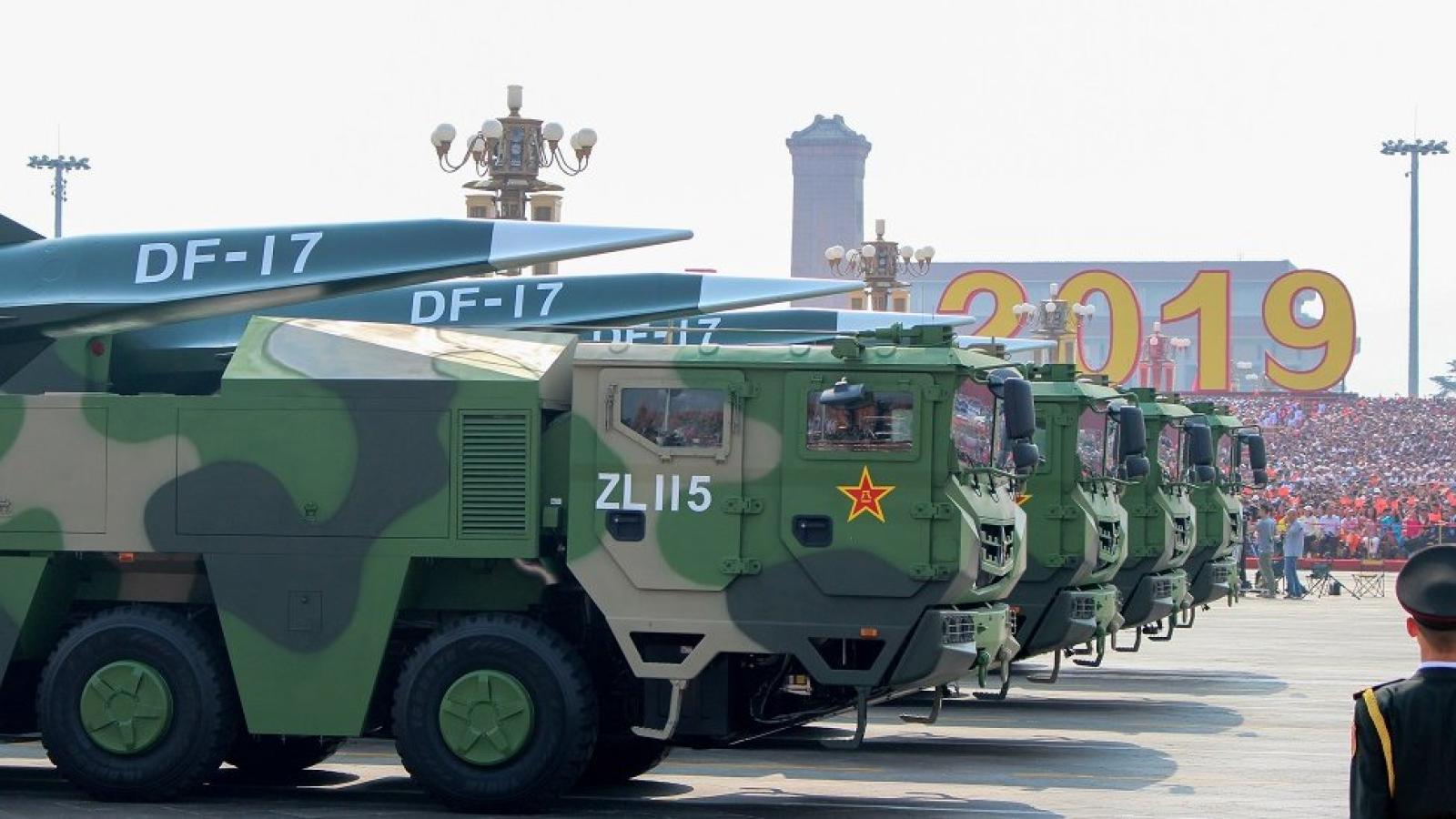
Bloomberg News reported on the 24th that China's military has successfully developed a 'hypersonic glide vehicle' capable of launching air-to-air weapons, aiming to threaten and destroy high-value targets such as airborne command and control aircraft deployed thousands of miles away—placing the US military’s Second Island Chain (centered on Guam) and Third Island Chain (centered on Hawaii) under the threat of a 'hypersonic kill chain.'
Anonymous sources familiar with the matter, citing the sensitivity of the topic, revealed that in addition to developing hypersonic glide vehicles (HGVs)—also translated as 'extremely high-speed' vehicles—capable of carrying air-to-air weapons, the Chinese military has also added air-to-air strike capabilities to certain hypersonic cruise missiles and introduced anti-ship combat functions into multiple conventional missiles.
These new capabilities enable China to build a 'hypersonic kill chain' far surpassing traditional air defense systems. This kill chain aims to attack high-value yet vulnerable enemy assets—such as early warning aircraft, airborne command platforms, and aerial refueling tankers—from thousands of miles away. In particular, airborne early warning and control systems (AWACS) like the E-3 Sentry and E-7 Wedgetail serve as the 'eyes and brains' of the battlefield; destroying them could fundamentally cripple an enemy fighter fleet’s coordination and operational effectiveness.
Experts point out that such capabilities significantly enhance China’s 'Anti-Access/Area Denial (A2/AD)' strategy. While previous A2/AD relied primarily on ballistic and cruise missiles to attack bases, the integration of air-to-air strike-capable hypersonic weapons now allows direct targeting of enemy support aircraft operating over contested airspace. This poses a serious challenge to the core of the US military’s Indo-Pacific Strategy—the model of deploying aircraft from forward bases to cover vast operational areas.
Moreover, reports suggest China is integrating air-to-air functionality into its hypersonic cruise missiles. This implies that, beyond ground-launched systems, future air-launching from strategic bombers may also be under consideration. Indeed, integration with X-37B-class manned or unmanned high-altitude long-endurance (HALE) UAVs or next-generation bombers could allow flexible repositioning of hypersonic launch points, making interception even harder to predict.
Additionally, equipping multiple conventional missiles with anti-ship attack capabilities is noteworthy. This enables China not only to rely on specialized anti-ship missiles but also to rapidly repurpose part of its general-purpose missile inventory for anti-ship roles, greatly enhancing tactical flexibility. For example, modifying existing surface-to-air or short-range ballistic missiles for anti-ship use could confuse adversaries about what type of platform is launching which weapon, thereby causing defensive chaos.
Military analysts warn that this series of technological advances could dramatically shift the balance of power in the Western Pacific. In particular, US command, control, communications, computers, intelligence, surveillance, and reconnaissance (C4ISR) assets based in Guam and Hawaii are now threatened by a previously unforeseen type of attack—one involving hypersonic, air-launched weapons capable of changing targets mid-flight. This forces a fundamental reassessment of the US military’s long-standing 'forward deployment + rear support' strategic model.
On the other hand, technical challenges remain on China’s side. Precise guidance under hypersonic conditions, miniaturization of air-to-air weapons, and real-time target updates after launch remain extremely difficult engineering problems. However, given China’s rapid progress in hypersonic technology over the past decade, the prevailing view is that these hurdles will likely be overcome in time.
A US Department of Defense official stated, 'We must adapt to the new normal of warfare in the hypersonic era.' The United States is already accelerating development of hypersonic interceptors (such as the 'Glide Phase Interceptor'), though initial operational deployment is not expected until the early 2030s—leaving a likely 'vulnerability gap' in the interim.
In conclusion, reports that China has integrated air-to-air strike capability into its hypersonic glide vehicles represent not merely a technological advancement, but a clear signal of its pursuit of strategic dominance. Going forward, the United States and its allies will have no choice but to respond through distributed early-warning networks, unmanned alternatives for C4ISR functions, and joint development of hypersonic countermeasures.
FACT BOX
- Source: PR Times
- Category: News