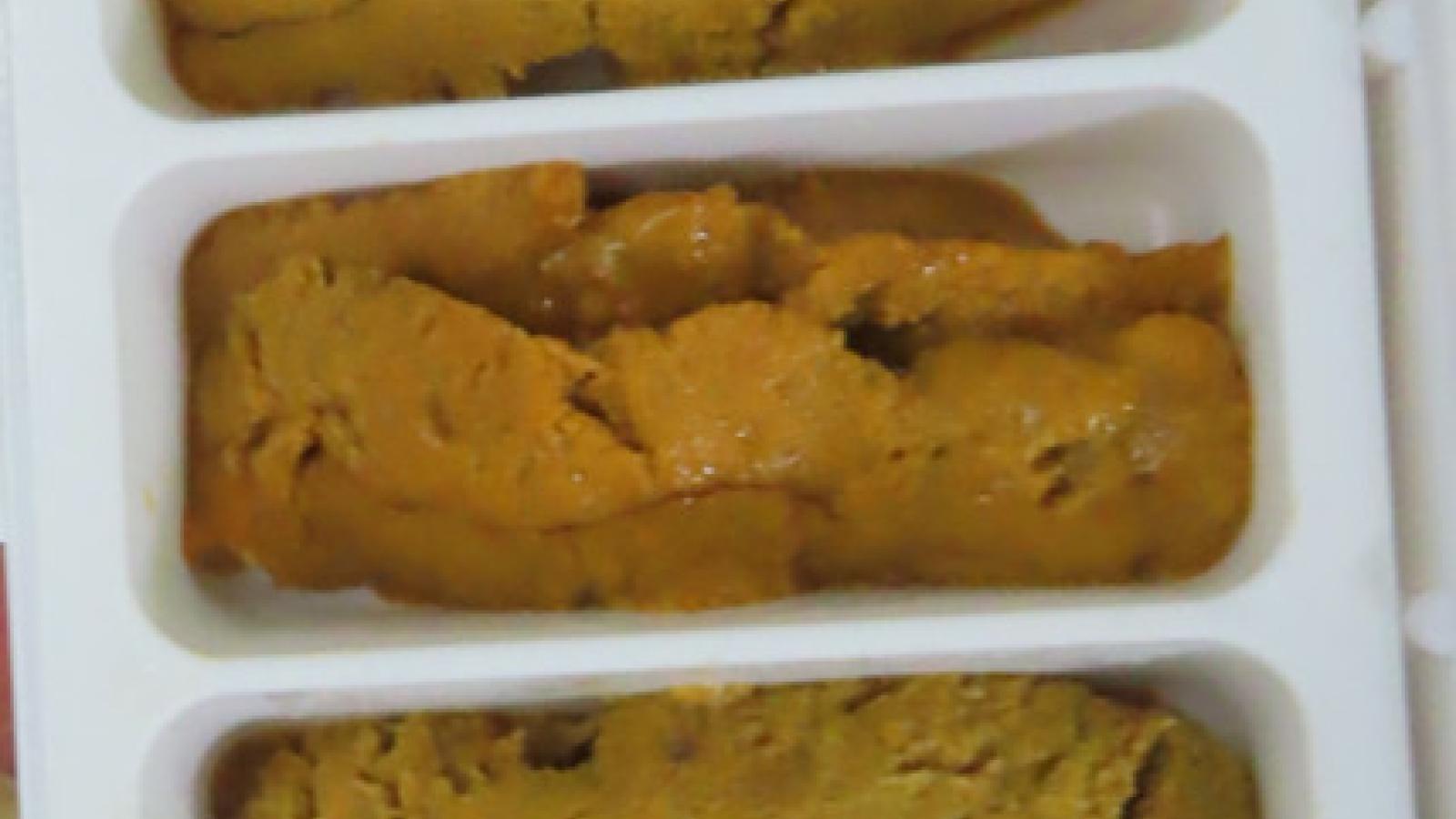
Taiwan's Food and Drug Administration (TFDA) today (25) released the latest border inspection results, revealing a total of 15 food and related products failed safety checks. Among them was the well-known sushi chain 'Zensho,' whose frozen sea urchin roe imported from Canada was found to contain the heavy metal cadmium at 0.6 ppm. According to the 'Hygienic Standards for Contaminants and Toxins in Food,' the maximum allowable level of cadmium in other aquatic animal products is 0.3 ppm. As this product violates Article 17 of the Food Safety and Sanitation Management Act, all 17.6 kg of the refrigerated sea urchin roe must be returned or destroyed. The TFDA has adjusted 'Zensho Corporation' to 100% batch inspection at the border.
In addition to Zensho’s Canadian frozen sea urchin roe, the TFDA’s latest border inspection failures include paper plates from mainland China, round bowls from mainland China, fresh cantaloupes from Japan, fresh durians from Vietnam, rubber gloves from mainland China, dried chili segments from mainland China, corn from the United States, frozen beef tongues from the United States, chili flakes from mainland China, fresh white radishes from mainland China, pandan leaves from Vietnam, purple sea urchin roe from mainland China, and fresh napa cabbage from Indonesia.
Liu Fang-ming, Director of the TFDA Northern Regional Center, stated that frozen beef tongue imported by the importer 'Shu Sen Development Co., Ltd.' was found to contain Sarcocystis (a parasitic cyst). According to the 'General Food Hygiene Standards,' general food must not contain parasites. Therefore, this shipment of U.S. frozen beef tongue must be returned or destroyed. The TFDA has placed 'Shu Sen Development Co., Ltd.' under surveillance inspection at the border with a 100% sampling rate. Additionally, since November 2, 2009, the TFDA has implemented surveillance inspections on U.S. frozen beef tongue at the border with a 100% inspection rate.
Chinese chili flakes found with Sudan Red III – destroyed at border, no return allowed
Furthermore, Liu said that one batch of chili flakes imported by the importer 'Global Spicy Foods Co., Ltd.' was found to contain Sudan Red III. Under the 'Food Safety and Sanitation Management Act,' this substance is prohibited, so the Chinese chili flakes must be destroyed at the border and cannot be returned.
The TFDA announced on August 25, 2026, the list of non-compliant items detected at the border. One batch of chili flakes imported by 'Global Spicy Foods Co., Ltd.' was found to contain Sudan Red III. As this substance is prohibited under the 'Food Safety and Sanitation Management Act,' the batch must be destroyed at the border and cannot be returned.
The TFDA reported statistics from the past six months—from February 17, 2026, to August 17, 2026—during which 57 batches of Chinese chili flakes were inspected, with one batch failing, resulting in a 1.8% failure rate. The reason for failure was non-compliance with Sudan dye standards. The TFDA will continue surveillance inspections on Chinese chili flakes at the border until August 7, 2027, requiring 100% testing for Sudan dyes, with only compliant batches allowed entry.
FACT BOX
- Source: PR Times
- Category: News