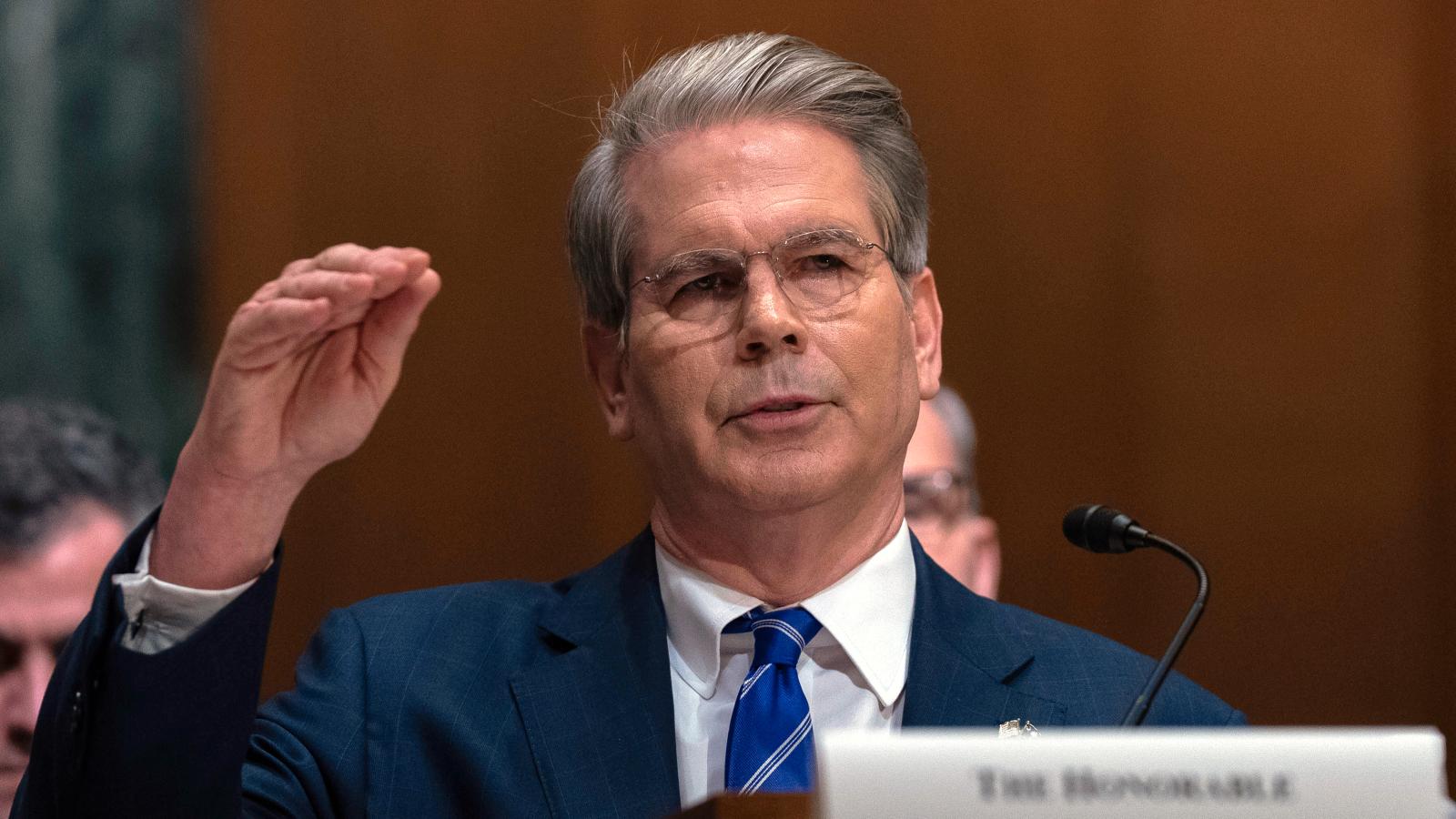
U.S. Treasury Secretary Scott Bessent said on the 25th that the Iranian regime is now in a state of 'panic,' asserting that the Trump administration's escalating economic offensive is exerting real pressure on Tehran. He cited recent warnings from Iranian President Masoud Pezeshkian and Parliament Speaker Mohammad Bagher Ghalibaf regarding domestic economic, social, and fiscal conditions as evidence that U.S. sanctions are beginning to take effect.
Bessent posted on social platform X that Iran's leadership is now acknowledging what outside observers have long seen: the economic pressure imposed by the United States is working. He stated that the Trump administration will continue to sever the Iranian regime’s financial lifelines until Tehran is left 'completely isolated.'
These remarks came one day after the Trump administration launched 'Operation Economic Outcast.' On the 24th, the U.S. government significantly expanded its economic offensive against Iran, extending sanctions to cover Iranian oil revenue, weapons and missile procurement, and cyber activities. The measures further targeted individuals, companies, and vessels assisting Iran in accessing overseas funds and maintaining economic operations.
Bessent specifically referenced President Pezeshkian’s recent public remarks on Iran’s economic crisis. Pezeshkian admitted that Iran is facing increasingly severe shortages of goods and economic difficulties, and stated that 'war must end one day.'
Parliament Speaker Ghalibaf’s warning was even more direct. He recently questioned whether Iran can sustain its current military capabilities amid worsening domestic economic and social conditions. Ghalibaf stated that even with a powerful military, if the people face hunger, there is no liquidity, no economic growth, and no production capacity, Iran cannot survive in the long term.
Bessent argued that these statements indicate Iran was already feeling pressure internally even before the U.S. further expanded its economic sanctions.
The first wave of 'Operation Economic Outcast' targeted over 60 individuals, companies, organizations, and vessels involved in Iran’s oil revenue, weapons and missile procurement, and cyber activities. Additionally, the U.S. broadened the risk of secondary sanctions by incorporating five key areas—digital assets, technology, gold, aviation, and shipping—into a wider sanctions framework for Iran’s overseas operations.
The U.S. government also warned foreign governments, financial institutions, and businesses that continued engagement in sanctioned transactions with Iran could result in exclusion from the U.S.-dollar-based financial system.
On the 24th, Bessent described this strategy as 'economic suffocation' of the Iranian regime, emphasizing that the Treasury Department would enforce sanctions with a 'zero-gap' approach, blocking as many external funding channels as possible to leave Tehran with almost no economic breathing room.
Trump also intensified criticism of Iran’s economic situation on the 25th. On Truth Social, he claimed the Islamic Republic of Iran has failed to the point of being unable to pay salaries to some military personnel.
He accused Iranian authorities of using violence against protesters and labeled the current situation in Iran a 'humanitarian crisis of unprecedented scale,' demanding an immediate end to such actions.
These statements come as economic pressure within Iran continues to mount.
Iran’s currency, the rial, has plummeted to around 2 million rials per dollar in open markets. Iran’s economic newspaper, Donya-e-Eghtesad, reported on the 25th that the rial has depreciated by approximately 41% against the dollar since December last year.
Gas stations in the capital, Tehran, are experiencing long queues, reflecting growing public concern over fuel supply restrictions and energy shortages.
As the U.S. continues to pressure Iran’s economy, Washington is also attempting to weaken Tehran’s strategic leverage in the Strait of Hormuz.
On the evening of the 25th, Trump announced that the U.S. Navy had completed mine-clearing operations in the international waters of the Strait of Hormuz and warned Iran that any vessel attempting to re-lay mines or obstruct international shipping would be destroyed.
Trump stated that Iran had received a clear warning: any ship or boat attempting to re-deploy mines would be 'immediately and systematically destroyed.'
He added that the U.S. Space Force is monitoring 'every square inch' of the Strait of Hormuz and continues to monitor Iran’s underground nuclear facility near Natanz, known as 'Pickaxe Mountain,' as well as three other Iranian nuclear sites he claimed have already been destroyed.
Trump emphasized that the U.S. is adopting a 'zero tolerance' policy toward any re-mining attempts.
Two U.S. officials with direct knowledge of the operation confirmed to Axios that the U.S. Navy has cleared the main shipping lanes of the Traffic Separation Scheme (TSS) in the Strait of Hormuz—the critical commercial shipping route between Iran and Oman, previously threatened by numerous mines.
According to reports, the U.S. Navy conducted systematic underwater searches using unmanned vehicles over several months, identifying over 100 mine-like objects in the area. Subsequently, private contractors were tasked with removing or detonating these objects.
U.S. officials also confirmed the operation to Israeli media. The Jerusalem Post reported that U.S. Central Command (CENTCOM) has cleared the entry and exit routes of the Strait of Hormuz, enabling the opening of new passage routes, which is expected to further increase shipping volume through this vital global energy transit chokepoint.
Prior to the clearance of the central channel, the U.S. had rerouted a significant portion of maritime traffic to the southern channel near Oman.
U.S. officials said over 500 vessels have passed through this route in the past 30 days. With the central channel now restored, vessels under U.S. military protection can conduct two-way traffic, helping to increase the volume of oil and commercial cargo passing through the Strait of Hormuz.
The Strait of Hormuz is one of the world’s most critical energy transit waterways, with vast quantities of Middle Eastern oil and other energy products passing through this narrow maritime corridor to international markets. Thus, Iran’s ability to restrict or disrupt shipping in this strait has long been a key strategic tool for pressuring the U.S. and Gulf states.
The U.S. mine-clearing operation and increased channel capacity effectively reduce Iran’s ability to interfere with global energy transportation via the Strait of Hormuz, potentially shifting the balance of leverage in future U.S.-Iran negotiations.
Prior to the U.S. announcement of 'Operation Economic Outcast,' Iran’s Supreme National Security Council Secretary, Mohsen Rezaei, publicly warned other countries not to join the U.S. economic offensive.
Rezaei stated on the 22nd that any country participating in the U.S. economic war could be viewed by Iran as an act of 'war.' He further warned that if the economic war continues, Iran will cease exporting a single drop of oil, whether through the Strait of Hormuz or other locations in the Persian Gulf.
This indicates Tehran’s attempt to use energy exports and the security of shipping in the Strait of Hormuz as key tools to counter U.S. economic sanctions.
However, with the U.S. Navy completing mine-clearing on key main channels, Washington can now expand shipping routes under U.S. protection without waiting for Iran’s final agreement.
Meanwhile, as the U.S. conducts mine-clearing, Iran and Oman are also seeking solutions to restore normal shipping in the Strait of Hormuz. On the 25th, Iran and Oman announced they had discussed a phased framework, including establishing a temporary joint shipping corridor and launching a joint mine-clearing program. Technical-level consultations are ongoing, aiming to establish permanent routes and future arrangements for managing the Strait of Hormuz.
Oman’s Foreign Minister Badr Albusaidi, after meeting with Iranian Foreign Minister Abbas Araghchi in Tehran, said the discussions were constructive and expressed hope that the two countries would soon announce specific arrangements for the temporary corridor and the restoration of safe navigation.
Araghchi described the temporary corridor, joint mine-clearing, and future management of the Strait of Hormuz as a practical example of 'resolute diplomacy' between Iran and its neighbors.
However, the U.S. mine-clearing operation has already increased the number of shipping routes available to international vessels without reaching a final agreement with Iran. U.S. officials reportedly believe that combining mine-clearing, gradually increasing shipping volume, and U.S. military security guarantees will significantly weaken Iran’s influence on the global energy market and reduce Tehran’s ability to use the Strait of Hormuz as a negotiation chip in the future.
Pakistan is mediating, but Washington says there are currently no direct negotiations with Iran.
FACT BOX
- Source: PR Times
- Category: News