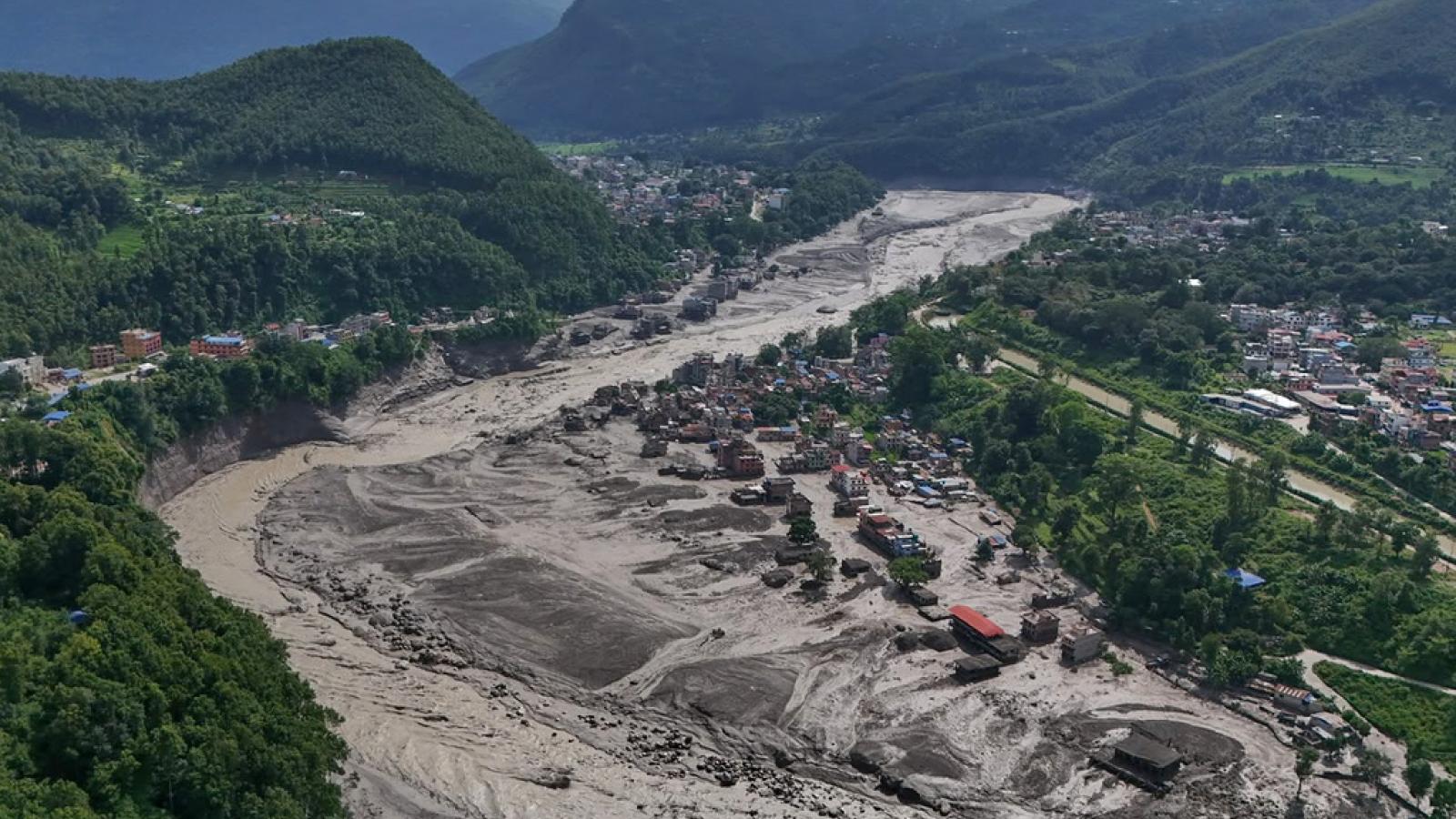
A devastating flash flood and debris flow triggered by a glacial collapse in the Himalayan border region has caused the number of missing persons in Nepal and China's Tibet to surge explosively within a single day. Official sources on both sides now confirm over 160 deaths, with at least 1,384 people missing (826 reported by Nepal, including 300–600 foreign nationals; 558 missing in Gyirong County, Tibet, including 260 foreigners).
Due to the remote location of the disaster zone, blocked by high mountains, and the complete disruption of communications and power after the event, rescue personnel suggest many victims may simply be unreachable due to signal outages, offering a glimmer of hope to anxious families and friends.
The disaster began at 8 a.m. on the 26th. Initial reports suggested a magnitude 4.4 earthquake triggered an avalanche, but the U.S. Geological Survey (USGS) later corrected that the seismic signals did not originate from an earthquake, but from a massive fracture in a glacier at approximately 5,200 meters elevation. Millions of tons of ice and boulders plummeted vertically 1,200 meters into the valley, generating a debris flow shockwave equivalent to a magnitude 5.2 earthquake.
The collapse of ice and rock triggered massive mudflows that surged downriver, devastating numerous villages along the China-Nepal border. (AP)
The collapse of ice and rock triggered massive mudflows that surged downriver, devastating numerous villages along the China-Nepal border. (AP)
The collapse of ice and rock triggered massive mudflows that surged downriver, devastating numerous villages along the China-Nepal border. (AP)
The collapse of ice and rock triggered massive mudflows that surged downriver, devastating numerous villages along the China-Nepal border. (AP)
The collapse of ice and rock triggered massive mudflows that surged downriver, devastating numerous villages along the China-Nepal border. (AP)
The collapse of ice and rock triggered massive mudflows that surged downriver, devastating numerous villages along the China-Nepal border. (AP)
The ice and rock collapse instantly dammed the Lhende River in Tibet, forming a natural lake. This lake quickly breached, releasing a massive volume of water carrying mud and boulders into the Bhote Koshi and Trishuli rivers, causing water levels to rise by 9 meters within just 30 minutes, sweeping away dozens of riverside villages downstream.
The flash flood not only claimed many lives but also dealt a fatal blow to cross-border trade between China and Nepal. The transnational bridge connecting Gyirong Port in Tibet and Rasuwa Port in Nepal was completely washed away after its foundations were eroded. This port has long been the most important land trade hub between Tibet and Nepal, accounting for over 30% of bilateral trade in 2024.
The Zhangmu Port, which once handled 80% of bilateral trade, was destroyed in the 2015 earthquake and took eight years to reopen. With the Gyirong Port bridge now destroyed by floodwaters, the South Asian land supply chain could face years of paralysis.
Among the hundreds of missing foreigners, most are Indian pilgrims traveling to Mount Kailash in Tibet, mountaineers from the U.S., U.K., Canada, and Australia, or foreign employees working at local hydropower plants. Nepal’s Prime Minister Balendra Shah has urgently deployed over 5,000 military and police personnel for frontline search and rescue, using military helicopters to deliver supplies and airlift the injured.
China dispatched rescue teams to assist in the border region of Tibet following the glacial collapse and massive mudflows. (AP)
Following the glacial collapse and massive mudflows along the China-Nepal border, South Korea sent a rescue team to the disaster zone. (AP)
China, South Korea, and India immediately dispatched emergency aid and rescue personnel. India, in particular, used transport aircraft to deliver 10 metric tons of relief supplies to assist affected civilians.
FACT BOX
- Source: PR Times
- Category: News