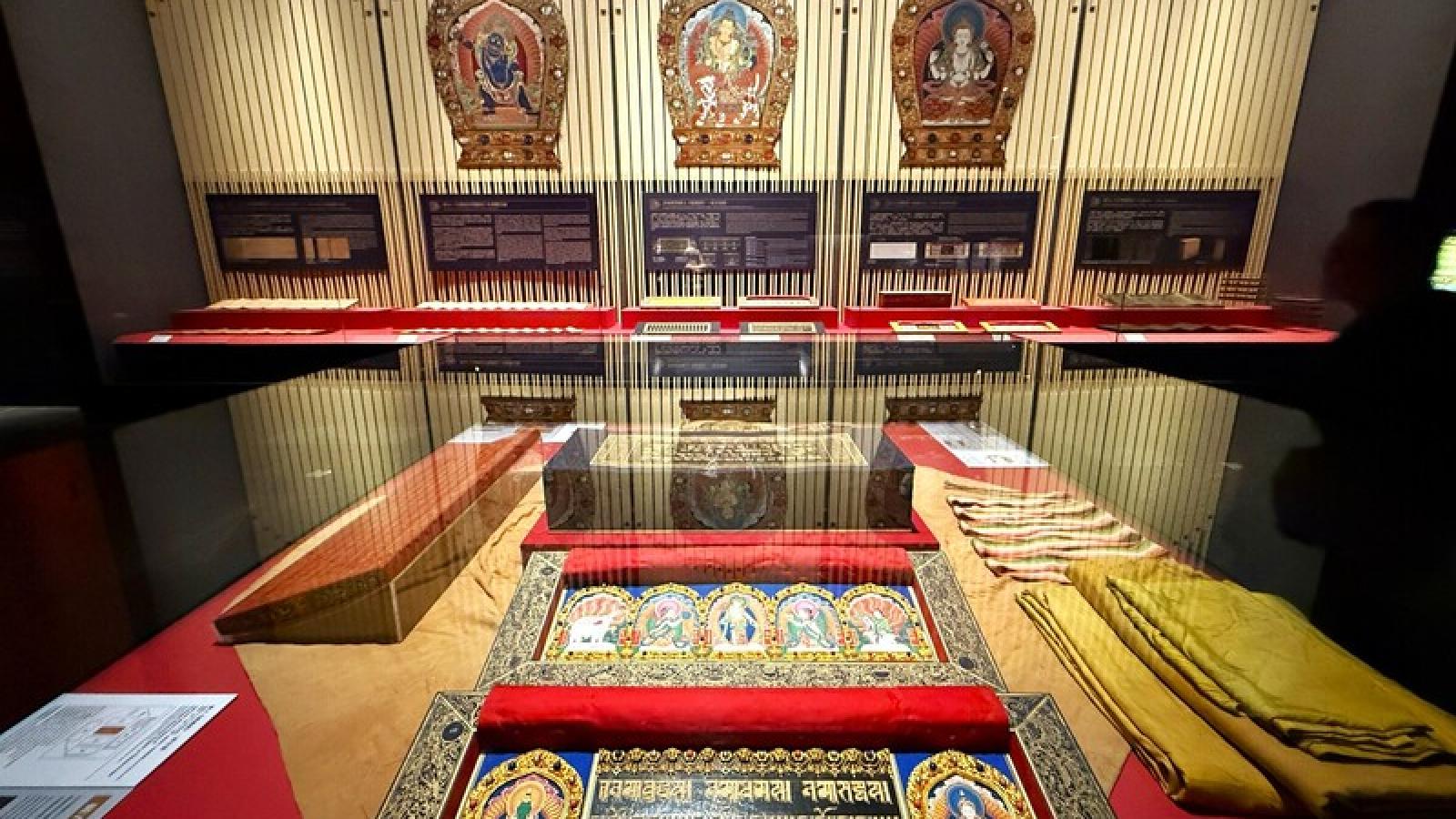
The Palace Museum's treasured 'Dragon Tripitaka' has gone viral, with legends claiming that merely viewing it grants 'seven lifetimes of blessings.' Former President Chen Shui-bian even specially visited to 'read' the scripture before leaving office. Senior media figure Ma Xiping revealed to Storm Media that Chen was advised by a spiritual mentor to seek blessings through the 'Dragon Tripitaka,' but he got it wrong. The scripture that truly protected Emperor Kangxi was the 'Collected Mantras of Various Sutras,' which is also on display at the Palace Museum. The museum deliberately avoids highlighting this, allowing visitors to discover it themselves—an impressively subtle move.
Ma Xiping explained that the 'Dragon Tripitaka' protects the empire, while the 'Collected Mantras of Various Sutras' protected Emperor Kangxi personally. The 'Dragon Tripitaka' was meant for emperors; ordinary people gain little from viewing it. Chen Shui-bian looking at it was harmless, but the public should not miss the 'Collected Mantras of Various Sutras' if seeking personal protection.
What are the 'Dragon Tripitaka' and 'Collected Mantras of Various Sutras'? The 'Dragon Tripitaka,' officially titled 'Imperial Gold-Script Tibetan Kangyur,' is one of the Palace Museum's largest and most luxurious artifacts. Comprising 108 volumes, the text is written in gold pigment using over 5,000 taels of gold, adorned with thousands of pearls, coral, and turquoise. 'Kangyur' means 'translated words of the Buddha' in Tibetan, containing the teachings of the Buddha. Commissioned by Empress Dowager Xiaozhuang in the 6th year of Kangxi (1667) and completed in 1669, it remains vivid despite being over 350 years old.
The 'Collected Mantras of Various Sutras' compiles protective, obstacle-removing, and fortune-enhancing mantras from Mahayana scriptures. The volume is wrapped in three layers of cloth, with colorful Eight Auspicious Symbols painted on both sides. The upper inner cover features an image of Emperor Kangxi as an offering figure, presenting a mandala tray and khata to the Buddha, identifiable by his attire and crown.
The Palace Museum's North Branch 'Dragon Tripitaka' special exhibition is now in its second phase, running from August 8 to November 8, with the 'Collected Mantras of Various Sutras' also on display. The museum has placed the latter beside the 'Dragon Tripitaka' but intentionally avoids explaining its significance, letting visitors uncover it themselves.
Regarding the 'seven lifetimes of blessings' claim, Ma Xiping noted that it wasn't an official Qing Dynasty doctrine but emerged from people reporting unusual sensations after approaching the scripture. The 'Dragon Tripitaka' itself is a massive 'mandala'—a sacred structure in Tibetan Buddhism symbolizing the universe. The museum's website acknowledges it as a strictly constructed mandala system based on esoteric rituals.
Many people report spiritual sensations when near the 'Dragon Tripitaka,' including museum staff. After being stored in the damp Bei Gou for 15 years, only one of the 108 volumes showed moisture damage when cleaned. Opening the sealed volumes after 15 years triggered unusual feelings in those present. The reason for the sandalwood scent and spiritual reactions will be revealed after the Lunar July.
Why the sudden attention? Previously displayed with little interest at the Southern Branch, the 'Dragon Tripitaka' is now drawing crowds. It has only been fully exhibited twice at the North Branch—once for the ROC centennial and now. The Southern Branch showed just one volume; this time, more content is available. Media coverage of the 'seven lifetimes of blessings' myth has also driven public interest.
Chen Shui-bian visited on February 9, 2008, during a political low point amid the Red Shirts Movement and corruption scandals. Contrary to media reports of a 3 PM visit, he arrived at 9:09 PM, after closing. Accompanied by only three aides, he was guided by then-Deputy Director Feng Mingzhu, then head of the Painting and Calligraphy Division. Chen personally flipped through one volume, advised by a spiritual guide that viewing the 'Dragon Tripitaka' would bring blessings, believing it protected Kangxi.
But Ma Xiping insists Chen viewed the wrong scripture. The 'Dragon Tripitaka' protected the empire—Kangxi's 61-year reign, the longest in Chinese history. The 'Collected Mantras of Various Sutras' was Kangxi's personal 'Diamond Armor.' 'Chen lives diagonally across from me. He should've asked me—I'd have told him to see the 'Collected Mantras' instead,' Ma said.
Empress Dowager Xiaozhuang ordered both scriptures in Kangxi's 14th year, when he began personal rule. The 'Collected Mantras' was completed first, followed by the 'Dragon Tripitaka,' both finished the same year. But the 'Dragon Tripitaka' received more attention, so the initial 'Collected Mantras' was modest. At age 20, Kangxi received a newly crafted, superior version—the one now on display.
'For personal protection, people should see the 'Collected Mantras,' not the 'Dragon Tripitaka,' Ma emphasized. Most visitors overlook it, which he finds deeply regrettable.
The 'Collected Mantras' contains 178 mantras, not traditional scripture. The museum's decision to display it beside the 'Dragon Tripitaka' without explanation is brilliant yet subtle.
The cover depicts Kangxi kneeling before the Buddha, an unprecedented image in Buddhist texts. This holds three meanings: first, no emperor had ever been depicted offering to the Buddha—this was Kangxi's personal protector, hence the tribute; second, it's the earliest authentic portrait of Kangxi; third, it confirms the scripture's role in protecting him.
Kangxi ruled for 61 years—the longest in Chinese history. Qianlong dared not surpass him, stepping down after 60 years and serving three more as Retired Emperor. Otherwise, he would have ruled 63 years.
In conclusion, the 'Dragon Tripitaka' protects emperors and empires, not ordinary people. Chen Shui-bian viewing it was harmless, but those seeking personal blessings should focus on the 'Collected Mantras of Various Sutras.'
FACT BOX
- Source: PR Times
- Category: Event