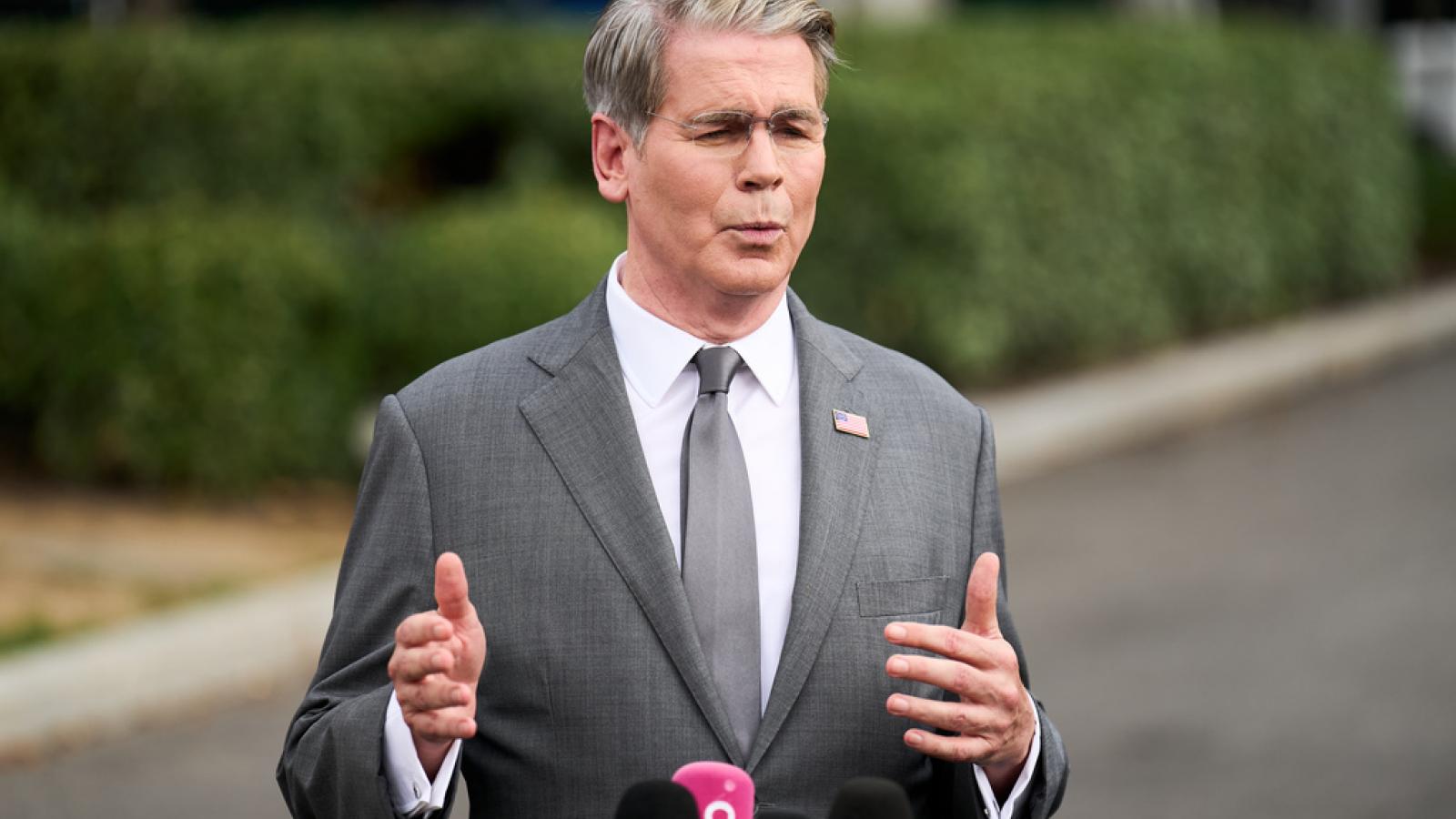
US Treasury Secretary Scott Bessent attended this week's G20 summit, aiming not only to reduce global trade imbalances, promote economic growth, and strengthen sanctions against Iran, but also to alleviate concerns over the rising US debt and increasing Treasury yields.
According to Reuters, Bessent, who skipped last year's Group of 20 (G20) summit in South Africa, is now attempting to reshape the G20's core mission under US leadership to advance the Trump administration's policy agenda.
Diplomatic Challenges
However, the meeting comes amid uncertainty over the Trump administration's next tariff moves, a stalemate in the trade war between the US and Canada, and rising energy and commodity prices due to the ongoing conflict with Iran, further complicating the situation.
The Iran conflict continues, with the Strait of Hormuz remaining closed, dragging down growth across nearly all G20 economies. Bessent warned that countries continuing to purchase Iranian oil or assist Iran in trading with other nations could face secondary US sanctions. The US Treasury recently imposed restrictions on a bank in Egypt, a G20 member, for conducting business with Iran through its branch in the United Arab Emirates.
Josh Lipsky, international economic expert at the Washington-based think tank Atlantic Council, said: "Bessent wants to place the Iran issue at the center, discussing tighter sanctions on Iran, but other G20 members may want to discuss other topics. They want to talk about tariffs."
Bessent Urges G20 to Jointly Pressure China
To address US trade imbalances, the Trump administration has primarily relied on imposing high tariffs to reduce the trade deficit. US Treasury officials say global trade imbalances stem from government economic policies that distort markets and hinder fair competition. European officials have expressed interest in discussing the impact of China's massive exports on European industries.
Due to persistently weak domestic demand, China continues to expand exports of electric vehicles, semiconductors, and other goods, with July's total exports rising 23.9% year-on-year. Amid high US tariffs and a complete ban on Chinese car imports, Chinese goods are flooding into Europe, fueling growing calls within the EU to impose stricter limits on Chinese imports.
However, China has shown little response to demands to reduce industrial subsidies and shift its economy from export reliance to domestic consumption-driven growth. Meanwhile, economists argue that the US should also significantly cut its fiscal deficit to reduce demand for imported goods.
Bessent stated today that he will urge G20 members to reassess trade terms with China as part of efforts to reduce global imbalances and pressure Beijing to shift its economy from exports to greater domestic consumption.
Bessent said other countries must find ways to incentivize Beijing to reduce its reliance on exports and strengthen its long-weak domestic demand.
US Debt Trends Unsettle Markets
The total amount of US government debt outstanding surpassed $40 trillion for the first time on August 19, setting a new historical high. Markets are increasingly uneasy about the trajectory of US debt. The yield on 30-year US Treasury bonds rose this month to a 19-year high. Bessent subsequently announced that the size of long-term Treasury buybacks would be doubled to $4 billion per operation, causing yields to briefly retreat.
This move drew criticism from prominent hedge fund manager Stanley Druckenmiller, and central bank officials also worry that the Treasury may further intervene in the massive US bond market.
Bessent's market intervention strategy also involves currency markets, including a joint US-Japan market intervention on August 1 to support the yen, and a planned purchase of Argentine pesos in October 2025 to help Argentina curb peso selling pressure and stabilize markets.
US Hopes G20 Returns to Core Mission
Mark Sobel, a former US Treasury official, said G20 finance ministers will not simply accept soothing statements from the US. He pointed out that the Trump administration's Iran policy is negatively impacting the economies of many G20 countries, which do not support the war, and no amount of US diplomacy can change this reality.
The US hopes to promote global economic growth by reducing regulation, increasing energy production, and encouraging private-sector innovation, and to bring the G20 back to its original core mission of focusing on global economic issues. The G20 was elevated to a leaders-level forum during the 2008 global financial crisis. Its most recent major collective action was during the 2020 pandemic, when members agreed to inject $5 trillion to revive the global economy.
FACT BOX
- Source: PR Times
- Category: News