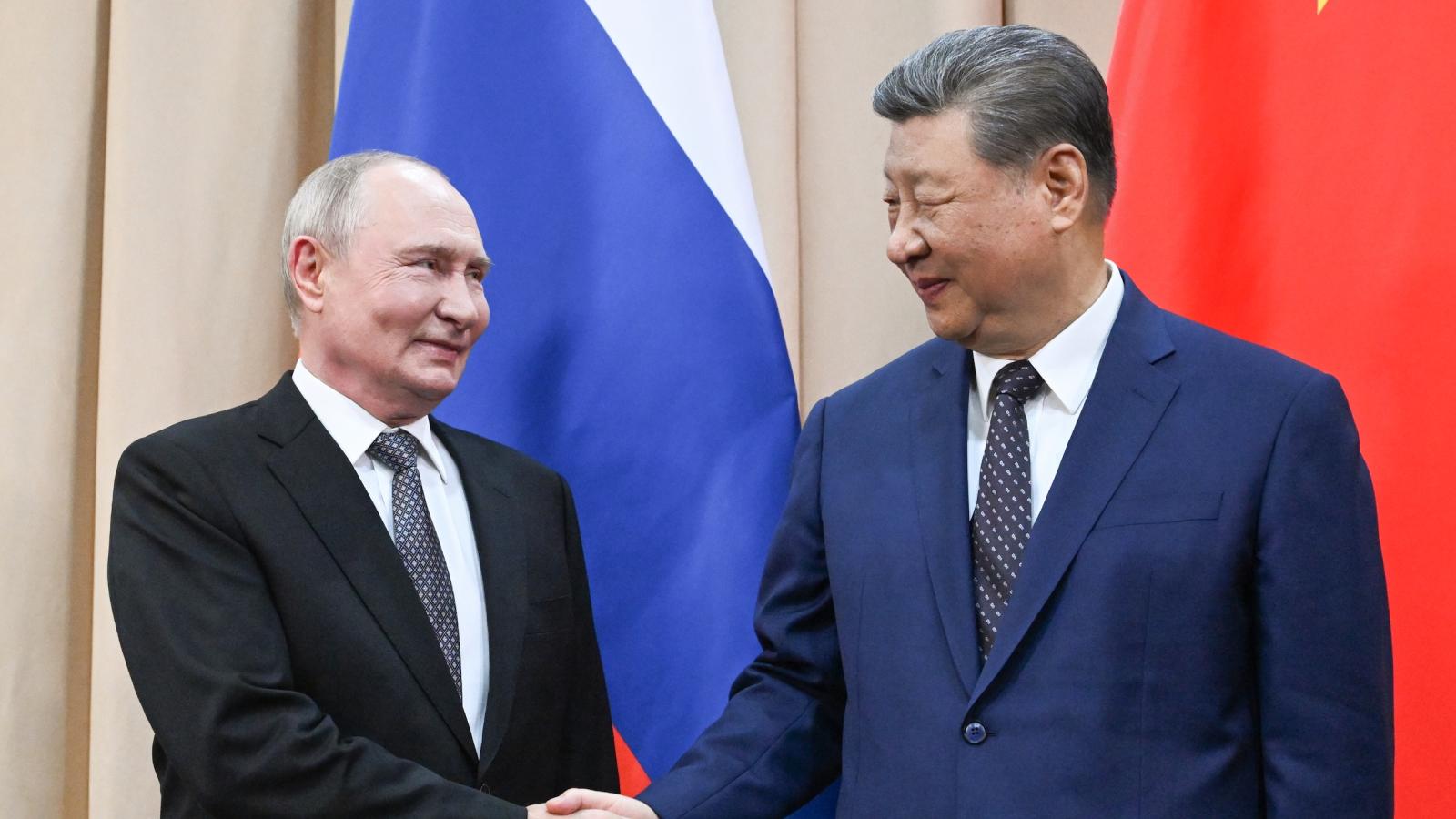
Leaders from China, Russia, India, and other countries convened in Kyrgyzstan for the Shanghai Cooperation Organization (SCO) summit, an organization promoted as a counterweight to U.S. global influence. Ahead of the summit, Chinese President Xi Jinping and Russian President Vladimir Putin held a sideline meeting, reaffirming the stability of Sino-Russian friendship and emphasizing the importance of the SCO.
On Monday (August 31), Chinese President Xi Jinping met with Russian President Vladimir Putin in Bishkek, the capital of Kyrgyzstan. This was the second "Xi-Putin summit" of the year, held on the sidelines of the Shanghai Cooperation Organization (SCO) summit. The two leaders last met in May, when Putin visited Beijing shortly after U.S. President Trump.
According to China's state-run Xinhua News Agency, Xi Jinping stated that cooperation between China and Russia has "achieved many results" since their last meeting, expressing confidence that the foundation for future bilateral relations will become "even more solid." He noted that "uncertain and unpredictable factors in the international situation have clearly increased," and that the SCO "shoulders the important mission of maintaining regional stability and promoting regional development." China and Russia will jointly advance "the forces for an equal and orderly multipolar world."
According to a Kremlin press release, Putin addressed Xi as "dear friend" and began his remarks by expressing condolences to the families of victims of a deadly flood disaster last week along the Tibet border. He also emphasized the solid friendship between Russia and China and highlighted progress in bilateral cooperation across various fields, including China's trial implementation of a 30-day visa-free policy for Russian citizens one year ago. Putin expressed hope that this trial policy would be expanded into a permanent one.
Dmitry Peskov, Kremlin spokesperson, stated that the leaders' meeting primarily focused on bilateral relations, particularly economic and trade issues, with the Ukraine issue occupying only a small part of the discussion.
The summit takes place as the Russia-Ukraine war enters its fourth and a half year, and tensions between the U.S. and Iran have flared for six months. China continues to maintain trade relations with both Russia and Iran, drawing criticism from Western democracies.
As a regional organization aimed at countering Western influence, the SCO is celebrating its 25th anniversary. Its members include Russia, China, India, Pakistan, Iran, four Central Asian nations (Kazakhstan, Kyrgyzstan, Tajikistan, and Uzbekistan), and Belarus, a Russian ally.
Xi Jinping arrived in Bishkek last Sunday, stating that Sino-Kyrgyz relations are in a "golden era." Kyrgyzstan has traditionally been within Russia's sphere of influence.
Xi and Putin have previously used SCO summits to promote their vision of a multipolar world and demonstrate a united front against the West. Last week, China's Foreign Ministry stated that the organization has successfully "explored new paths for regional cooperation." Beijing has been pushing the concept of a new world order with Russian support.
In addition to Putin and Xi, Iranian President Pezeshkian, Indian Prime Minister Modi, and Pakistani Prime Minister Sharif attended the SCO summit. Turkish President Erdogan also attended, despite Turkey not being a formal member of the organization.
Russia and Iran, two of the most heavily sanctioned countries in the world, have significantly deepened their military and economic ties since Moscow's invasion of Ukraine.
U.S. President Trump has warned Moscow and Beijing against providing weapons to Iran.
A few days ago, U.S. Central Intelligence Agency (CIA) Director John Ratcliffe made a rare visit to Moscow. U.S. media speculated that he may have discussed Ukraine and Iran issues with his Russian counterparts.
Historically focused on economic issues, the SCO has seen its influence and activities grow in recent years under the leadership of Moscow and Beijing. In addition to its 10 member states, the organization currently has 15 "dialogue partners," including Turkey, Saudi Arabia, and Qatar.
It also has two observer states: Afghanistan and Mongolia.
The SCO's founding declaration states that the organization "is not an alliance directed against other countries."
However, Putin and Xi have repeatedly delivered anti-Western rhetoric at past summits. At last year's summit, Putin blamed Western countries for instigating the Ukraine war, while Xi condemned "coercive practices," referring to tensions between the U.S. and China.
The Bishkek summit occurs as some SCO member states are embroiled in actual conflicts (such as Ukraine and Iran-related conflicts) or trade wars, the latter involving U.S. tariffs on Chinese and Indian goods.
This month, the U.S. imposed secondary sanctions on Iran's trade partners in gold, technology, digital assets, aviation, and maritime sectors, aiming to severely damage Tehran's economy.
Washington has also threatened sanctions against Iran's allies.
As a major importer of Iranian oil, China responded that it will "firmly safeguard" its own interests.
Since the 1979 revolution established an Islamic regime, Iran has been under sanctions and has repeatedly stated it will never yield to economic pressure.
However, Pezeshkian acknowledged the country is facing "economic difficulties."
Iran only joined the organization in 2023.
International relations expert Mohammad Hassan Najmi told AFP that Tehran "believes that becoming a member of these organizations and actively participating in them helps bypass U.S. and European sanctions."
But he noted that the actual benefits are uncertain, as "these organizations rarely help Iran solve its problems during times of crisis."
Although the organization claims to represent about 40% of the world's population and 25% of global GDP, its internal composition is diverse, and member states have their own disagreements.
Russia and China are competing for influence in Central Asia, a resource-rich region and a key hub for Eurasian cargo transport. Meanwhile, Beijing's relations with India and Pakistan are occasionally tense.
DW Chinese has an Instagram! Follow dw.chinese for more in-depth图文 and video reports. © 2026 Deutsche Welle. All rights reserved. Unauthorized use of this content is prohibited and may result in legal and criminal liability.
FACT BOX
- Source: PR Times
- Category: Event