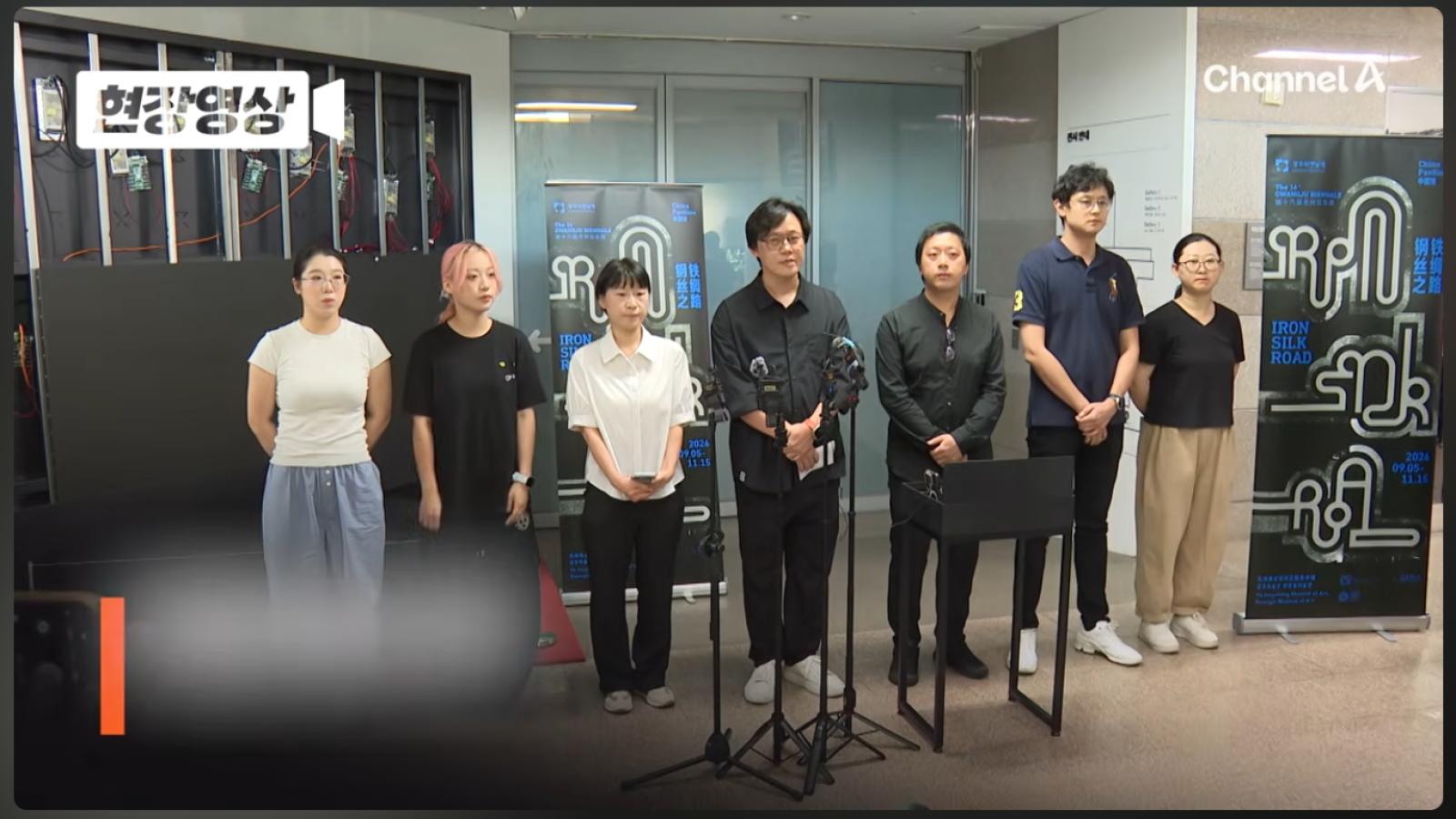
The 2026 Gwangju Biennale (Gwangju Biennale 2026), originally scheduled to officially open on September 5, was thrown into turmoil two days prior when the Chinese participating party announced an unexpected full withdrawal from the exhibition. This decision came in response to their dissatisfaction with the South Korean organizers allowing Taiwan’s delegation to use the name 'Taiwan Pavilion' (Taiwan Pavilion). As a result, all exhibitions and installations at the Ha Jung-woong Art Museum in Gwangju were halted, drawing renewed global attention to how political rivalries continue to intrude upon artistic spaces.
Yuan Yuelai, curator of the Chinese pavilion, held a press conference at the museum, stating that Chinese artists and institutions 'cannot accept' the organizers’ decision and have unanimously chosen to withdraw as their strongest form of protest. Yuan emphasized, 'We highly value the Gwangju Biennale and have invested tremendous effort into preparations. However, the organizers’ use of an incorrect designation regarding Taiwan’s participation has allowed political factors to invade the realm of art.'
The naming controversy stems from the organizers’ shifting stance. This year’s biennale invited 16 countries and 11 professional institutions. Taiwan’s representative, the National Taiwan Museum of Fine Arts (NTMoFA), was initially approved by the organizers to exhibit under the name 'Taiwan Pavilion.' Although Taiwan was invited as an institutional entity rather than a national delegation, it was still permitted to use a national designation.
However, the organizers later unilaterally changed Taiwan’s delegation name to 'NTMoFA Pavilion,' sparking strong protests from Taiwan and demands to revert to the original name. This renaming was also criticized by local art groups, who accused the organizers of self-censorship. Under public pressure, the Gwangju Biennale Foundation relented on August 25 and reinstated the 'Taiwan Pavilion' name. Yet this decision triggered backlash from the Chinese delegation, which immediately suspended preparations and began exerting diplomatic pressure upon learning of the name’s restoration.
The Chinese Embassy in South Korea issued a statement supporting its delegation’s withdrawal, asserting that allowing the use of 'Taiwan Pavilion' violates South Korea’s commitment to the 'One China' principle. The embassy and the Consulate General in Gwangju had previously communicated multiple times with the Gwangju Metropolitan Government and the Gwangju Biennale Foundation regarding the issue but claimed they did not receive 'proper handling.'
Chinese Ambassador to South Korea Dai Bing personally met with officials from South Korea’s Ministry of Foreign Affairs to protest the naming decision. Seoul expressed regret over the diplomatic intervention but clearly rejected Beijing’s interference, emphasizing that the Gwangju Biennale is an independent event led by a civilian foundation.
FACT BOX
- Source: PR Times
- Category: News