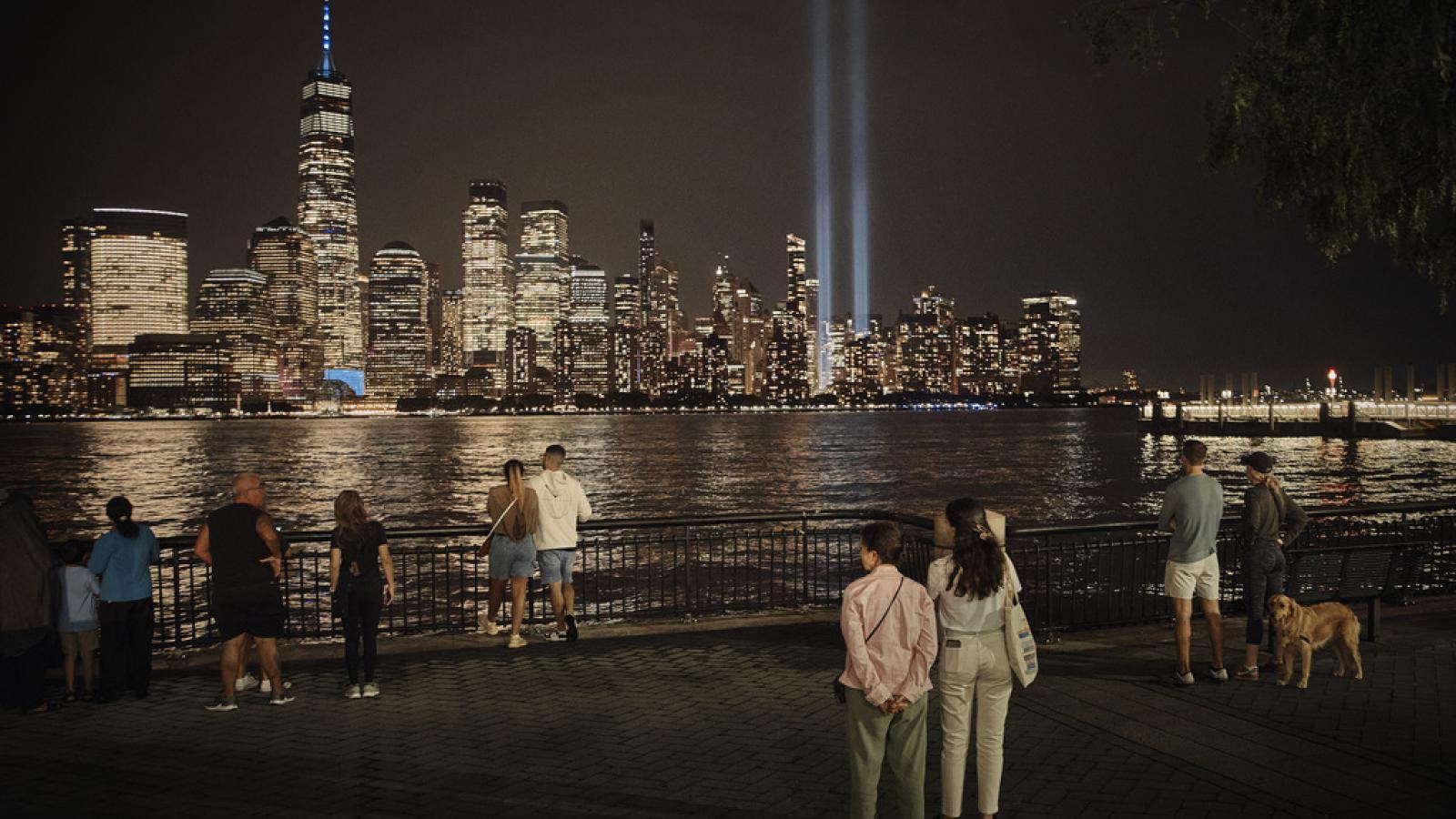
The United States will hold a series of events on Thursday, September 11, to mark the 25th anniversary of the 9/11 attacks. On September 11, 2001, suicide attackers hijacked U.S. passenger planes and crashed them into two skyscrapers in New York, killing thousands. The event had profound global impacts.
Which buildings were targeted?
Four aircraft flying over the eastern United States were simultaneously hijacked by small teams. The planes were then used as giant guided missiles, crashing into landmark buildings in New York and Washington.
Two planes struck the Twin Towers of the World Trade Center (WTC) in New York. The second impact occurred 17 minutes after the first. The buildings were engulfed in fire, trapping people on upper floors, and the city was shrouded in thick smoke. Within less than two hours, both 110-story towers collapsed in a massive cloud of dust.
The third plane hit the western outer wall of the Pentagon, the U.S. military headquarters located near Washington, D.C.
The fourth plane crashed into a field in Pennsylvania after passengers fought back. It is believed the hijackers had intended to target the U.S. Capitol in Washington.
How many people died in the 9/11 attacks?
A total of 2,977 people were killed (excluding the 19 hijackers), with the majority in New York:
- All 246 passengers and crew aboard the four planes died - 2,606 people died at the WTC Twin Towers, including those killed instantly and those who later died from injuries - 125 people died at the Pentagon
The youngest victim was two-year-old Christine Lee Hanson; the oldest was 82-year-old Robert Norton. Both were passengers on the planes.
At the time of the first impact, an estimated 17,400 people were inside the Twin Towers. No one above the impact zone in the North Tower survived, but 18 people above the impact zone in the South Tower managed to escape.
Victims came from 77 different countries. In New York City, 441 first responders died.
Thousands were injured or later developed illnesses related to the attacks, including firefighters who worked in the toxic debris.
Who were the 9/11 attackers?
An Islamist extremist network called al-Qaeda, operating from Afghanistan, planned the attacks. Under the leadership of Osama Bin Laden, al-Qaeda blamed the U.S. and its allies for conflicts in the Muslim world.
Khalid Sheikh Mohammed is believed to have masterminded the entire plot and assisted in recruiting pilots, some of whom trained in the U.S.
Nineteen individuals carried out the hijackings, divided into three five-member teams and one four-member team (responsible for the plane that crashed in Pennsylvania).
Fifteen of the hijackers were from Saudi Arabia, like Bin Laden; two were from the United Arab Emirates (UAE), one from Egypt, and one from Lebanon.
How did the U.S. respond to 9/11?
Less than a month after the attacks, then-U.S. President George W. Bush, with international allies, launched a military invasion of Afghanistan to dismantle al-Qaeda and capture Bin Laden.
However, U.S. forces did not locate and kill Bin Laden until 2011, in neighboring Pakistan.
Khalid Sheikh Mohammed had already been captured in Pakistan in 2003.
Al-Qaeda still exists today, with its strongest presence in Sub-Saharan Africa, though members remain active in Afghanistan.
U.S. forces withdrew from Afghanistan in 2022 after nearly 20 years, raising concerns that the extremist network could regain strength.
Who is Khalid Sheikh Mohammed, and what happened to him?
Born in Kuwait, Khalid Sheikh Mohammed studied engineering in the U.S. and later fought in Afghanistan in the 1980s.
Before 9/11, he was already wanted by the FBI for involvement in other bombings and attempted attacks.
After his 2003 capture, Mohammed was held for three years in secret CIA prisons, subjected to harsh interrogation techniques, then transferred to the U.S. naval base at Guantanamo Bay, Cuba, where he remains detained.
Due to concerns that his treatment during U.S. custody may undermine the evidentiary basis for prosecution, a military tribunal at the base has spent over a decade debating whether and how to try him for his role in 9/11.
In January 2025, he and two other defendants—Walid Muhammad Salih Mubarak Bin Attash and Mustafa Ahmed Adam al-Hawsawi—were scheduled to plead guilty to involvement in the attacks. In exchange, they would avoid the death penalty and receive life sentences without parole.
However, the day before the hearing, the U.S. Court of Appeals for the District of Columbia Circuit, at the government’s request, paused the proceedings to review a motion to withdraw the plea agreement. The government argued the deal would cause “irreparable” harm.
What legacy did 9/11 leave?
In the years following 9/11, global aviation security measures were significantly strengthened. In the U.S., the Transportation Security Administration (TSA) was created to enhance airport and aviation security.
Clearing Ground Zero—the site of the Twin Towers’ collapse—took over eight months. Today, a memorial and museum stand on the site, and new buildings have been constructed with different designs.
The centerpiece building, One World Trade Center, standing at 1,776 feet (541 meters), also known as the Freedom Tower, is taller than the original North Tower it replaced, which was 1,368 feet (417 meters) high.
Reconstruction of the Pentagon was completed in less than a year, and by August 2002, staff had returned to their offices.
We used artificial intelligence to assist in translating this article. The original was in English. BBC journalists reviewed the translation before publication. Click here to learn how we use AI.
FACT BOX
- Source: PR Times
- Category: News