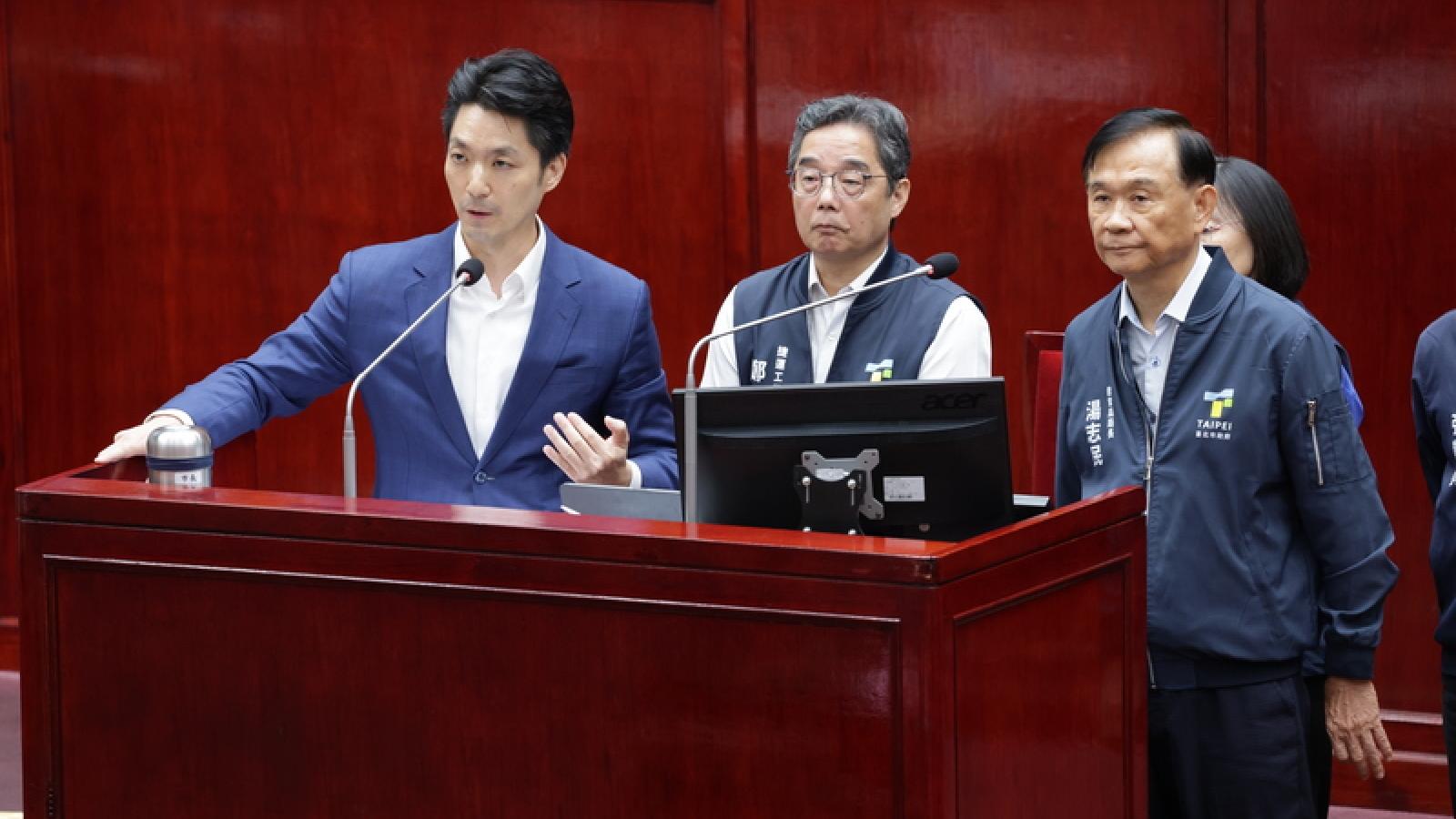
Chiang Te-li, the eldest son of KMT Taipei Mayor Chiang Wan-an, was accepted into the Taipei City Government's 'Exchange Student Program,' gaining the opportunity to study in the United States. However, the Green camp has portrayed this as a series of 'heinous crimes,' even politicizing Chiang Te-li's enrollment at the Affiliated Senior High School of National Taiwan Normal University, turning it into a media spectacle. This reflects a disturbing level of online and societal bullying.
Similarly, Wei Ching-lun, the daughter of Wei Ping-cheng—a relatively low-profile KMT candidate for Changhua County magistrate who may not even win—faced online backlash after posting a self-made 'unboxing' video mentioning, 'Dad said if I get 10,000 comments, he'll take me to every Disney park worldwide.' The response was absurdly disproportionate, with some comments escalating to online sexual harassment and appearance-based discrimination. Wei Ping-cheng has announced plans to file a lawsuit, a move the author strongly supports.
Taiwan's online environment has become a breeding ground for bullying. According to a report by U.S. market research firm Resourcera, Taiwan has approximately 94.86 million Threads accounts, despite a population of only 23 million—averaging four accounts per person. While Taiwan's Fact-Checking Center argues this calculation is flawed, it fails to explain why no other country exhibits such a phenomenon.
In the same survey, the U.S. had 66.83 million accounts, Japan 31.64 million, and India 32.99 million. Taiwan's significantly higher activity suggests the presence of numerous fake accounts, PR operations, cyber armies, AI bots, or other non-human entities, distorting what appears to be public opinion.
On the 10th, Wei Ping-cheng, the KMT's Changhua County magistrate candidate, stated that online comments had degraded into personal and physical humiliation, particularly involving sexual harassment, and had filed a police report. CNA
Having studied and worked abroad, including in foreign companies, the author notes that a closer look at mainstream international media or political figures' social media reveals no equivalent to Taiwan's or the Chinese-language internet's endless insults, relentless bullying, or comments that clearly resemble cyber-army activity. This chaos in the Chinese-language online sphere is a unique social ugliness in Taiwan.
A key factor is Taiwan's lack of an anti-discrimination law. As a result, many still wrongly equate discrimination based on gender, age, race, nationality, or origin with 'freedom of speech'—a farcical misunderstanding. This shows how Taiwan's 'quasi-democracy' still lags far behind advanced nations.
While Western media like Fox News, BBC, and CNN also face intense political polarization, personal attacks, and offensive language on platforms like X (Twitter) and Instagram, governments worldwide are moving toward anti-cyberbullying legislation, such as the EU's Digital Services Act.
Take Australia, where the author studied and worked: the country passed the 'Racial Discrimination Act' in 1975, banning discrimination based on race, ethnicity, or nationality. Awareness and enforcement are deeply embedded in society. Broadly speaking, the level of acceptance correlates directly with age, years of education, and educational attainment.
March 27, 2026—Vice Premier Cheng Li-chun appeared visibly downcast upon entering the legislature when asked about allegations that Yen Hui-hsin, former Deputy Chief Negotiator of the Office of Trade Negotiations, had suffered bullying before her death. (Photo by Chen Pin-yu)
When Public Discourse Turns into Bullying
Although Chiang Te-li is Chiang Wan-an's son, the Green camp and its supporters seem to forget he is still a minor protected by law. When political parties, government bodies, supporters, and propaganda machines launch disproportionate attacks on a minor student, how should his rights be protected? This is a question the Green camp refuses to address.
Yet, under 10 years of DPP rule, bullying has spread beyond the internet and beyond targeting only KMT figures and their families. It permeates every corner of society and is worsening. For example, senior officials in the Ministry of Foreign Affairs have repeatedly been accused of bullying. A recent case involves Li Kuan-teh, Director of the Taipei Representative Office in Geneva, who was jointly accused by all staff of 15 misconducts, including a 15-page complaint and 134 pages of evidence, covering workplace bullying, inappropriate speech, and misuse of public funds. Reports indicate the Ministry has ordered him back to Taiwan for investigation.
Earlier, high-profile cases reported in the media include allegations against Representative to the U.S. Yu Ta-wei and his spouse for misuse of public funds and bullying; former Director of the Taipei Economic and Cultural Office in São Paulo, Feng Kuang-chung, suspected of bullying组长 Wang Chih-hua; and Director of the TECO in Boston, Liao Chao-hung, accused of long-term bullying of subordinates—each case more unbelievable than the last. It also raises public curiosity: does the Ministry have specific anti-bullying regulations or reform measures for overseas offices? Without them, such cases will continue to multiply.
Other departments shouldn't celebrate prematurely. Besides the widely remembered case of a male labor ministry official, the military and other agencies remain frequent targets of complaints. Last week, the online influencer 'History Bro' (Li Yi-hsiu) cited a netizen's complaint about a major-level officer still suffering bullying from superiors, leading to mental health issues, with internal reporting channels nearly ineffective.
Foreign Minister Lin Chia-lung (pictured) responded on the 19th before attending the Legislative Yuan's Foreign Affairs and National Defense Committee, addressing allegations of misuse of public funds and bullying involving Li Kuan-teh, Director of the Taipei Representative Office in Geneva. CNA
Do You Remember the 'Yen Hui-hsin Case'?
Comparing these cases reveals a clear pattern: under prolonged DPP rule, many public agency supervisors have become local 'tyrants,' enabled or even complicit with higher-ups, subjecting subordinates to immense psychological and physical stress, and eroding the system's ability to improve and progress.
If we haven't completely forgotten, Vice Minister-level Deputy Chief Negotiator Yen Hui-hsin of the Office of Trade Negotiations resigned due to illness and later reports emerged of workplace ostracism. The Executive Yuan launched an investigation and acknowledged that Chief Negotiator Yang Chen-ning was responsible for two cases of 'workplace bullying.' Yang, however, dismissed the report as based on 'one-sided claims' from a few individuals—a baffling response.
The reason the 'Yen Hui-hsin case' drew attention is that despite her father, Yen Ching-chang, having served as Minister of Finance and Taiwan's first permanent representative to the WTO, and both father and daughter being educated abroad and trained in law, they still couldn't prevent this tragedy. This reveals the depth of systemic decay.
Domestic media citing data from the Public Functionaries Protection and Training Commission found that workplace bullying complaints last year were ten times higher than five years ago—rising from 12 cases in 2020 to 132 in 2025—indicating that the longer the DPP remains in power, the more workplace bullying cases emerge in public agencies. When compared with the treatment of families of KMT politicians like Chiang Wan-an, it's clear that, intentionally or not, public agencies under Green rule have become a massive 'bullying conglomerate.'
Thus, Yen Ching-chang stated in a public message that turning his daughter's unfulfilled mission into 'national systems' is the way to deliver justice to her—a view the author fully supports. This 'small step' requires the cooperation of all citizens.
Yen Hui-hsin's resignation letter. (From Facebook)
Starting with Stopping Bullying of Minors
Visiting major online forums like 'Kao Pei Chang Kuan' reveals countless workplace issues. Many whistleblowers provide specific details—names, events, times, locations, and evidence. Recently, one post mentioned that the author's friend, a section chief at the Ministry of Foreign Affairs, was recognized as a 'public interest whistleblower witness,' yet the 'price of brave whistleblowing was prolonged workplace bullying'—highlighting the severity.
Returning to the beginning of this article, the author discusses the long-avoided 'Chiang Te-li Exchange Student Case,' witnessing intellectuals, propaganda systems, and political circles launching disproportionate attacks on a minor—a situation absolutely unacceptable in Western countries. For example, Australia has legal regulations on youth social media use, precisely for this reason. The case of Chiang Wan-an and his son has led the author to further reflect: if such an incident occurred in Australia, the U.S., Canada, the UK, Japan, or other advanced nations, how would it be handled?
First, consider the Taipei City Education Bureau's response: the bureau clarified that the exchange program's selection criteria have remained unchanged for 15 years and were not suddenly modified or relaxed this year. Thus, the Green camp's attacks based on 'privilege' have already lost their ground.
FACT BOX
- Source: PR Times
- Category: News