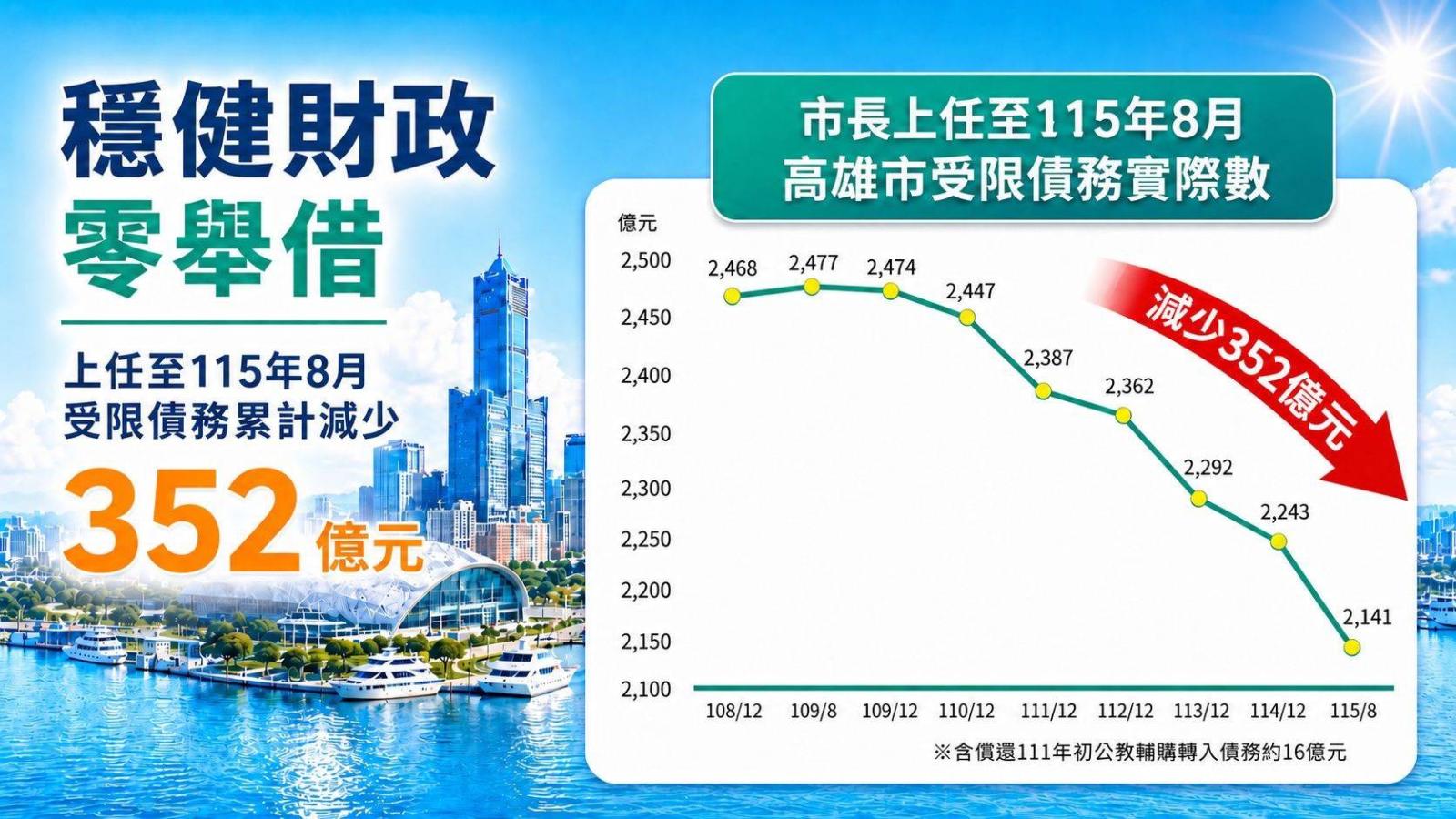
Today (14th), Kaohsiung City councilors conflated 'self-liquidating debt' with 'general restricted debt.' In response, Kaohsiung City Government spokesperson Fu Wei-ling stated that since Mayor Chen Chi-mai assumed office, the city's cumulative public debt has decreased by NT$35.2 billion, and per capita debt has dropped by NT$103,000. Regarding self-liquidating debt, all six special municipalities have seen increases due to major infrastructure projects. Taoyuan City recorded the largest increase at NT$9.2 billion, followed by New Taipei City with NT$8.03 billion, while Kaohsiung increased by NT$5.52 billion. These debts are supported by specific future revenue sources such as farebox income, land development proceeds, tax increment revenue, and floor area ratio transfer income. Deliberately confusing different types of debt constitutes inappropriate political manipulation.
Fu Wei-ling pointed out that under Mayor Chen Chi-mai's leadership, proactive measures to increase revenue and reduce expenditures, along with advancing major infrastructure projects, have led to a cumulative reduction of NT$35.2 billion in Kaohsiung's public debt, demonstrating clear achievements in fiscal management. Self-liquidating debt is primarily used to pre-finance major projects such as rail systems, with repayment secured through future revenues generated after project completion—including ticket sales, land development gains, increased tax receipts, and floor area ratio transfer income—making it fundamentally different from general restricted debt.
Fu emphasized that all six special municipalities have generally increased their self-liquidating debt levels in recent years as they advance major developments. Kaohsiung is not ignoring fiscal risks but rather proceeding with construction within controllable fiscal parameters and with identifiable revenue sources. Particularly, Kaohsiung is currently advancing four metro lines simultaneously, which will connect the S-corridor and gradually form a comprehensive rail network.
Finance Bureau Director Lee Chiong-huei further clarified that self-liquidating debt and general restricted debt differ entirely in nature. When local governments undertake major public works like rail construction, they can use self-liquidating financing during the construction phase to accelerate progress. After completion, these debts are repaid through farebox revenue, land development returns, tax increment revenue, and floor area ratio transfer income. The key principle is that such projects must have inherent future revenue sources and repayment capacity.
Director Lee noted that once the four metro lines are completed and integrated into a full network, they are projected to generate approximately NT$130 billion in farebox revenue. Additionally, to strengthen funding for rail projects, the city has proactively promoted joint development initiatives, with cumulative estimated returns reaching NT$92 billion. These revenues will serve as crucial financial resources for future construction and debt repayment.
She added that beyond joint development, the land readjustment project at the 205 Arsenal site is expected to yield future benefits of up to NT$80 billion. The city government is actively injecting funds into construction projects through land development and joint development mechanisms, rather than relying solely on borrowing.
She stressed that in recent years, the Kaohsiung City Government has continuously promoted investment attraction, public-private partnerships (PPPs), and fiscal efficiency measures, resulting in self-generated revenue exceeding NT$100 billion. For major construction needs, the city prioritizes PPPs, joint development, and integration of private capital to reduce public fiscal burdens while accelerating project timelines and ensuring on-time delivery.
Finally, Fu Wei-ling reiterated that urban development requires long-term investment but must also uphold fiscal discipline. While Kaohsiung continues to reduce general public debt and lower per capita liabilities, it simultaneously advances major projects like metro expansions through self-liquidating plans backed by revenue sources. These are fundamentally distinct concepts. She urged councilors to engage in rational discussions based on data and debt characteristics, rather than deliberately confusing self-liquidating debt with general restricted debt or distorting normal construction financing operations as fiscal mismanagement for political gain.
FACT BOX
- Source: PR Times
- Category: News