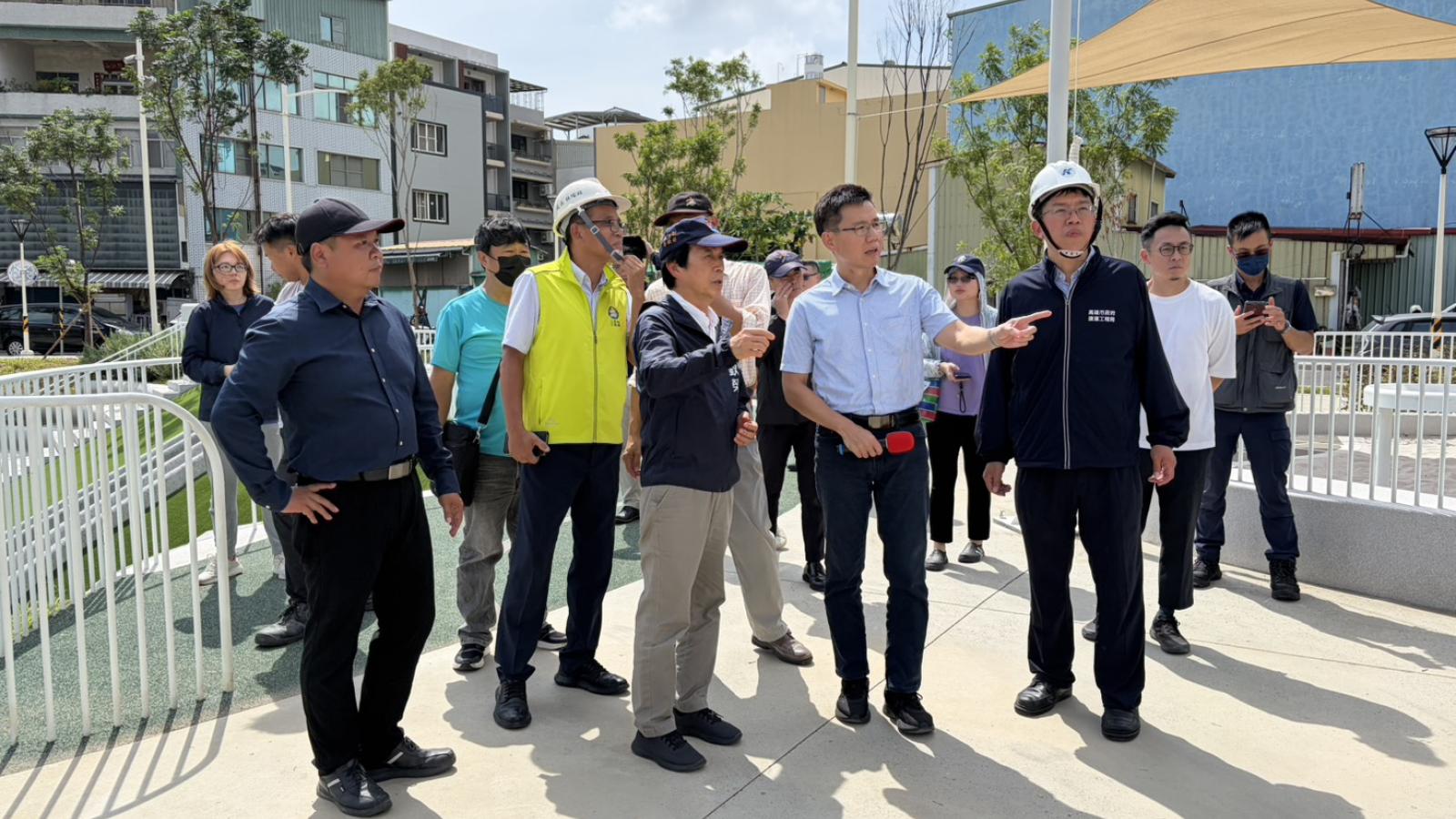
A new chapter has been added to urban development around O9 Station on Kaohsiung’s MRT Orange Line. The Kaohsiung City Government has advanced the O9 Park development project, with Deputy Mayor Lin Chin-jung inspecting the construction results today (14). In coordination with the O9 Joint Development Project and the overall plan for Lingya Sports Park’s 'Kaohsiung Highline Park,' the integration of MRT-linked development, public spaces, and sports facilities will gradually shape a new urban lifestyle zone at O9 Station, connecting diverse functions such as commerce, housing, sports, and leisure.
The 0.57-hectare park is now complete, with a detention capacity of 5,633 cubic meters, creating a public space that combines recreation and flood resilience.
Deputy Mayor Lin emphasized that the O9 Station area is a key urban node linking Lingya and Sanmin districts. Through comprehensive planning of MRT joint development, sports parks, and public spaces, the city government is progressively enhancing local living functions and urban environments, ensuring that transportation, sports, and leisure are seamlessly integrated into citizens’ daily lives—maximizing the urban development benefits driven by MRT infrastructure.
He noted that the O9 Detention Park construction has been completed and will not only provide citizens with space for rest, play, and exercise but will also connect with surrounding sports venues and green walking systems, becoming a vital public space within the O9 lifestyle zone.
Aligned with the O9 Joint Development Project, the area around the station will introduce mixed-use functions including offices, business hotels, retail stores, and residential complexes. Lower floors will feature sports equipment shops and sports-themed restaurants, connected via a three-dimensional skybridge system to the 'Kaohsiung Highline' green walking network, integrating sports, leisure, commerce, and daily life to create a walkable, functionally rich urban node.
Yang Chin-fu, Director of the Public Works Bureau, stated that the total developed area of the O9 Detention Park is approximately 0.57 hectares. By leveraging green space and terrain elevation differences, the park provides everyday recreational, sports, and play areas while also serving urban flood regulation purposes. A circular walking system connects different activity zones, complemented by play structures, fitness equipment, and rest areas, making the park not just a neighborhood leisure spot but also a key green connector to surrounding sports facilities.
According to the Parks & Greening Office, the park utilizes terrain elevation differences to enable flood detention functionality and incorporates Low Impact Development (LID) design to enhance rainwater retention and infiltration. With a detention capacity of about 5,633 cubic meters, the park serves recreational purposes under normal conditions and activates flood regulation during extreme rainfall events, strengthening urban resilience.
In terms of recreational facilities, the park uses terrain variations to create multi-level activity spaces. The children’s playground includes climbing walls, slides, and grass sledding areas, offering terrain-integrated play experiences. A looped walking path connects various rest nodes and, together with outdoor fitness equipment, supports diverse activities such as strolling, relaxing, and exercising.
The Public Works Bureau highlighted that the O9 Detention Park’s master plan integrates flood control, ecological, and recreational functions, meeting needs ranging from children’s play and family activities to daily walks and outdoor fitness. Through layered spatial design, it offers an inclusive and accessible public environment suitable for all age groups.
The city government stated that upon completion of the O9 Detention Park, further integration with surrounding sports and leisure facilities will expand public activity spaces within the Lingya sports lifestyle district. Under normal conditions, the park will serve recreation, sports, and play, while during rainfall it will perform flood detention and regulation—embedding both 'daily leisure' and 'urban disaster prevention' into park design. This demonstrates how MRT infrastructure not only addresses transportation needs but also simultaneously drives improvements in surrounding public spaces and quality of life.
FACT BOX
- Source: PR Times
- Category: Event