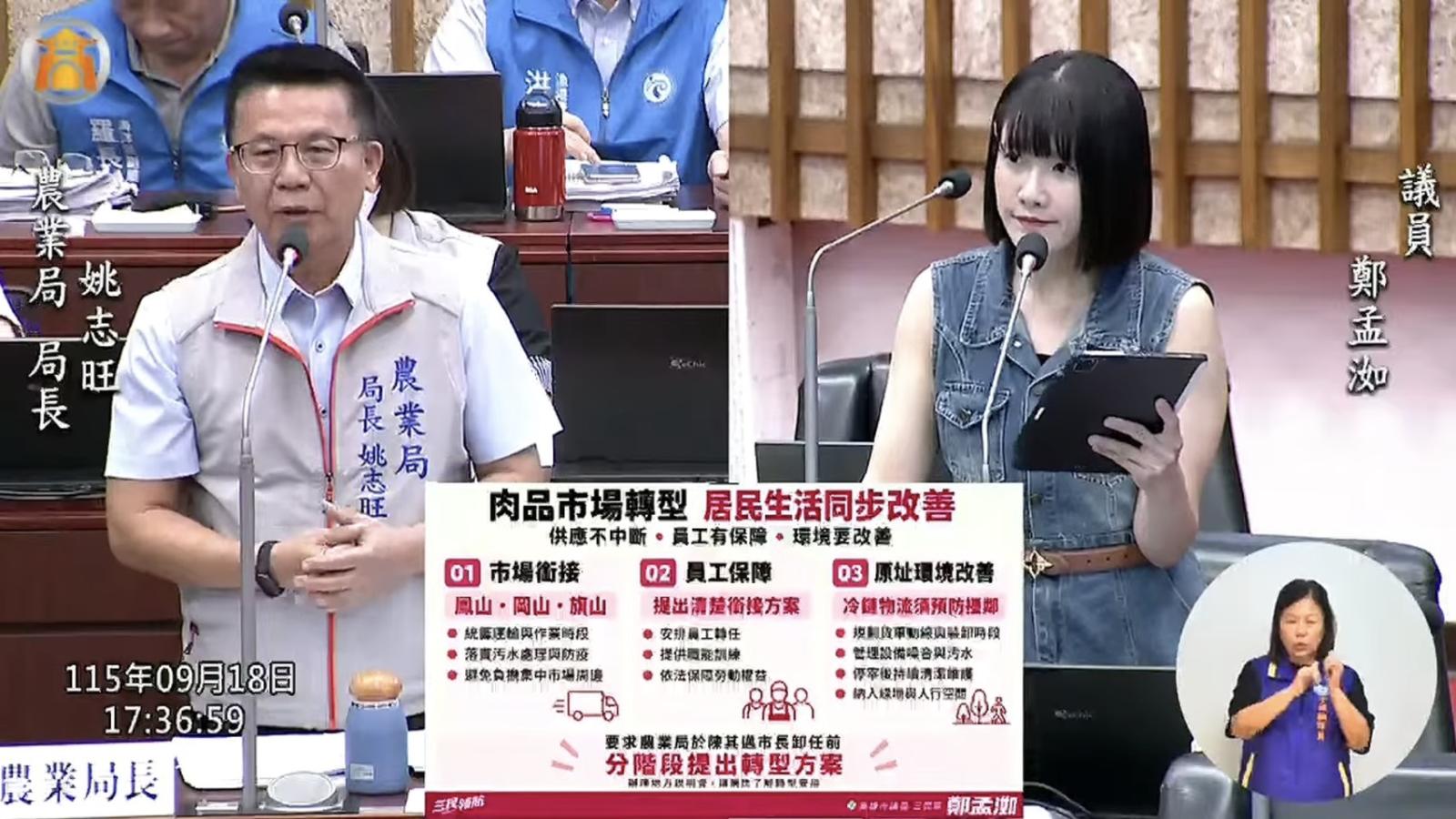
Kaohsiung City Councilor Cheng Meng-ju focused on two major issues—the transition and closure of the Kaohsiung Meat Market and the adoption rates at public animal shelters—during an agricultural department inquiry on September 18, demanding that the Agricultural Bureau present specific implementation schedules.
First, regarding the meat market, which is scheduled to halt auctions and slaughter operations by March 31 next year, Cheng demanded that a preliminary execution plan be submitted by the end of October. This plan must clarify operational boundaries for ceasing auctions, temporarily housing live livestock, and ending slaughter activities. She also called for coordination with existing vendors to relocate trading venues and requested concrete measures for employee reassignment, training, and rights protection to ensure both industrial continuity and labor welfare during the transition.
Concerning the Agricultural Bureau’s plan to redirect operations to markets in Fengshan, Gangshan, and Qishan, Cheng emphasized that these arrangements must go beyond verbal commitments. Transportation routes, operating hours, wastewater treatment, and animal disease prevention must all be carefully planned in advance to maintain meat supply while preventing environmental burdens such as traffic, odors, and noise from simply shifting from Sanmin District to surrounding areas.
Regarding the proposed redevelopment of the site into a cold-chain logistics center, Cheng warned that residents might still face issues such as refrigeration equipment noise, early-morning truck deliveries, and loading/unloading operations after slaughter ends. Therefore, she urged that truck routes, unloading times, noise control, and wastewater management be incorporated into the design phase. Additionally, cleaning and maintenance procedures should be arranged post-closure to prevent management gaps between the shutdown and the launch of new facilities.
Agricultural Bureau Director Yao Chih-wang responded that immediate transformation would be difficult due to peak meat demand during the Mid-Autumn Festival and Lunar New Year, hence the decision to cease auctions and slaughter by the end of March next year. He noted the meat market occupies approximately 2 hectares, with about 2,000 ping of the land to be repurposed into a cold-chain logistics center, while the remainder will be planned by the city government in alignment with surrounding developments and MRT expansion.
Yao added that current personnel involve various employment types, and the bureau will cooperate with the Labor Bureau to provide job counseling as needed. Existing meat-cutting operations will remain unaffected and continue on-site, while auction and slaughter functions will be taken over by meat markets in Fengshan, Qishan, and Gangshan, with ongoing coordination to assist vendors in relocating their trading activities.
Beyond the meat market transition, Cheng also raised concerns about dog and cat intake and adoption trends at Kaohsiung’s public shelters. Citing Agricultural Bureau data, she noted that in 2025 (Minguo Year 114), 2,503 dogs and cats were admitted, an increase of 113 from the previous year, yet adoptions dropped by 90 to 1,742. The annual adoption-to-intake ratio also fell from 76.7% to 69.6%. While acknowledging recent efforts in diversified adoption campaigns and digital promotion, Cheng stressed the need for further review of matching and care services, especially for long-term unadopted animals.
She pointed out that so-called "special-needs" animals—older, injured, sick, or behaviorally challenged—accounted for 460 adoptions in 2024 (Minguo 113), rising to 489 in 2025. As of August 27 this year, 336 such animals had already been adopted, representing 36.1% of total adoptions during the same period. Cheng argued that families willing to adopt these special-needs animals often bear greater caregiving responsibilities, and the city should offer comprehensive support to lower the barrier to adoption.
She urged the Agricultural Bureau to increase budget and staffing, and within two months, integrate adoption support measures for hard-to-place animals, prioritizing those in shelters for over a year, seniors, injured/sick animals, and those needing behavioral assistance. She recommended joint evaluations by veterinarians, caretakers, and behavioral specialists, followed by tailored medical treatment, rehabilitation, or behavioral support based on individual needs, and matched with suitable households.
On post-adoption care, Cheng suggested enhancing the existing "Meet & Know: 30-Day Trial Adoption" program by adding care guidance and clear contact points, enabling adopters to receive timely help when facing adaptation or medical issues. Proactive follow-ups at 7, 30, and 90 days post-adoption could help refine future matching mechanisms based on reasons for returns.
She also recommended expanding the "Wang Wang Program," urging the Agricultural and Education Bureaus to jointly recruit volunteer schools and provide care counseling within two months. However, schools must first meet basic conditions—adult supervision, vacation care, medical access, and handover protocols—before the Animal Protection Office evaluates whether specific animals are suitable for campus placement, allowing students to engage in life education under teacher guidance.
Using the example of the "cat manager" at Hotel Indigo Central Park in Kaohsiung, Cheng proposed scaling up the "City Meet Program," allowing enterprises with suitable premises and staff to participate in animal care and adoption promotion after evaluation. Companies unable to host animals could still contribute through sponsorship of medical care, behavioral training, food, or adoption publicity. She demanded the Agricultural Bureau establish cooperation frameworks and contact points within two months and, together with the Tourism, Economic Development, and Youth Bureaus, initiate new partnership sites or care sponsorships within three months.
Additionally, Cheng advocated enriching pet profiles on adoption websites, prioritizing updated photos, personality traits, health status, and care needs for long-unmatched animals. Unassessed items should be marked as "under observation" to help prospective adopters understand care responsibilities beforehand. She suggested recruiting photography volunteers and collaborating with university clubs to simultaneously share updated adoption statuses, effective links, and contact points on Threads and Facebook.
In response, Yao acknowledged that promoting pet adoption across diverse settings remains a key goal for the Animal Protection Office and pledged to incorporate Cheng’s suggestions for continuous improvement. Regarding budget and staffing shortages, he stated they would actively seek additional support.
Cheng emphasized that although the meat market closure and pet adoption are distinct issues, both are deeply tied to urban quality of life and public governance. She urged the city government to progressively implement the market’s shutdown, vendor relocation, employee rights protection, and site redevelopment, while strengthening comprehensive support—from adoption matching and trial periods to post-adoption care—to ensure the transition genuinely improves residents’ living environment and helps more shelter animals find suitable, stable homes.
FACT BOX
- Source: PR Times
- Category: News