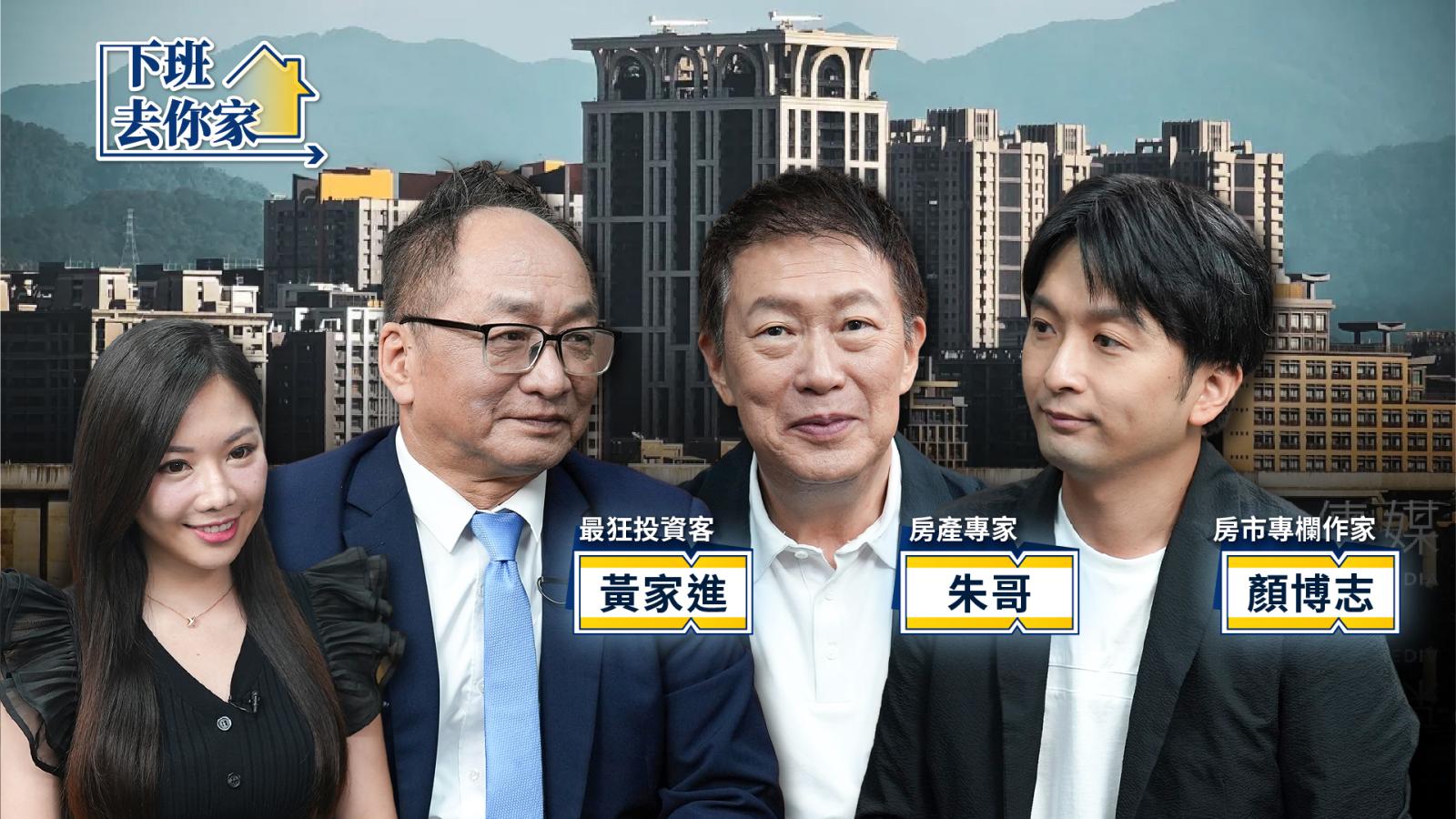
Taiwan’s Central Bank convened its board meeting on (09/17), unveiling two significant easing measures for the housing market: raising the maximum loan-to-value ratio for second-home loans by natural persons from 60% to 70%, and lifting the 18-month deadline requiring developers to commence construction after acquiring land loans. Will these changes push housing prices higher? Will the property market finally become more active? This episode of 'After Work, Let’s Go to Your Place' features host Tsai Shang-hua, self-proclaimed 'craziest investor' Shuai Guotou, real estate expert Zhu Ge, and property columnist Yen Po-chih to help unpack the implications.
Second-home loan ratio raised to 70% — will this give the housing market some breathing room?
Housing market regulations have been adjusted, with the second-home mortgage LTV ratio increased to 70%. The market had hoped this would help buyers with upgrade needs who were previously stuck due to insufficient down payments. However, real estate experts caution that loan easing isn’t simply about 'rescuing buyers.' It may also offer new exit opportunities for owners holding multiple properties and waiting for buyers. 'Craziest investor' Shuai Guotou notes that one direct effect of raising the second-home loan ratio is helping buyers who already purchased a second home but now face delivery pressure reduce their funding threshold. Using a property priced at NT$15 million as an example, if banks previously lent only 50%, buyers needed around NT$7.5 million in down payment. Now, with the loan ratio raised to 70%, the required down payment drops to NT$4.5 million — a difference of NT$3 million. For upgrade-seeking homeowners whose funds are tied up, this could significantly alleviate delivery pressure. 'It allows those who shouldn’t be hurt — innocent people — to successfully complete handovers,' says Shuai Guotou, adding that one goal of the policy is to prevent home-upgraders from failing to complete transactions due to financial issues, enabling developers to deliver smoothly and minimizing ripple effects across the market.
Second-home loan relaxation clearly reduces financial pressure for home-upgraders
Real estate expert Zhu Ge points out that for individuals with genuine upgrade needs but insufficient cash, increasing the second-home loan ratio indeed provides greater financial flexibility. However, the key question is whether, after policy easing, the renewed flow of capital helps only truly needy buyers or also creates new exit windows for owners holding properties awaiting sale. Property columnist Yen Po-chih states bluntly that the answer likely includes both. He reveals he holds dual roles as both buyer and seller: over the past few years, he planned to sell certain properties at peak prices, but 'I haven’t sold a single unit in the last one to two years.' In his view, as the second-home loan ratio has gradually risen from lower levels to today’s 70%, what’s truly being stimulated isn’t just buyers’ purchasing power, but also sellers’ selling opportunities.
A 70% mortgage doesn’t mean 'borrow the full purchase amount' — banks still assess appraisal value and repayment capacity
Zhu Ge also reminds that there have been past cases where contracts were signed but transactions failed because actual loan amounts fell short. Therefore, raising the loan ceiling doesn’t guarantee every buyer will receive full funding. In other words, 'raising the second-home loan ratio' lowers institutional funding barriers, but the final loan amount still depends on the property’s condition and the borrower’s repayment ability. For home-upgraders, this may be an opportunity to relieve delivery fund pressure; for sellers in the market, improved financial conditions among potential buyers could revive transaction chances for long-stagnant listings. How buyers and sellers readjust their strategies post-policy will be a key point to watch in the housing market. More insights await in 'After Work, Let’s Go to Your Place,' hosted by Tsai Shang-hua, alongside 'craziest investor' Shuai Guotou, real estate expert Zhu Ge, and property columnist Yen Po-chih.
FACT BOX
- Source: PR Times
- Category: News
- Dates in source: 09/17