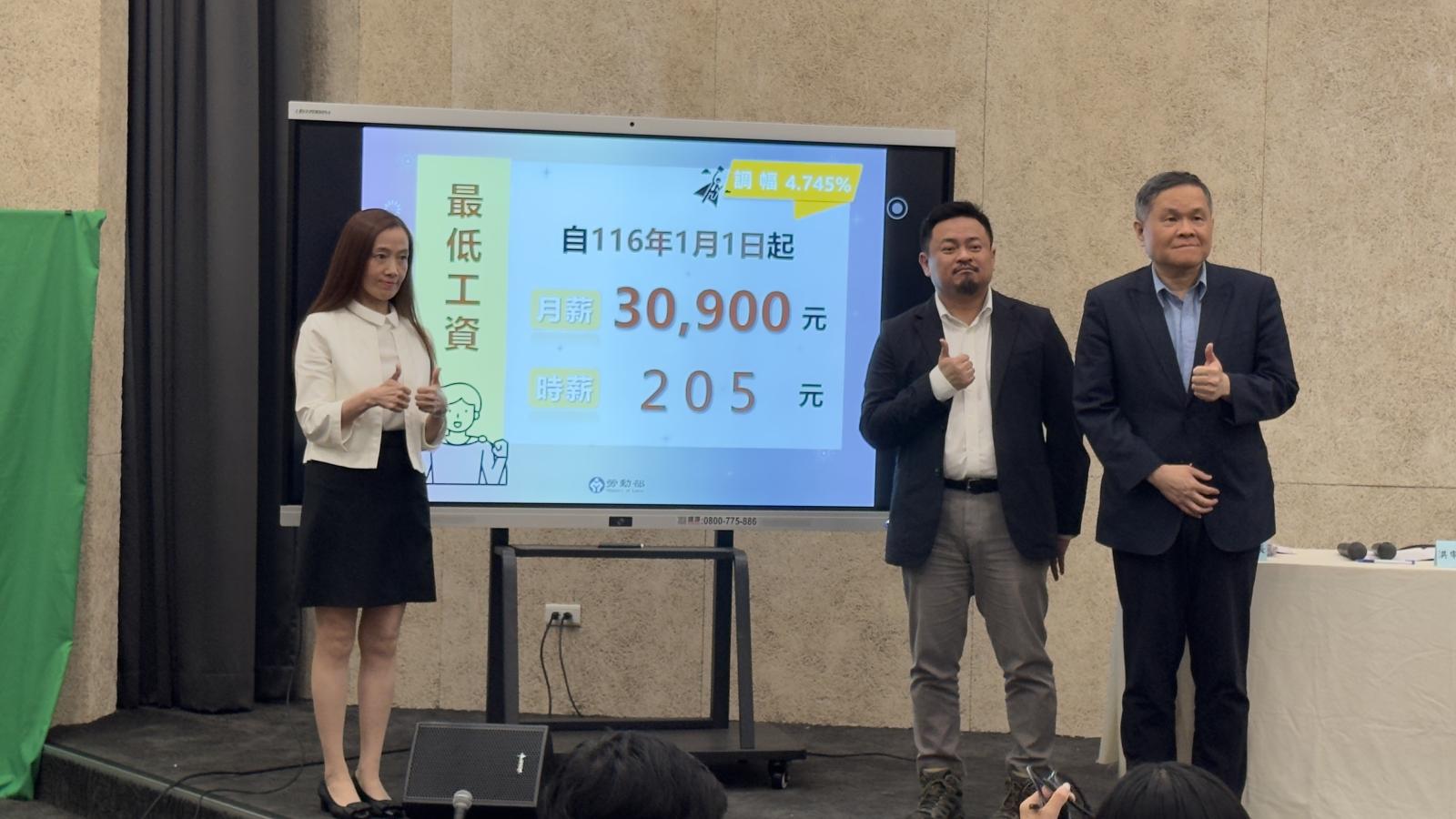
The Minimum Wage Review Committee convened today (24th) and, after deliberations among labor, business, academic, and governmental representatives, decided that starting January 1, 2027, the monthly minimum wage will be adjusted from NT$29,500 to NT$30,900—an increase of NT$1,400, or 4.745%. The hourly minimum wage will also rise proportionally from NT$196 to NT$205. The proposal will be submitted by the Ministry of Labor to the Executive Yuan for approval. If approved, it will mark the 11th consecutive year of increases.
It has been reported that before finalizing the decision, Labor Minister Hung Shen-Han called Economic Minister Kung Ming-Hsin. In response, Hung stated they did not discuss the specific adjustment percentage during the call but focused instead on related supportive principles.
Minister Hung Shen-Han, along with Deputy Minister Li Chien-Hung and Director Huang Chi-Ya of the Department of Labor Conditions and Employment Equality, held a press conference this evening to announce the outcome of the committee meeting.
Addressing Cost-of-Living Increases and Sharing Economic Growth with Workers
The Ministry of Labor explained that both labor and business representatives discussed various factors, including the annual growth rate of the Consumer Price Index (CPI), economic performance, industrial development, and basic living needs of workers. All committee members agreed that CPI increases should be fully reflected and that GDP growth should be reasonably shared with workers.
Labor representatives emphasized that the minimum wage is designed to protect workers’ basic livelihoods. They pointed out that despite rising living costs in recent years, real wages for low-income and frontline workers have declined, increasing financial pressure. Given this year’s strong economic growth, they strongly advocated for workers to fairly share in the fruits of that growth.
Business representatives presented data showing a K-shaped economic recovery—while AI and high-tech industries are driving growth, many small and medium-sized enterprises (SMEs) and traditional industries are struggling or even declining. These sectors employ the vast majority of workers and face mounting pressures from rising raw material costs, international competition, and labor shortages. Therefore, they argued that minimum wage adjustments must consider varying capacities across industries.
Academic representatives noted that adjustments should follow indicators stipulated in the Minimum Wage Act, comprehensively considering inflation, economic growth, and labor market conditions, while also respecting employers’ ability to pay and maintaining harmonious labor relations. They acknowledged the challenges faced by traditional industries and SMEs. The Ministry of Labor added that supporting micro, small, and medium enterprises (MSMEs) is a national priority. The Ministry of Economic Affairs has launched the "Support and Strengthen MSMEs Initiative" and is drafting amendments to the "MSME Transformation and Upgrading Development Act," aiming to enhance productivity through inter-ministerial cooperation.
The Ministry also highlighted that the government’s plan to distribute NT$10,000 cash to every citizen in 2027 will positively benefit domestic-demand-driven industries.
With initial deadlock between labor and business positions, Minister Hung facilitated multiple rounds of negotiation, leading both sides to compromise and ultimately reach consensus on the current adjustment.
Minimum Wage Rises for 11 Consecutive Years, Cumulative Increase Reaches 54.4%
The Ministry of Labor emphasized that the minimum wage system is a crucial policy for safeguarding workers’ basic living standards. Raising the minimum wage helps offset inflation, maintain purchasing power for frontline workers, and ensure shared benefits from economic growth. If approved by the Executive Yuan, this will be the 11th consecutive annual increase since 2016. Monthly wages will rise from NT$29,500 to NT$30,900—a cumulative increase of 54.4%. Hourly rates will climb from NT$196 to NT$205, a total increase of 70.8%. Approximately 2.6116 million workers are expected to benefit, including about 2.1972 million local workers, continuing the government’s commitment to protecting grassroots workers.
Regarding concerns raised by committee members about manufacturing and service industries affected by Middle East conflicts, dumping practices, and rising raw material costs, the Ministry of Labor pledged to work swiftly with the Ministry of Economic Affairs to develop supportive measures to assist these industries, aiming to achieve the goal of "strongly supporting workers and strongly supporting industries."
Hung initially claimed the NT$1,400 increase was "the largest in history," but corrected himself after media pointed out that in 2007, the monthly minimum wage rose from NT$15,840 to NT$17,280—an increase of NT$1,440. Hung clarified that the NT$1,400 increase is the largest over the past decade. He explained that previous large adjustments occurred after long periods without changes, but since 2016, adjustments have been nearly annual, making this year’s NT$1,400 rise the highest in the last ten years.
When asked whether he discussed the wage adjustment percentage with Minister Kung before the final decision, Hung reiterated that the conversation focused on supportive principles rather than the specific adjustment figure.
FACT BOX
- Source: PR Times
- Category: News