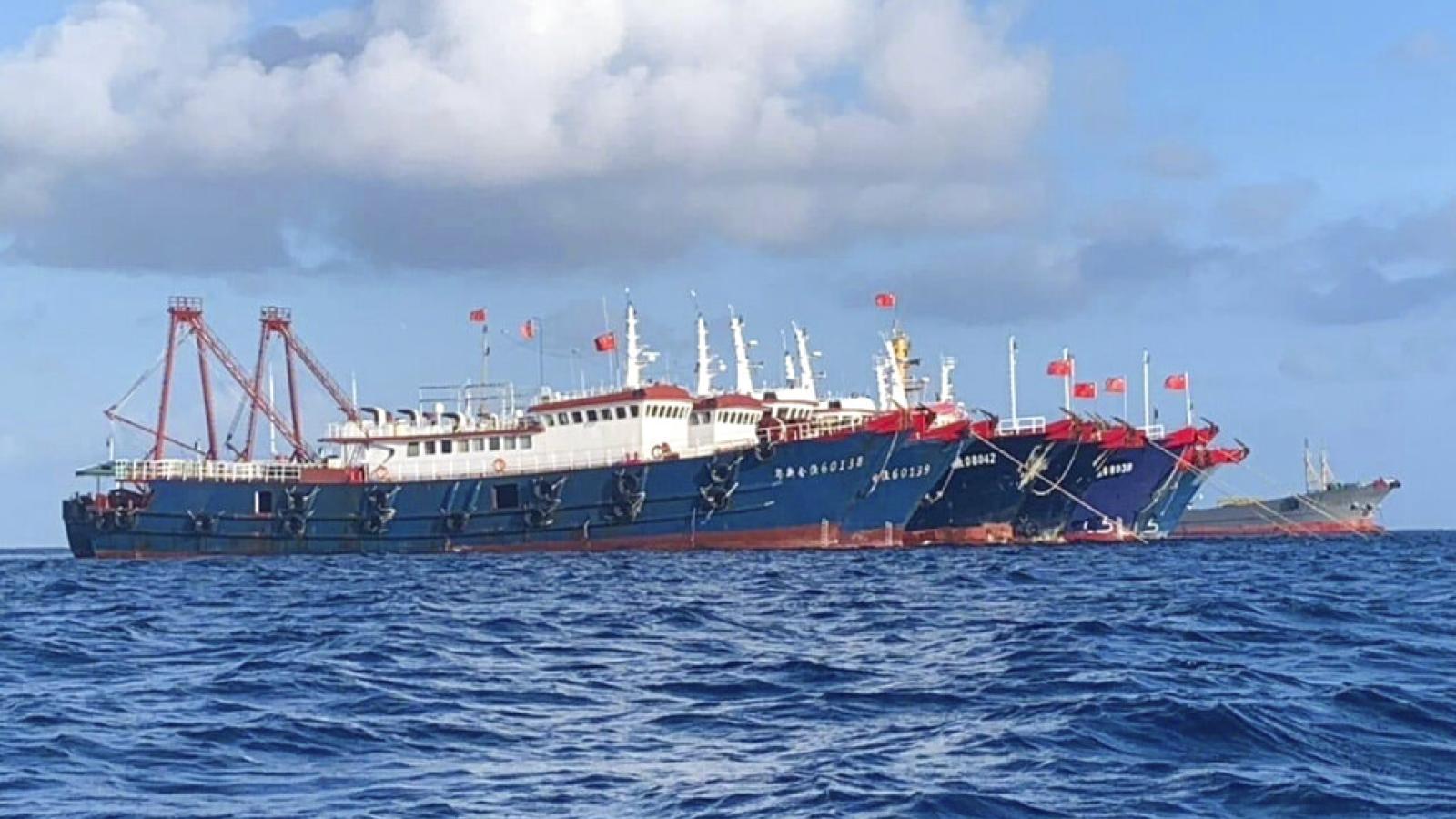
In mid-August, after China's annual unilateral fishing moratorium ended, more than 6,000 Chinese fishing boats set out in large numbers, dispersing across vast sea areas. The scene evokes the Battle of Red Cliffs, where Cao Cao arrayed thousands of warships on the river to confront the allied forces of Sun Quan and Liu Bei. The difference is that these fishing boats are not heading to a naval battle but are dispersing to different fishing grounds, including within Vietnam's exclusive economic zone off the central-southern coastal province of Quang Ngai. Maritime researchers say the number of Chinese fishing boats appearing in these waters has increased significantly in recent years. What once seemed like seasonal fishing activity now reflects a larger issue: the scramble for marine resources, the livelihoods of fishermen, and broader strategic calculations over control of the South China Sea. Researchers from the SeaLight project under Stanford University's Gordian Knot Center for National Security Innovation found a large fleet of Chinese fishing boats gathered near the Vietnamese coast. Citing maritime data, they said the fleet consists of about 100 boats, most departing from Guangxi ports, and has been operating off Vietnam's Quang Ngai province since 2024, as close as 28 nautical miles (about 52 kilometers) from Ly Son Island. SeaLight project director Ray Powell told BBC Vietnamese: "We looked at data from 2024 to 2026 and found that in 2026, there were over 40 boats every day, far more than seen in previous data, and the numbers are still rising." "The situation hasn't really stabilized, so this problem seems likely to continue." Seasonal patterns Data provided by SeaLight shows that during certain times of the year, Chinese fishing boats appear very close to the Vietnamese coast. Grace Gabrielli, a SeaLight intern who directly analyzed maritime data, said: "From their activity patterns, they travel back and forth between different ports, stay around Quang Ngai province, and then return to port. This is a common activity pattern for fishing boats." The data shows the fleet was particularly active in late 2025 and the first few months of 2026, with February 2026 being an exception. Professor Carl Thayer of the University of New South Wales in Australia said this pattern can be partly explained by China's annual unilateral fishing moratorium, which runs from May 1 to August 16 noon. He explained: "At the beginning of the year, there is the Lunar New Year, and you see some boats that were there returning to China for the holiday. Then they come back, and there is a large concentration from March to May. At the end of April, they start to withdraw, including some escort vessels. After the fishing season resumes in mid-August, they return." Government and military vessels in the fleet Powell, a former US Air Force attaché in Vietnam, told the BBC that most Chinese vessel activity in the area resembles that of ordinary fishing boats and they are indeed engaged in fishing. However, the fleet also includes government vessels and maritime militia boats. Notably, SeaLight found a Chinese government vessel moving with the fishing fleet during the same seasonal activity period, which SeaLight identified as a military vessel. Powell said: "The government vessel we found was classified as a military vessel, flying the Chinese flag, with zero recorded fishing activity, and its appearance coincided with the fleet's seasonal pattern. In other words, it seems to move back and forth with the entire fleet." He said this indicates government vessels are accompanying the fishing fleet, a pattern "highly consistent with the activities of maritime militia vessels." He said: "When a vessel clearly classified as a government vessel is mixed in, we are seeing fishing activities off the coast of Vietnam that are recognized by the Chinese government." Powell believes China "cannot claim, and in fact does not want to claim, that this is just a group of fishing boats acting on their own." He explained: "China wants Vietnam to know that it is monitoring and endorsing these activities, and if Vietnam poses a significant challenge to these fishing activities, China is ready to protect them." He added: "China is also sending a geopolitical message to Vietnam that it can operate anywhere within its claimed areas, and Vietnam has very limited means to stop it." Thayer similarly believes the fleet's activities are likely supported by the Chinese government. He said: "China doesn't just send unarmed fishing boats to the South China Sea to fish for money and then go home. They need to protect these boats because they say, 'This is our place, we have to intimidate others and drive them out.'" However, Thayer warned against making assumptions about the identity of the fishermen themselves. He said: "We don't have exact photographic evidence. Some analysts call them 'little blue men,' meaning one moment they are fishing, the next they go into the cabin and come out wearing blue uniforms as maritime militia." Therefore, he believes the fleet may consist of a mix of personnel and vessels, including commercial fishermen, government-subsidized militia, and larger maritime law enforcement vessels, some of which are militia-type, plus Chinese Coast Guard ships. Why Quang Ngai? Quang Ngai province is located in central Vietnam, with rich fishing grounds and abundant marine resources. Its waters are vast with favorable natural conditions, hosting a variety of fish and seafood, including tuna, mackerel, jack mackerel, anchovies, squid, and shrimp. Fishing has long been an important part of life for coastal communities, especially on islands and coastal areas. Each fishing trip not only brings back large amounts of food but also provides employment and income for the local economy. According to the Vietnam News Agency, as of May 2026, there were nearly 5,000 registered fishing boats in Quang Ngai's fishing vessel management system. Local fishermen have long operated in fishing grounds around the Paracel and Spratly Islands and are experienced. However, in waters around the Paracel and Spratly Islands, Vietnamese fishing boats are frequently chased away or attacked by Chinese forces, with fishermen beaten and property seized or confiscated. On September 29, 2024, Quang Ngai fishing boat QNg 95739 TS was attacked by Chinese personnel. Fishermen on board said they were beaten, and their nets, equipment, and "several tons of catch" were taken. At least 10 Vietnamese fishermen were injured. Reuters reported on October 1, 2024, that China's Foreign Ministry said Vietnamese fishing boats "illegally entered China's Paracel Islands waters for fishing without the approval of the Chinese government, and Chinese relevant authorities took measures to stop them in accordance with the law." However, Beijing did not directly mention the September 29 attack. On October 2, 2024, the Vietnam Fisheries Association sent a document to the Ministry of Agriculture and Rural Development, the Ministry of Foreign Affairs, and the Central External Relations Committee of the Communist Party of Vietnam, "protesting China's obstruction of operations, looting of property, and attacks on fishermen, and recommending strengthening support for fishermen operating at sea." Earlier, in April 2020, Vietnamese media reported that a Quang Ngai fishing boat was rammed and sunk by a "foreign vessel" near Yongxing Island, and China later returned the eight fishermen on board. Powell said the simplest explanation for Chinese fishing boats coming to these waters is that the fish are abundant. However, he emphasized that these activities also serve Beijing's strategic and geopolitical goals. He said: "These fishing boats appear there for several months each year, and of course without asking Vietnam's permission. That itself is the purpose, not an accident. Because it helps China assert its claim of rights over these waters, even if under international law, that is not the case." SeaLight intern Gabrielli added: "Local enforcement of the exclusive economic zone is limited, and the fishing grounds are very rich. I think China has discovered in recent years that this area is rich in resources with limited enforcement, and is taking full advantage of the situation." What does it mean for Vietnamese fishermen? Professor Thayer, who has twice visited Quang Ngai to study the lives of local fishermen, said fishermen often go out at night to waters near the Paracel Islands, and they are "willing to take risks" because that is where the most valuable and profitable seafood can be caught. He noted that according to SeaLight data, China used a large number of maritime militia and maritime law enforcement vessels in 2024 and 2025 to form a large "barrier" preventing Vietnamese fishermen from accessing the relevant waters. As a result, fishermen from Quang Ngai told him they were forced to operate elsewhere, such as the Gulf of Tonkin or waters around Indonesia's Natuna Islands. He said: "They do complain to the media, including foreign media, but even if they ask for help, they cannot get immediate assistance. They are left alone. When they go out to sea, local patrols are insufficient, sometimes completely absent." Therefore, Thayer believes these fishermen are very vulnerable. He recalled: "China has steel-hulled militia boats, and Coast Guard ships have used water cannons. So fishermen say that when they see a boat approaching, because Chinese boats are much faster, they try to escape, but sometimes they are still caught due to distance and other reasons." As a result, the fishing grounds available for Vietnamese fishermen in this area are becoming increasingly restricted, he said. For coastal communities in Quang Ngai, this is not just a story about fishing grounds, but also about the livelihoods of families who have depended on the sea for generations. In January 2024, the Vietnam Fisheries Association
FACT BOX
- Source: PR Times
- Category: Survey
- Organizations: SeaLight / BBC