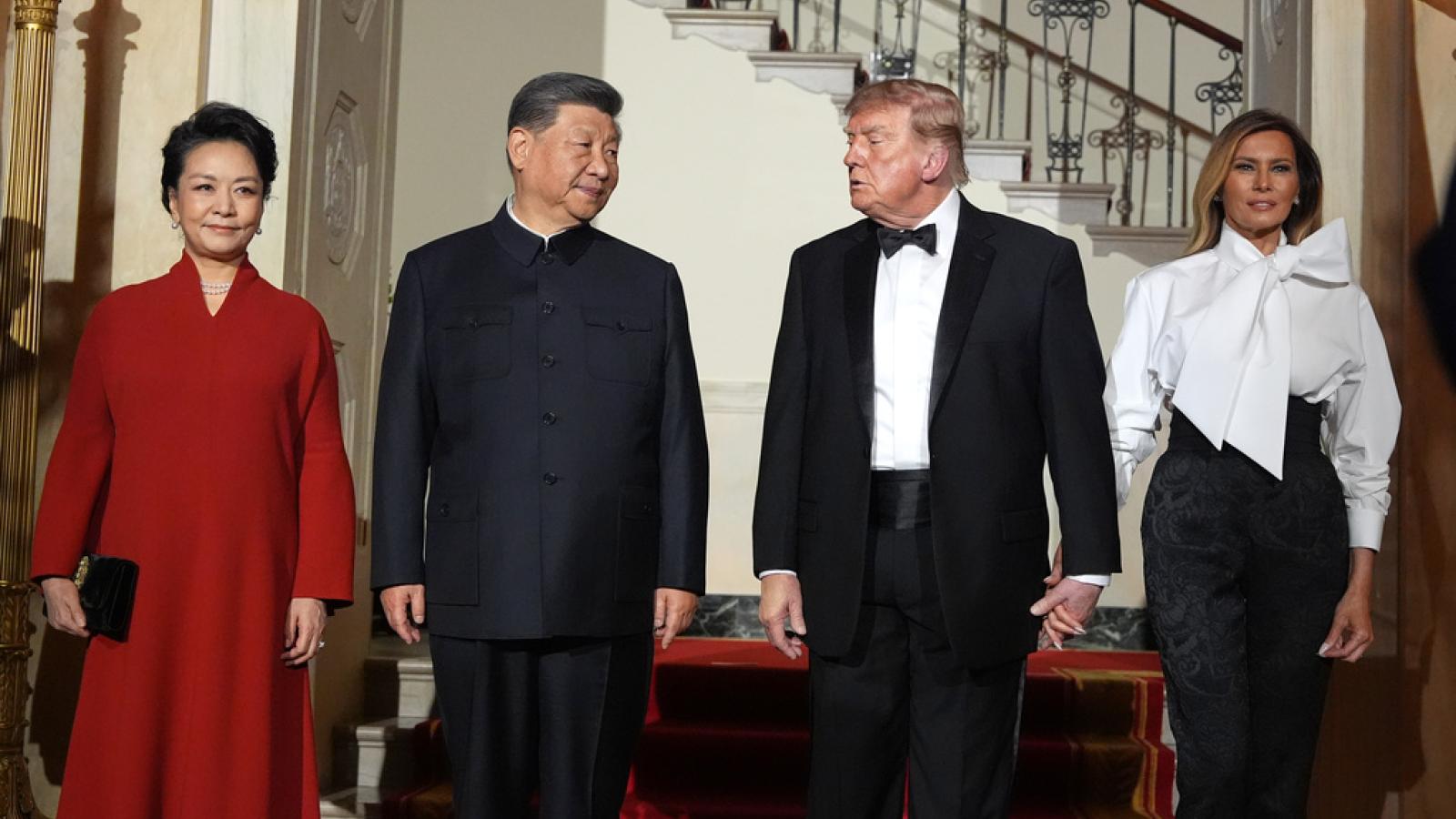
Chinese President Xi Jinping's visit to the United States has concluded. President Trump arranged for several technology giants to attend the state dinner and sit at the main table, demonstrating America's artificial intelligence (AI) industry strength and signaling that the next major battleground in US-China rivalry will be AI technology competition. In response, Xie Jinhe, chairman of Wealth Magazine, posted on Facebook that the state dinner was like "a carefully arranged political card game," noting that the market capitalization of the four AI giants at the main table roughly equals the total of China's Shenzhen and Shanghai stock markets combined. Xie mentioned that the drama of Xi's US visit had ended. Earlier, media reports suggested that China had put the Taiwan issue on the table, demanding that the US delay arms sales to Taiwan. However, Trump, who excels at deal-making, still laid out a meticulous calculation. The biggest highlight was the state dinner on September 24. Compared to Trump's state dinner during his visit to China on May 14 this year, Beijing's state dinner had a large table. Because Trump's wife did not attend, the main table was occupied by politicians, with Trump flipping through the menu becoming the most striking focus. Jensen Huang, Tim Cook, Elon Musk, and Lisa Su sat at the main table, with a combined market cap of $15 trillion, equivalent to the total of the Shanghai and Shenzhen stock markets. Xie pointed out that this time, the Washington state dinner was at a small table. Besides the two heads of state and their spouses, the main table included Apple's Cook, Tesla's Musk, and Jensen Huang and Lisa Su, who are originally from Tainan. It is unthinkable in China for entrepreneurs to sit at the main table of a state dinner. These tech giants at the main table represent: Huang with Nvidia ($5.5 trillion), Cook with Apple (nearly $5 trillion), Musk with Tesla and SpaceX ($3.5 trillion), and Su with AMD (recently reaching $1 trillion). The combined market cap of these four giants is about $15 trillion, roughly equal to the total of China's Shenzhen and Shanghai stock markets. Xie said that Trump's display this time was to showcase US AI strength, similar to when the US delegation left all disposable phones and gifts at the airport upon leaving Beijing. This also means that the next main battlefield in US-China rivalry is AI technology competition. Which is stronger, US AI or Chinese AI? China's AI is state-led, backed by state capital, with potentially unlimited resources. But the US has a strong capital market and entrepreneurs with unlimited creativity. Most importantly, the US can tolerate entrepreneurs whose wealth rivals that of the country, while in China, such wealth inevitably leads to disaster. Xie noted that recently, Huawei's Ren Zhengfei was out of contact for a time, and earlier, Jack Ma suddenly handed over management rights. At Chinese state dinners, private entrepreneurs are often ranked last among scholars, farmers, artisans, and merchants. Enterprises belong to the state; they may rise suddenly, but their sustainability is hard to maintain. This time, Trump invited Huang, Cook, Musk, and Su, which seems more like a carefully arranged political card game.
FACT BOX
- Source: PR Times
- Category: 國際政治