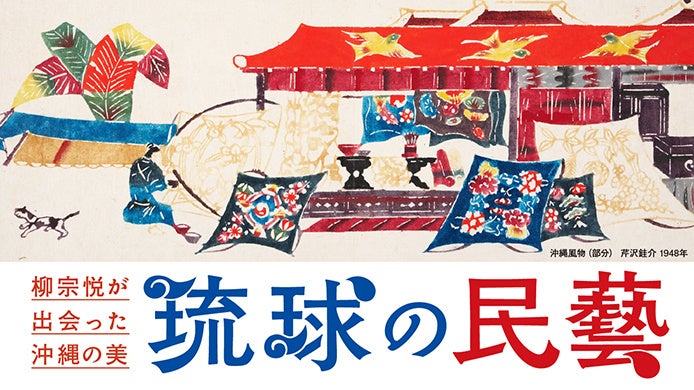
Takashimaya will host the exhibition 'The Beauty of Okinawa Discovered by Yanagi Soetsu: Ryukyu Folk Crafts' at its Nihonbashi store (August 26 to September 6, 2026) and Osaka store (September 9 to 21, 2026), under the sponsorship of the Japan Folk Crafts Museum and with the support of Okinawa Prefecture.
This year marks the planned reconstruction of Shuri Castle's main hall, which was destroyed by fire in 2019. Coinciding with this, 2026 also celebrates the 100th anniversary of the establishment of the 'Mingei' (folk crafts) philosophy by Yanagi Soetsu and his contemporaries—a significant milestone. This exhibition reexamines the timeless value of Okinawan crafts, which Yanagi once described as a 'treasure mountain,' and which captivated him throughout his life.
Background and Highlights
Yanagi Soetsu (1889–1961), a religious philosopher and pioneer of the Mingei movement from the late Taisho to the Showa era, became deeply fascinated with Okinawan crafts through his connection with Sho Masataka, the 21st head of the Ryukyu royal family and his former classmate. From 1938, Yanagi visited Okinawa four times to conduct research and collect artifacts. What he encountered were handcrafted textiles with vibrant colors born from the region’s unique climate, and robust, expressive ceramics shaped by local traditions.
Takashimaya has long supported the Mingei movement, beginning with the 'Modern Japanese Folk Crafts Exhibition' in 1934. Since then, the company has consistently organized 'Mingei Exhibitions,' promoting the concept of 'beauty of use' (younobi)—the aesthetic found in everyday utilitarian objects. This exhibition, made possible through Takashimaya’s enduring partnership with the movement, will systematically present around 100 items. These include Ryukyu folk crafts from the Japan Folk Crafts Museum’s collection, daily tools rooted in life and performance, and works created by Mingei artists such as Serizawa Keisuke, Kawai Kanjiro, and Hamada Shoji, who were inspired by their travels to Okinawa alongside Yanagi.
Visitors will experience the richness of Ryukyuan culture, where daily tools and expressive arts coexist, and feel the living spirit of the Mingei movement that Takashimaya has championed since its early days.
What is Mingei?
'Mingei' is an abbreviation of 'mingeshi kogei' (folk crafts), a term coined in 1925 by Yanagi Soetsu, Kawai Kanjiro, and Hamada Shoji. The movement focused on the overlooked beauty of everyday utilitarian objects—such as tableware, furniture, and clothing—crafted by anonymous artisans. It celebrated their healthy, honest aesthetic as 'beauty of use' (younobi). Amid rapid industrialization, Mingei aimed to preserve Japan’s regional handcraft traditions and enrich daily life through beauty.
Who was Yanagi Soetsu?
Yanagi Soetsu (1889–1961), born in Tokyo, was a religious philosopher and art critic. During his time at Gakushuin’s Higher School, he co-founded the literary magazine 'Shirakaba,' introducing Western modern art and literature to Japan. Later, deeply moved by the beauty of Korean ceramics and Japanese folk Buddhist sculptures (mokujiki), he became the leading figure of the Mingei movement. In 1936, he founded the Japan Folk Crafts Museum in Komaba, Tokyo, serving as its first director. Throughout his life, he introduced a new aesthetic vision to society through his unique artistic sensibility.
Exhibition Structure
Prologue: Yanagi Soetsu’s Encounter with Okinawan Folk Crafts
Cotton and ramie plain cloth with indigo cloud, wave, chrysanthemum, and peony pattern (123.3×121.0 cm, 19th century)
This section introduces the charm of Okinawan Bingata through garments and stencil papers, alongside Yanagi’s own words, exploring the origins of his fascination with Okinawa.
Chapter 1: Ryukyuan Textile Dyeing
Indigo-dyed hemp cloth with checkerboard and ancient-style plum, bamboo, and pine motif (48.5×49.0 cm, 19th century)
Focusing on Bingata, Okinawa’s representative dyeing technique, this chapter displays colorful garments and stencils, explaining the cultural and environmental contexts behind their colors and designs. It delves into the allure of Bingata that captivated Yanagi.
Ramie light-blue cloth with wavy willow, cherry blossom, and maple pattern (152.0×125.0 cm, 19th century); Cotton pattern-dyed cloth with cloud, crane, turtle, and distant mountains (158.0×146.0 cm, 19th century)
Chapter 2: Ryukyuan Weaving
Banana fiber and cotton hand towel with floral pattern (82.0×24.0 cm, late 19th to early 20th century)
This section highlights the diversity of textiles rooted in daily life, showcasing banana fiber cloth (bashofu) and kasuri (ikat) weaving, and illustrating the breadth of Ryukyuan weaving culture.
Bashofu warp-ikat garment (124.0×123.6 cm, early 20th century); White cotton warp-and-weft ikat kimono (139.0×115.0 cm, 19th century)
Chapter 3: Ryukyuan Ceramics
Amber-glazed white unglazed double-handled Buddhist flower vase, Tsuboya (18.2×8.4 cm, 19th century)
This section features Tsuboya ware and everyday vessels such as sake jars, dachibin (large bottles), plates, and bowls. It conveys the朴素 yet powerful forms shaped by potters and the unique beauty of clay nurtured by local terroir.
White-glazed colored-line carved lidded dish, Tsuboya (11.0×11.0 cm, 19th century); Unglazed stoneware flask, Tsuboya (26.3×21.4 cm, 19th century)
Chapter 4: Ryukyuan Cultural Artifacts
Costumes for dance, theater backdrops, baskets, pillow boxes, and papier-mâché dolls—this section comprehensively displays tools rooted in Okinawan daily life and performing arts. It showcases the richness of Ryukyuan culture, where utilitarian objects and expressive traditions are deeply intertwined.
Akatori (19.0×31.2×29.0 cm, c. 1939); Hat (height 21.6 cm, diameter 39.6 cm, 1930s–1950s)
Butsudan urn (64.0×60.0×54.0 cm, Second Sho Dynasty); Indigo-dyed cloth with crane, turtle, pine, bamboo, and plum motif, Bingata theater backdrop (175.0×200.0 cm, 19th century)
Chapter 5: Mingei Artists and Okinawa
Works by Mingei artists such as Serizawa Keisuke, Kawai Kanjiro, and Hamada Shoji, as well as postwar artists, are displayed.
Bingata-style Ryukyuan motifs, Serizawa Keisuke (62.4×79.4 cm, 1939); Kimono with Okinawan hat and fan pattern, Serizawa Keisuke (length 160.0 cm, c. 1960)
Cobalt-blue ground with cinnabar flower pattern flat jar, Kawai Kanjiro (23.4×24.0×13.0 cm, c. 1940); Iron-painted shared-hand teapot, Hamada Shoji (25.8×19.0 cm, 1941)
Underglaze painted 'fuku' character plate with floral design, Suzuki Shigeo (7.0×25.0 cm, 1939)
Video Corner
The cultural film 'Ryukyu Folk Crafts' will be screened, visually presenting prewar Okinawan landscapes, daily life, and the cultural environment where living traditions and performing arts thrive.
Concurrent Exhibition and Sale: 'Mingei Exhibition'
Adjacent to the exhibition space, Takashimaya will host the 'Mingei Exhibition'—a marketplace of 'beauty of use' from across Japan—after a three-year hiatus. This year’s event emphasizes regional identity, showcasing crafts that inherit local traditions and embody the Mingei spirit. Events such as talk shows and workshops will also be held to deepen public understanding of Mingei.
Tokyo Venue
Dates: August 26 (Wed) to September 7 (Mon), 2026, 10:30 AM to 7:30 PM daily (closed at 6:00 PM on final day)
Venue: 8th Floor Event Hall, Takashimaya Nihonbashi Store
Additional spaces: ● 7th Floor Gallery 'Kurashi no Kogei: Mingei no Wa' (August 26 to September 8; closed at 4:00 PM on final day) ● 1st Floor Front Event Space (August 26 to September 1)
Osaka Venue
Dates: September 16 (Wed) to 21 (Mon, national holiday), 2026, 10:00 AM to 7:00 PM daily (closed at 6:00 PM on final day)
Venue: 7th Floor Event Hall, Takashimaya Osaka Store
Main Exhibits and Sales at the 'Mingei Exhibition':
Folk Crafts from Across Japan: Jofukuji lacquerware, Kutsugiwara pottery, Nanbu ironware, Matsumoto folk craft furniture, Seto Hon-gyo kiln, Denshigama kiln, Sodeshi kiln, Yumachi kiln, Kaneko forge studio, Ogatami pottery, Yomitan-yaki Kitagama kiln, Ryukyu glass, Bingata, and more
※ Items vary by period and location
Mingei and Craft Shops: Tottori Takumi Craft Shop (Tottori), Ginza Takumi (Tokyo), Kurashi no Gallery (Okayama), Utsubo: Tools for Living Tekura (Shizuoka), Enkin
FACT BOX
- Source: PR TIMES
- Category: Event