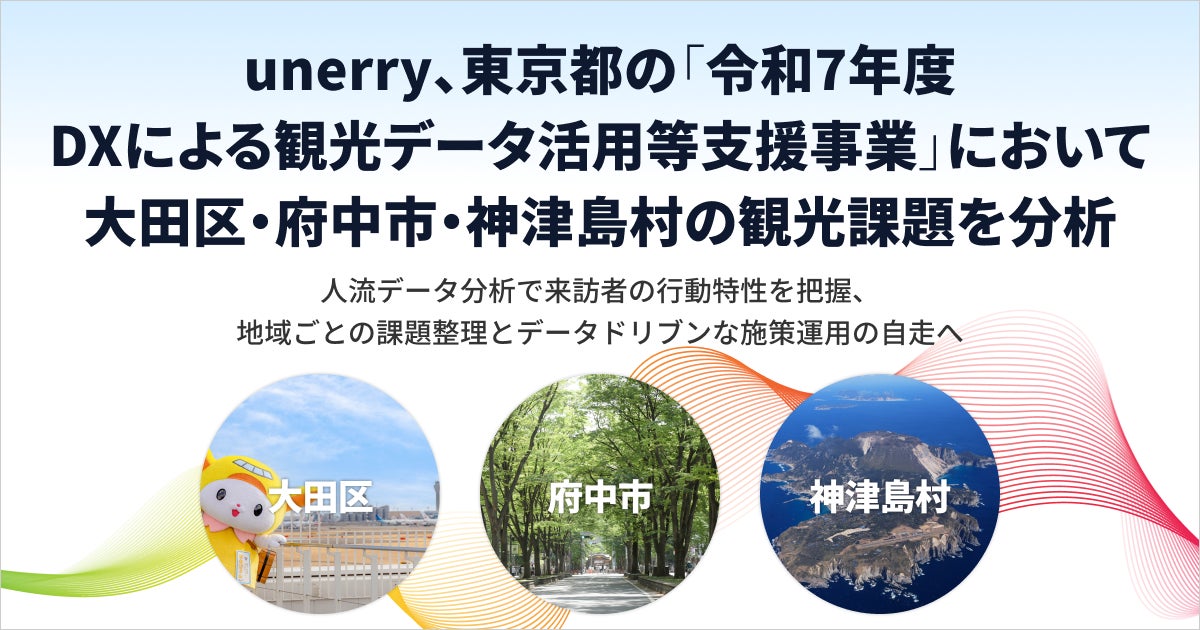
unerry Inc. (Headquarters: Minato-ku, Tokyo; President and CEO: Hidetoshi Uchiyama; hereinafter referred to as unerry) has utilized human flow big data and other data sources in the Tokyo Metropolitan Government's "FY2025 Support Program for Tourism Data Utilization through DX" to identify tourism challenges in three regions: Ota Ward, Fuchu City, and Kozushima Village, and has organized directions for their resolution. Based on these analysis results, specific policy considerations and effect verification will be advanced moving forward.
In this project, unerry analyzed various tourism-related data, including its proprietary domestic human flow big data of 240 million IDs, to formulate measures that capture the actual situation and needs of tourists. In collaboration with the support group for FY2025-2026, the Ota Tourism Association, Fuchu City, and the NPO Kozushima Tourism Association, analyses were conducted on visitor behavior patterns, satisfaction levels, and needs in each region. This clarified the challenges in considering tourism policies and organized directions for their resolution. Tourism Challenges Revealed by Human Flow Data Analysis and Future Initiatives 【Ota Ward (Ota Tourism Association)】 <Challenges> While Ota Ward, as a transportation hub with Haneda Airport, has many opportunities for visitors, there is a desire to enhance intra-ward circulation, length of stay, and consumption amounts, but data has been lacking. Although a certain degree of movement to surrounding areas like Kamata before and after using Haneda Airport has been observed, indicating potential for circulation originating from the airport, it has also become clear that in the Kamata and Omori areas, there are many short stays by workers and local residents, and opportunities for visits are not being fully leveraged to increase intra-regional circulation and consumption.
<Current Resolution Policy> Regarding existing initiatives such as stamp rallies, discussions are underway to design policies and maximize their effects from the perspective of "where to place spots to expand circulation," utilizing human flow data. Furthermore, by establishing indicators that allow for the comparison of effects between initiatives and creating mechanisms for data collection, the aim is to build a system that allows for the continuous operation of tourism policies even with limited personnel.
【Fuchu City (Fuchu City)】 <Challenges> Fuchu City aims to improve the satisfaction of repeat visitors and promote longer stays within the city, but a key challenge has been the lack of sufficient understanding of who is visiting where within the city, from where, and for what purpose. Human flow data analysis revealed that visitors can be broadly categorized into two types. One type is those who visit for specific purposes, such as the Tokyo Racecourse or events. This group's residential distribution is wide-ranging, indicating opportunities for attracting visitors from beyond the immediate vicinity. The other type is those who spend leisure time at commercial facilities and parks, primarily local residents, suggesting that "opportunities to visit as an extension of daily life" are being formed to a certain extent.
<Current Resolution Policy> As policy considerations progress, a concrete approach is emerging that includes local residents' "outings" rather than limiting the target audience to visitors from outside the region. Content and policies that are valuable to residents are likely to gain consensus within the region and cooperation from businesses, and consequently, contribute to the development of an environment that welcomes visitors from outside the region. Moving forward, by analyzing the behavioral characteristics of residents and local visitors, and based on these results, efforts will be made to develop existing and new policies that lead to increased intra-city circulation and length of stay, rather than just "point visits," aiming to improve satisfaction and expand consumption opportunities.
【Kozushima Village (NPO Kozushima Tourism Association)】 <Challenges> In Kozushima, there is a stagnation in the number of visitors during the off-season.
FACT BOX
- Source: PR TIMES
- Category: News