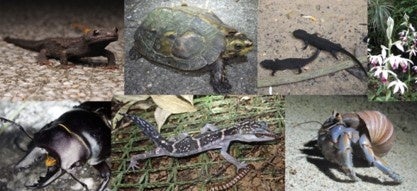
The Japan office of the World Wide Fund for Nature (WWF Japan), a public interest foundation headquartered in Minato Ward, Tokyo (Chairman: Takejirō Sueyoshi), announced on June 25, 2026, that 27 companies and organizations have endorsed the 'Joint Declaration to Prevent Extinction Caused by Illegal or Overexploitation of Wildlife.' The declaration was launched during a symposium titled 'A Pledge to Prevent Wildlife Extinction – Considering the Responsibility of Trade, Consumption, and Society from the Frontlines of the Southwest Islands,' which WWF Japan hosted and where it called upon stakeholders in the pet trade, e-commerce, transportation, and tourism industries to participate.
Endangered Species in the Southwest Islands Targeted by Poaching, Illegal Harvesting, and Mass Collection
In recent years, poaching, illegal removal, and overharvesting and trading of wildlife have increasingly occurred both domestically and internationally, posing a serious threat to biodiversity. In particular, Japan’s biodiversity hotspot, the Southwest Islands, has seen repeated reports of endemic and rare species being collected or removed, raising concerns about the ecological impact. Moreover, various stakeholders—including pet businesses, e-commerce platforms, transportation providers, and tourism operators—are involved in the trade and consumption of wildlife, potentially placing unintended pressure on species and their habitats.
In response to these challenges, WWF Japan hosted the symposium 'A Pledge to Prevent Wildlife Extinction – Considering the Responsibility of Trade, Consumption, and Society from the Frontlines of the Southwest Islands' on June 25, 2026. The event brought together stakeholders across the supply chain—from habitat to market—to discuss the current situation in the Southwest Islands, the impact of wildlife collection, trade, and sales on biodiversity, and the roles expected of businesses, organizations, government, and citizens.
As a result, the symposium concluded with the launch of the 'Joint Declaration to Prevent Extinction Caused by Illegal or Overexploitation of Wildlife,' endorsed by 27 organizations. The declaration aims to transform society from one that unknowingly threatens wildlife into one that recognizes its own impact and takes action to protect species and their habitats.
Organizations endorsing the declaration have expressed their commitment to recognizing the impact of their business operations on biodiversity and to taking action to prevent illegal or unsustainable use of wildlife.
'Joint Declaration to Prevent Extinction Caused by Illegal or Overexploitation of Wildlife'
The declaration outlines the following commitments by endorsing organizations:
1. Recognize that illegal or excessive capture, removal, import/export, and sale of wildlife—and the associated release of invasive species into the wild—pose direct threats to biodiversity.
2. Identify, assess, and take action regarding their own involvement with wildlife and habitats to prevent the capture, removal, import/export, and sale of wildlife when legality cannot be confirmed or when such activities pose a high risk of harming species survival or ecosystems.
3. Businesses handling live animals must thoroughly prevent their release into the wild.
4. Promote awareness of points 1–3 among consumers, tourists, business partners, employees, and others, and encourage participation in these efforts.
The full declaration and list of endorsing organizations are available at: https://www.wwf.or.jp/activities/statement/6316.html
Summary of Expert Comments
Six experts specializing in the ecology of reptiles, amphibians, freshwater fish, aquatic insects, fish, entomology, conservation biology, and wildlife management provided supportive comments upon the adoption of the declaration.
The experts emphasized that illegal and overexploitation of wildlife is a major driver of biodiversity loss and that wildlife trade and distribution can lead to invasive species problems and the spread of infectious diseases. They also highlighted that rather than outright rejecting wildlife collection or captivity, society must collectively advance sustainable and responsible engagement, with full awareness of impacts and responsibilities.
Furthermore, experts expressed hope that this joint declaration—supported by diverse stakeholders including tourism, transportation, e-commerce platforms, and the pet industry—represents a crucial first step toward the broad cooperation needed for wildlife conservation, which extends beyond habitats to include trade, sales, and consumption.
Experts who provided comments:
Dr. Kunio Araya (Professor, Graduate School of Integrated Arts and Sciences, Kyushu University)
Nobuo Ishii (Professor Emeritus, Tokyo Woman’s Christian University; Advisor to the Japanese Government Delegation at CITES Conferences of the Parties)
Hidetoshi Ohta (Professor Emeritus, University of Hyogo)
Atsushi Tominaga (Professor, Faculty of Education, University of the Ryukyus)
Jun Nakajima (Special Researcher, Fukuoka Institute of Health and Environmental Sciences)
Takahiro Morizawa (Center for Wildlife Management Studies, Faculty of Agriculture, Tokyo University of Agriculture and Technology)
The full text of the declaration and expert comments is available at:
・Symposium Report: 'A Pledge to Prevent Wildlife Extinction – Considering the Responsibility of Trade, Consumption, and Society from the Frontlines of the Southwest Islands' https://www.wwf.or.jp/activities/activity/6315.html
WWF Japan will continue to promote awareness and expand support for the declaration, fostering collaboration among businesses, government, research institutions, and civil society to prevent extinction caused by illegal or overexploitation of wildlife.
Reference Information
・Symposium Report: 'A Pledge to Prevent Wildlife Extinction – Considering the Responsibility of Trade, Consumption, and Society from the Frontlines of the Southwest Islands' https://www.wwf.or.jp/activities/activity/6315.html
・Environmental Challenges in the Southwest Islands after World Heritage Listing and WWF’s Activities https://www.wwf.or.jp/activities/activity/4670.html
・Challenges of Wildlife as Pets and WWF Japan’s Initiatives https://www.wwf.or.jp/activities/basicinfo/5099.html
・Challenges of Online Wildlife Trade and the Responsibility of Online Platforms https://www.wwf.or.jp/activities/basicinfo/5720.html
・Eradicating Illegal Wildlife Trade: Initiatives by the Transportation Industry https://www.wwf.or.jp/activities/activity/4598.html
About WWF
WWF is an environmental conservation organization established in 1961, operating in over 100 countries. It works toward a future where people and nature coexist in harmony, restoring lost biodiversity and combating climate change. https://www.wwf.or.jp
FACT BOX
- Source: PR TIMES
- Category: キャンペーン